
Journal · Topic · 20 articles
Eyes and under-eye
Eye bags, dark circles, hollows, eyelids and the skin around the eyes: which kind you have, what each treatment can do there, and when it is a medical question.
Foundations
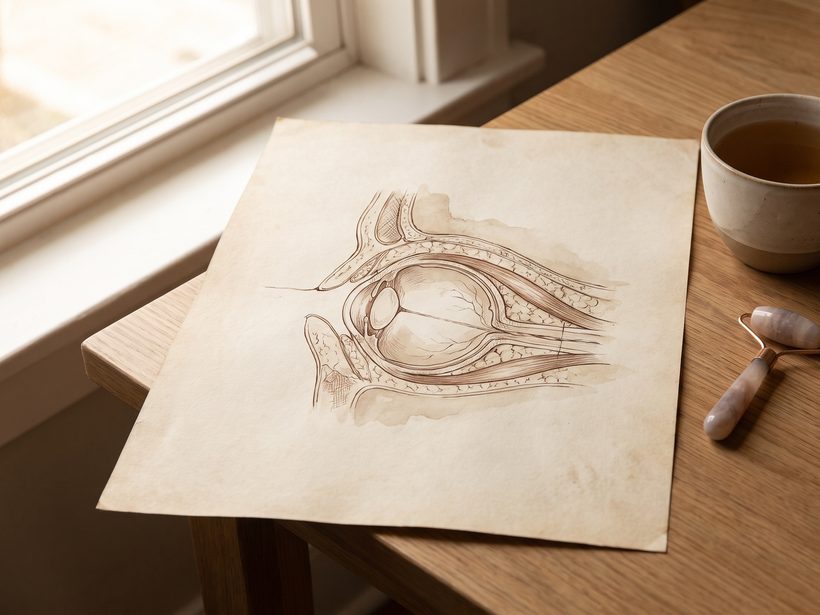
Eye bag treatment in Setia Alam: which kind of eye bag do you have?
Fat, fluid, a hollow, loose skin, a mound or pigment: six kinds of eye bag, what a doctor checks in Setia Alam, which can be helped in an aesthetic clinic and which need an eye surgeon.
Read →
Foundations
Tear trough filler in Malaysia: who suits it, the risks and what it cannot fix
Under eye filler adds volume to a true hollow. It does not remove puffy bags, pigment or festoons. What trials report, how long it lasts, the risks and how it is reversed.
Read →Foundations
Can Ultherapy or XERF be used around and under the eyes? What is treated, what is not, and why
Where focused ultrasound (Ultherapy) and radiofrequency (XERF) are cleared or used near the eye, where they are not, the side effects reported there, and what each kind of under-eye problem is.
Read →
Foundations
Loose or crepey eyelid skin without surgery: what the XERF eye tip is designed to do, and what polynucleotide skinboosters can do now
What loose or crepey eyelid skin is, how to tell it from a heavy brow or a low lid, what radiofrequency and the XERF eye tip are designed to do, what polynucleotide skinboosters have shown, and what does not tighten a lid.
Read →
Foundations
Droopy eyelid after Botox: the eye drops that lift it, and how long it lasts
A droopy eyelid after Botox is the toxin reaching the muscle that lifts the lid. What a doctor can prescribe to lift it while it settles, how much lift to expect, how long it lasts, and when a droop is not the toxin at all.
Read →
Foundations
Hooded eyes without surgery: what a Botox brow lift, Ultherapy or XERF can and cannot do
A hooded look has three different causes: a low brow, extra lid skin, or a lid that sits low. How to tell them apart, what a botulinum toxin brow lift, micro-focused ultrasound and radiofrequency can do for the first one, how small the lift is, and when surgery is the straight answer.
Read →
Foundations
Lash extensions, lash serums and eye makeup: what they do to the eyelid
What the glue, the remover, the growth serum and the makeup bag actually do to an eyelid, and where a skin clinic hands you to an eye doctor instead.
Read →
Foundations
When an aesthetic treatment irritates or burns the eye area
Some stinging and watering near the eye is expected. A small list of signs is not, and those belong with an eye doctor.
Read →
Foundations
Scar and pigment care after eyelid surgery: the skin clinic's part, and when it starts
The skin clinic has no part near a fresh incision. Its part, if any, starts only once the surgeon says the wound itself is done.
Read →
The Consulting Room
The face after fast weight loss, and the hollow under the eye
The body reads as a success and the face reads as a cost. What changes around the eye after a fast loss, and what an injectable can honestly reach.
Read →
Foundations
Xanthelasma is not a pigment target
The yellow is cholesterol sitting in the skin of the lid. There is no melanin in it for a pigment laser to find.
Read →
Foundations
Can an energy device do anything for eye bags? Usually not, and here is why
An energy device heats tissue so it rebuilds collagen. Four of the five things called an eye bag are not collagen problems.
Read →
The Consulting Room
The signs around the eye that make us stop and refer
A heavy lid, a prominent eye, a lump that has not healed. Some of what arrives here as tiredness belongs to an ophthalmologist.
Read →
Foundations
Botulinum toxin around the eye: why the periocular area is different
The eyelid is the thinnest structure on the face. Everything about treating near it follows from that one fact.
Read →
Foundations
Eye protection during laser treatment near the eyelid
Closing the eye is not eye protection. What the treatment field actually requires the moment it crosses the orbital rim.
Read →
Foundations
A port wine stain near a baby's eye: the skin question and the eye question
The birthmark is a skin question. Whether the eye needs watching is a separate one, and it has its own answer.
Read →
Foundations
Infantile eyelid haemangioma and the eye: why timing matters more than size
It mostly goes away on its own. The years it takes to do that are also the years vision is still forming.
Read →
The Consulting Room
Rosacea and the eye: why the redness is not the whole story
The same condition that reddens the cheeks can reach the eyelid margin, and the eye half needs a different doctor.
Read →
The Consulting Room
A lesion on the eyelid is not a pigment target
A lesion on the eyelid is never treated as a pigment target until somebody qualified has decided what it is.
Read →
Foundations
Why the eye cream keeps failing
Dark circles are at least three different problems. A cream only ever addresses one of them.
Read →
