
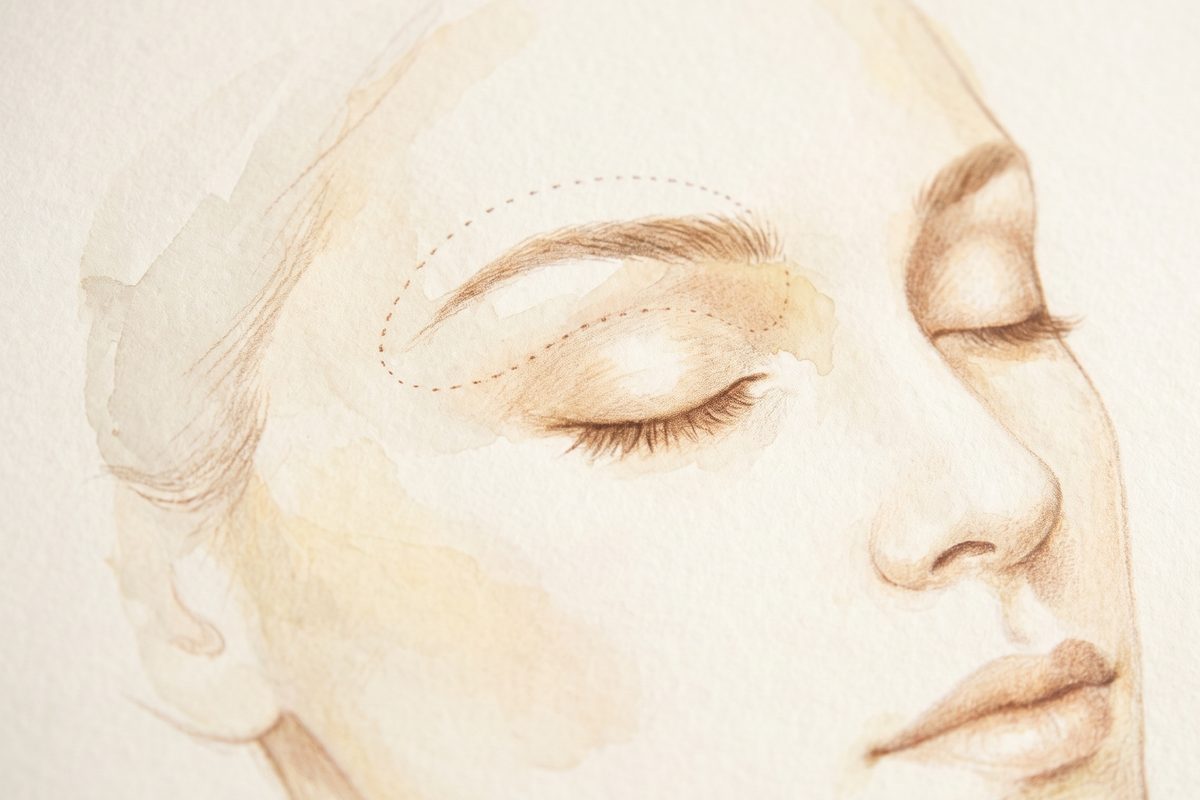
Can Ultherapy or XERF be used around the eyes at all?
In one place: the brow. The US FDA clearance for the Ulthera system (510(k) K233996, decision 22 February 2024) lists three uses. They are lifting the eyebrow, lifting lax tissue under the chin and on the neck, and improving lines and wrinkles of the decolletage. The lower eyelid and the under-eye skin are not on the list, which means the device is not cleared for them. It does not mean a study found harm there.
The clinic's Ultherapy page lists the brow, the jawline and the neck, and its XERF page lists the face, brow, jawline and neck. The sections below explain what that brow work involves, why the eye itself is a boundary, and what the different under-eye problems are.
What does the brow evidence show?
The most widely quoted study is a 2010 rater-blinded cohort study by Alam and colleagues. They treated the forehead, temples, cheeks, under the chin and the side of the neck with an investigational focused ultrasound device. Of 35 people evaluated, three masked clinicians judged 30 (86 per cent) to show a clinically significant brow lift at 90 days. The mean rise in eyebrow height, measured on photographs, was 1.7 mm. The authors describe the average lift as slightly less than 2 mm.
That is a real effect and a small one, from a single treatment and a device that was still investigational, with no untreated comparison group. The article on hooded eyes sets that millimetre or two against the other causes of a heavy upper eye, and what Ultherapy lifts explains who it suits. The brow sits above the bony rim of the eye socket. The treatment is aimed at the tissue there and not at the eye.
What about XERF near the eye?
XERF is a monopolar radiofrequency device, and its manufacturer lists lifting the brow among its uses. The published work near the eye is a 2026 protocol paper in Cureus that describes two small applicators. In it, energy to the eyelid area was confined to the region under the brow and along the orbital rim, without directing it toward the globe. It notes that the manufacturer's guidelines recommend protective lenses on the eye when energy is delivered directly toward the eye on the eyelid.
The paper is careful about its own limits. Its three-month observations of brow position and upper-lid tightness are described as qualitative and anecdotal, a prospective study is collecting measurements, and the lead author discloses fees from, and training work for, the manufacturer. The honest reading is a technique under study, not a settled result. At this clinic XERF is used for the brow and the neck, by assessment.
What about the eyelid skin itself? At this clinic it is not treated with Ultherapy or XERF at present. The smaller XERF tips made for the area around the eyes are due at this clinic, and until they arrive that stays the position. For loose or crepey eyelid skin the clinic currently uses polynucleotide skinboosters, after assessment. The published evidence is limited. A 2026 systematic review of under-eye treatments in Dermatologic Surgery, covering 50 studies, groups polynucleotides with microneedling as aimed at texture and fine lines. More is in loose eyelid skin without surgery.
Why is the eye itself a boundary?
Because the energy in both devices is heat. A 2025 case report from an ophthalmology department in China describes a 32-year-old woman who developed eye pain and reduced vision while the skin around one eye was treated with micro-focused ultrasound. The inflammation inside the eye settled with treatment, and a permanent scar on the cornea remained at three months. The authors conclude that periocular treatment carries a risk of irreversible thermal damage to the eye, and that the intensity limit and eye-protective devices need strict attention.
A single case cannot give a rate, and none is claimed here. It does show why the eyeball is not a target and why protection matters wherever a field crosses the orbital rim. The principle is the same one explained in why eye protection matters near the lid, and what to do if the eye area reacts is in when a facial treatment irritates or burns the eye area.
What side effects are reported?
In the Alam study, transitory mild redness and swelling commonly accompanied the response. A 2025 systematic review of microfocused ultrasound with visualization gathered 19 articles covering 506 patients and found temporary swelling, redness and pain most often, with one case of subcutaneous atrophy among the significant events in the literature. Among 106 reports in a US device-incident database, fat loss, nerve effects (damage, numbness, altered sensation and ptosis) and scarring were reported most often. The abstract does not say which part of the face those reports came from, and voluntary reports cannot give a rate.
The fuller picture, including the rare ones, is in Ultherapy and HIFU side effects, honestly explained.
So what is each under-eye problem, and what has evidence?
An eye bag can be fat pushing forward, a hollow beside it that casts a shadow, pigment, thin skin, or fluid that comes and goes. Most faces carry more than one. The longer pieces on why dark circles are not one problem and on whether an energy device can do anything for eye bags take each in turn.
In short, a fat bulge is a structural question that heat does not move, and surgery for it belongs with an oculoplastic surgeon. A hollow is a loss of support, which tightening does not replace, and Dr Catherine Chow, a consultant oculoplastic surgeon, explains why tear trough hollowing is not the same as eye bags. Pigment is a pigment problem, and heat in the skin tones common in Malaysia carries a recognised risk of darkening afterwards. Fluid follows sleep, salt and allergy. Thin, crepey skin is the one group closest to what collagen-building treatment is designed for, and the result is modest. No study read for this article tested focused ultrasound or radiofrequency on the lower lid, so no figure is given for it.
When should the eye be seen by an eye doctor?
Pain inside the eye, a change in vision, a light that hurts, or a red eye that does not settle after a treatment near the face needs an eye doctor promptly, not a wait-and-see approach. The decision about which tool suits the eye area, and whether any tool does, is made by examination in proper light. For most under-eye complaints, naming the cause comes before choosing the treatment.

