
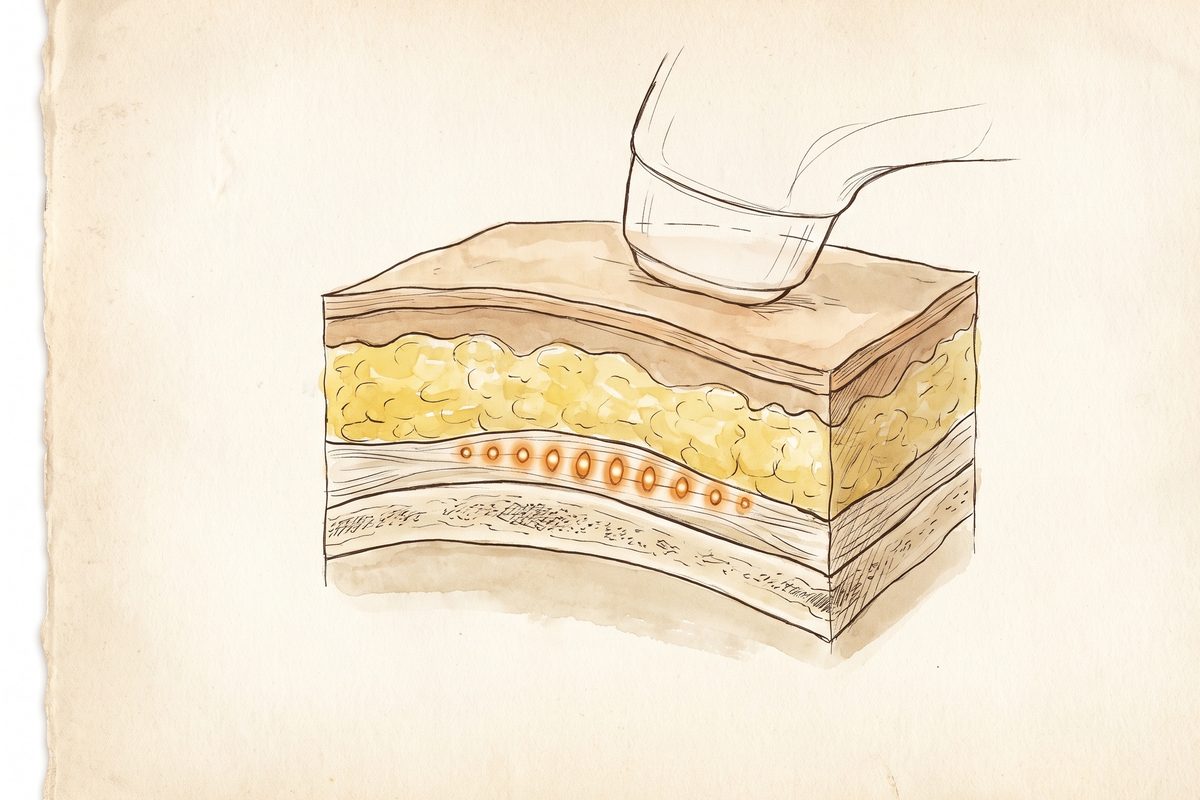
What does focused ultrasound actually do under the skin?
Micro-focused ultrasound and high-intensity focused ultrasound both pass sound through intact skin and bring it to a point at a chosen depth, where it becomes heat. Ultherapy's transducers work at 1.5 mm, 3 mm and 4.5 mm, and it includes ultrasound imaging, which is the "visualization" in the name microfocused ultrasound with visualization. HIFU is the wider family, and published reviews pool many different machines, so their figures describe the family and not any one device.
Every side effect below follows from one fact. The heat is delivered to a depth, and whatever sits at that depth in that particular face is heated: collagen-bearing tissue, which is the target, but also fat, small nerves, and the membrane over bone. What decides the outcome is what is at that spot, not how strong the machine is.
What are the common side effects, and how long do they last?
Discomfort comes first. It is a deep heat in short pulses, sharper near bone, and it is covered in what Ultherapy feels like. In one 2014 study of 93 evaluated patients, average pain scores for the cheek, under the jaw and along the jawline ran from 5.68 to 6.53 on that study's own rating, which is a reminder that painless is the wrong word.
Afterwards, redness, tenderness and slight swelling are the typical events. A 2014 safety review of the microfocused technique lists exactly those, and a 2010 rater-blinded study of 35 people found most treated individuals responded with transitory mild redness and swelling. A 2025 pooled review of HIFU devices put transient redness, swelling or mild discomfort at fewer than 5 percent of patients. The two numbers are far apart because studies record these things differently, so no single reliable rate exists.
How they are reduced: the energy is set line by line to the anatomy, imaging shows the tissue being treated, and comfort options are discussed before the session. If they happen: this clinic's own published account says flushing lasts a short while, the area can feel tender to touch or when chewing, and small tender spots at depth settle over a week or two. Call if any of it is getting worse rather than better.
Can it cause welts, bruising or numbness?
Yes, rarely. The same 2014 review lists bruising and welting as rare events. In the 2014 study of 93 evaluated patients, wheals were reported in 3 people and resolved without intervention or long-term effects. That is a figure from one study of one system, not a rate for every treatment.
Temporary numbness or tingling near a nerve is described in this site's own account of what Ultherapy feels like as something that usually resolves on its own. Nobody promises it will, and no reliable duration figure was read for this article. Call if numbness spreads or is not settling.
Can focused ultrasound weaken a facial nerve?
Rarely, and temporarily in the reports available. The 2014 safety review lists paresthesia and paresis, meaning altered feeling and weakness, among the rare events, and a 2017 report in Dermatologic Surgery is titled transient nerve damage after this treatment. In a 2025 systematic review, nerve damage, focal numbness, dysesthesia and ptosis (drooping) were among the most frequent entries in a device-event database of 106 records. That database is made of voluntary reports with no count of treatments, so it shows what can happen, not how often.
The mechanism is heat near a nerve. Take the marginal mandibular branch, which runs along the lower jaw and helps move the lower lip: heat that reaches it can leave one side of the smile lopsided for a while. Where a nerve runs varies between people, which is one reason the same settings are not right for every face.
How it is reduced: placement, imaging, and energy brought down over a region that is sharper than the rest. What is done if it happens: an in-person review by the treating doctor, and the reports describe the effect as temporary. Call the same day for any new droop, weakness or unevenness in the face.
Can Ultherapy or HIFU take away fat you wanted to keep?
It is reported, and it is the effect least often mentioned in marketing. If a focal point lands in fat and not in the collagen-bearing layer above it, the heat can injure the fat cells there, and the volume is lost. That is the proposed mechanism, and it is why the 2025 review opens by noting that plastic surgery colleagues have expressed unconfirmed concerns about effects on facial fat.
How often is not known. The 2025 systematic review found 19 published articles covering 506 patients, with one case of subcutaneous atrophy among them. In its 106 device-event records, lipoatrophy was among the most frequent reports. The first figure comes from studies that were not designed to count this outcome, and the second comes from voluntary reports with no denominator. Neither is a rate, and quoting one would be false precision.
How it is reduced: depth is chosen for the person, not for the machine. Someone whose main concern is volume loss is the wrong candidate for this tool, as set out in what Ultherapy lifts and what it cannot. A face with little fat to spare also has less to lose, so a small change is more visible there. If it happens: it does not reverse on its own, and the honest conversation is about volume, which is a different set of tools. Call early if a hollow is developing where the face was fuller.
Can it burn the skin?
Rarely. The 2014 safety review recorded rare surface thermal effects in cases where technique was improper, and otherwise transient and mild events. Because the energy travels through intact skin to a set depth, a surface burn points to a delivery fault, such as poor coupling or wrong settings, and not to a normal reaction.
This site's article on the 2026 medical device order lists burns, scarring and pigment change among the real possibilities when the dose, the depth or the placement is wrong. No rate is published here because none was read at source. If it happens: blistering or broken skin is treated as a wound and needs a doctor, not home remedies. Call the same day.
Why do depth and placement decide all of this?
Skin, fat, the structural layer called the SMAS, nerves and bone sit at different depths, and their arrangement differs from face to face. Three depths can be right for one person and the wrong plan for another, which is why an assessment comes before a booking. A transducer that is not what it claims, or a handpiece in untrained hands, moves the focal point away from where it was meant to be. That is covered in three checks before booking a low-priced HIFU.
Reading these risks alongside the benefits is the point. The comparison of ultrasound and radiofrequency devices sets each class next to the others, and how long Ultherapy lasts covers the other side of the trade.
What should you ask before you book?
Ask who is holding the handpiece and whether they are a registered doctor, which the guide to checking an aesthetic doctor in Malaysia explains how to verify. Ask whether imaging is used, which depths are planned for your face and why, how nerves near the jaw and brow are handled, and what happens if something goes wrong and who to call.
Two more questions are worth asking. What does the clinic tell you to watch for in the first days, and what is the way to reach a doctor if something does not look right? The answers should be specific, not a general reassurance. Consent to a treatment like this means knowing the list in this article before the session, not after it. A clinic that welcomes those questions is telling you something. A clinic that says the treatment carries no risk is telling you something too.