
Two questions hiding inside one
Searches for how long Ultherapy lasts usually carry a second question that never gets typed: when do I need to do this again? Both questions have the same answer underneath them, because the treatment does not work on a fixed clock. It starts a biological process and then gets out of the way.
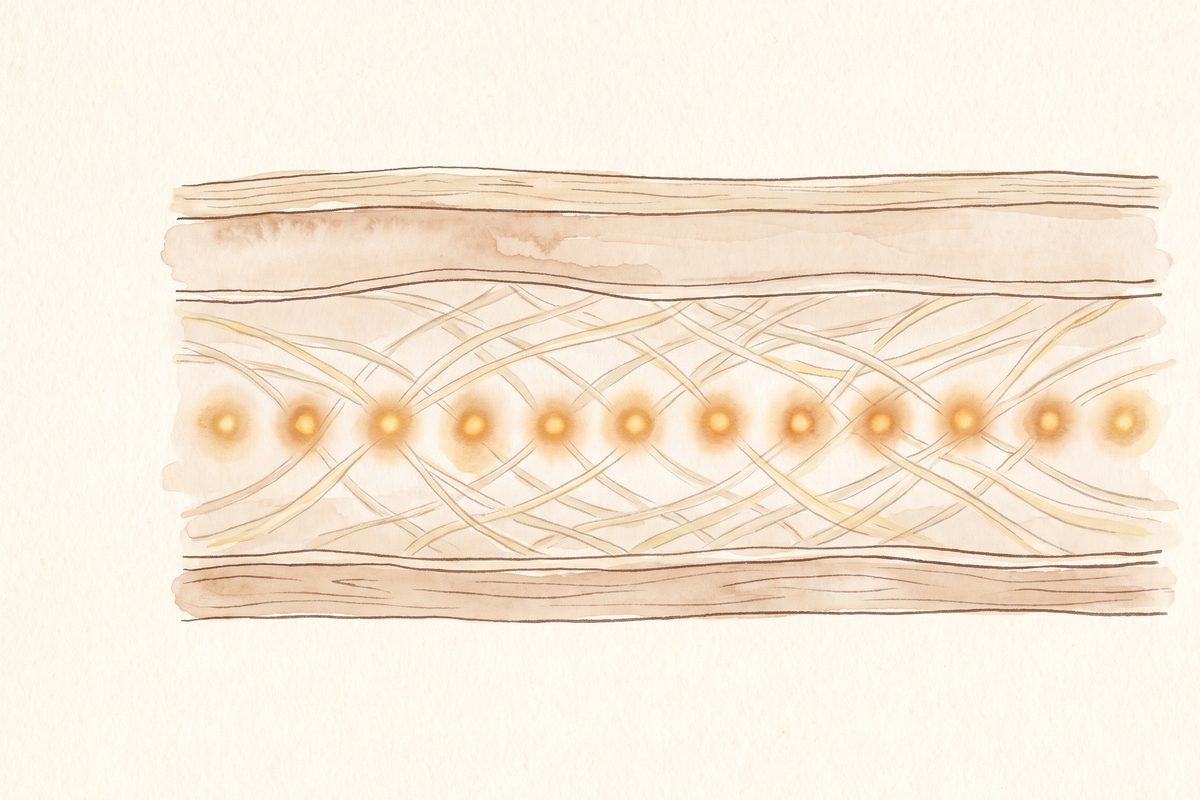
Ultherapy delivers focused ultrasound to a set depth without breaking the skin's surface, and the tissue at that depth responds by rebuilding collagen over the months that follow. The duration of the result and the timing of a repeat both come out of that same remodelling curve, not out of the session itself.
What the studies actually measured
The clearest published account of durability followed patients for a full year after a single treatment session, with assessments at 90 days, 180 days and one year. Most participants were rated as improved at each of those points, including at one year. Self-reported gains, less sagging, fewer lines, smoother texture, were still present for the majority of patients at the same one-year mark. That is one study, of one treatment protocol, in one population, and it describes what happened after a single session with no repeat.
A pooled review of 16 studies found a similar pattern at a larger scale: improvement in tightening or wrinkle reduction was generally still present at one year. Notably, the share of patients rating themselves improved was higher at 360 days than at 90 days in the cohorts measured, meaning the result was, for a meaningful share of patients, still building rather than already fading a year out. That detail matters because it corrects a common assumption: the year mark is not necessarily when things start to go backwards. For some patients it is closer to where the improvement plateaus.
None of this is a guarantee for any individual face. It is what those specific cohorts showed, under those specific protocols, and any one person's result depends on their own skin, the degree of laxity treated, and how their face ages more broadly, which is exactly what the candidacy conversation is for.
The lag between treatment and visible change
The collagen response has been documented beginning around day 28, well after any swelling or tenderness from the session itself has settled. Paired skin biopsies taken before treatment and two months after, in a study of Asian skin specifically, confirmed new collagen measurable at that two-month point. Visible assessment in the published literature is typically made at 90 days and again at 180 days, which matches what this clinic's own Ultherapy page says: the lift develops gradually and is usually assessed over two to three months, not on the day.
The practical effect is that nothing about the early weeks predicts the eventual result. What the session itself feels like is a separate question from what the tissue does afterward, and conflating the two, expecting an early sign of success or reading an early absence of change as failure, is a common and avoidable source of disappointment.
Why ageing keeps moving underneath a good result
A successful Ultherapy result is a real biological event: the treated layer genuinely lays down new collagen and genuinely holds a better position for a period. It is not a pause button. Everything else that drives facial ageing, ongoing changes in fat compartments, bone, skin elasticity and gravity, continues on its own schedule regardless of what happened at the treated layer. The improvement is measured against where the face would otherwise have been, not frozen against where it was on the day of treatment.
This is also why "how long does it last" cannot have a single number attached to it honestly. Two people with an identical treatment can diverge in how long the visible benefit holds, because the rest of their face is ageing at different rates underneath it. Skin quality, the degree of laxity actually treated, and how a particular face ages more broadly all move that figure, which is why the studies above report a range and a percentage, not a date.
How the interval to repeat gets decided
There is no fixed protocol published or followed here for when a repeat becomes due. The single-session studies above were not designed to answer that question at all; they measured how long one treatment holds, not when a second one should follow. At this clinic, Ultherapy is planned as a single session and repeated once the effect has faded, with the interval, the areas and whether repeating is worthwhile at all decided at a review rather than scheduled at the time of the first treatment.
That review is doing real diagnostic work, not administering a top-up. The layer that responded the first time needs to be the layer that has actually loosened again, rather than a face that has, in the meantime, lost volume instead of firmness. Descent and deflation are the most common thing an assessment has to tell apart, and a repeat treatment aimed at the wrong one of the two will not deliver what the first treatment did.
Who a repeat suits less well
A face where laxity has progressed well beyond what focused ultrasound reaches is not a candidate for another round of the same tool, even if the first treatment went well. The honest answer at that point is usually a different conversation altogether, sometimes a surgical one, and it is better said plainly than delayed by a treatment that will underperform. Equally, a face where the change since the last treatment is mostly volume rather than support does not need the same instrument reapplied. Both of these are review findings, not exceptions dreamed up in the abstract.
The honest version of "how long does it last" is not a single figure. It is a range drawn from real follow-up data, a timeline that trails the treatment by months before it even becomes visible, and a decision about repeating that belongs to a proper review rather than a calendar reminder. That review is where the actual answer, for one particular face, gets made.