

One name, three different problems
Dark circles is a single phrase doing the work of at least three distinct diagnoses. Understanding which one you have is the only thing that makes a treatment decision sensible.
The first is true pigment. Melanin deposited in the epidermis or deeper in the dermis gives the under-eye skin a brown or greyish cast. This is often genetic, more common in certain skin tones, and worsened over time by habitual rubbing and unprotected sun exposure. This is the one a brightening cream is actually designed to address.
The second is structural shadow. The tear trough is the groove that runs between the lower eyelid and the cheek. When that area loses volume, or when the anatomy is naturally deep, the hollow casts a shadow. The skin itself has no excess pigment. The darkness is geometry, a shade produced by the shape of the face in light.
The third is vascular show-through. The under-eye skin is the thinnest skin on the face. The small vessels that run beneath it are close enough to the surface to read as a bluish or purplish tint. This tends to worsen when you are tired, during allergy season, or when anything causes the vessels to dilate slightly. The same colour in a small child usually has a cause further up: Dr Chan Li Yen, a paediatric ophthalmologist, explains why dark rings under a child's eyes are usually made in an inflamed nose rather than by tiredness or low iron.
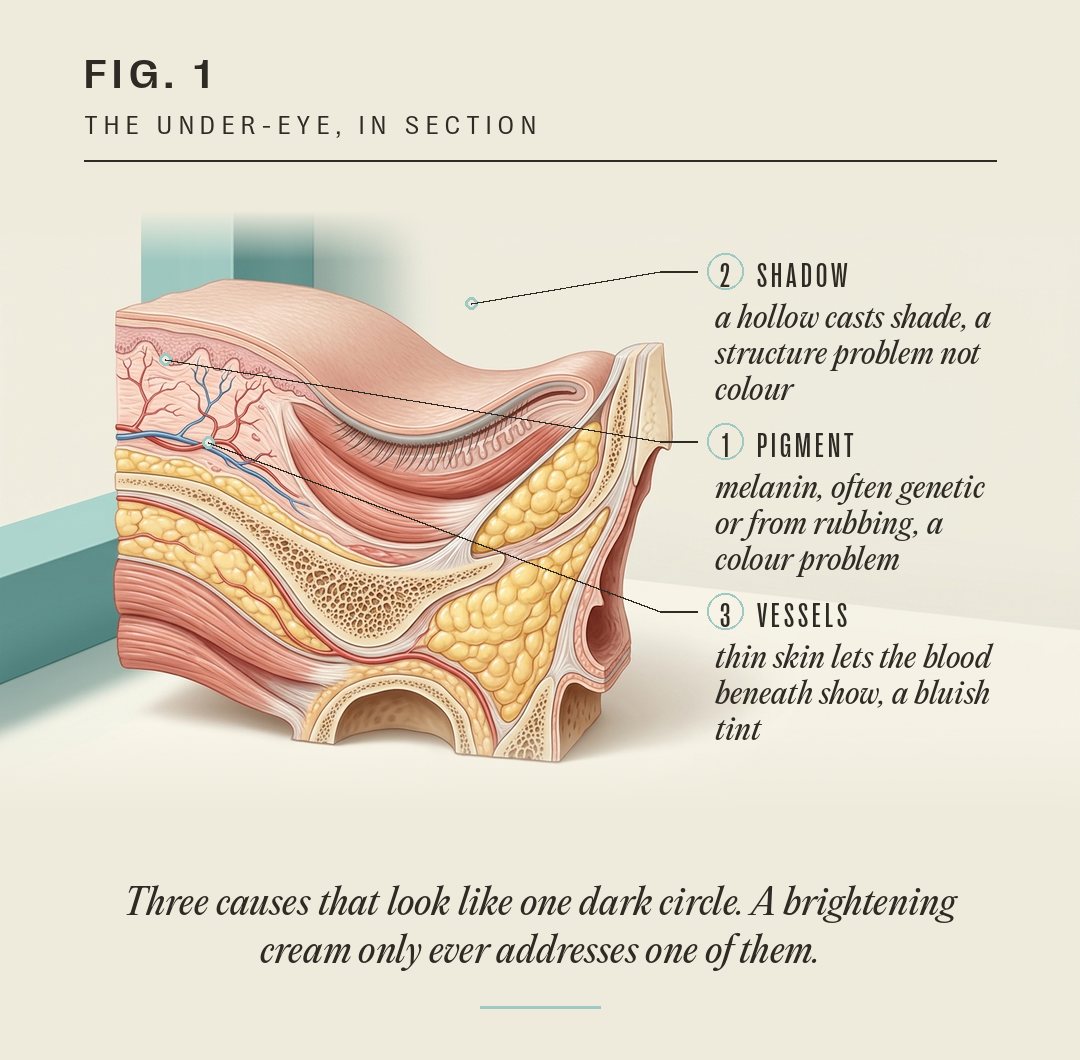
Why they all look the same from the mirror
From arm's length, all three look like a dark area under the eye. That is the practical problem. The mirror does not tell you the cause.
In a careful assessment, they separate quickly. How the darkness behaves when the skin is gently stretched tells you something about whether pigment is sitting in the skin itself. How it changes with the angle of light distinguishes shadow from colour. Whether it shifts when the patient looks upward, or whether the tint is warm or cool, helps distinguish pigment from vessels.
Mixed pictures are common. A patient can have all three contributing at once, which is why a single treatment rarely solves it completely. The honest answer in those cases is that the problem has more than one layer, and the approach has to match that. Dr Catherine Chow, a consultant oculoplastic surgeon, maps a wider set of causes again in what actually makes eyes look tired, useful when the tired look is not confined to the under-eye area alone.
Why the cream keeps failing
A brightening cream works by inhibiting melanin production or accelerating its turnover. That is a sensible mechanism for a pigment problem. It has no mechanism for a shadow. It has no mechanism for thin skin over vessels.
So when someone with a structural hollow uses a brightening cream for two years and sees nothing change, the product has not failed in the way they think. It has done exactly what it was designed to do, which is address pigment, and found nothing of that kind to address. The darkness persists because the cause was never pigment.
This is the version of events the packaging cannot tell you, and it is why the cycle of trying product after product tends to produce the same result.
An oculoplastic surgeon arrives at the same conclusion from the surgical side, which counts for something because she has no cream to sell either. Dr Catherine Chow has written about what eye creams actually do to eyelid skin, and the problems they were never going to reach.
Matching the tool to the cause
Once the cause is named, the decision becomes more straightforward. Pigment is a topical or a careful pigment-laser question, depending on the depth and the skin. A hollow is a structure question. Thin skin with visible vessels is a skin-quality question, where improving the skin's thickness and resilience over time is the more useful frame.
Often the answer involves more than one approach, because the causes coexist. That is not a complicated situation. It is an honest one, and it is better than spending years on the wrong single answer.
The tools themselves are worth discussing in a consult rather than on a page, because the right choice depends on which cause is present, how significantly, and in what combination. Generic recommendations here would be the same mistake as the generic cream.
The cost of getting this wrong
The wrong treatment here is not neutral. Filler placed under an eye where the real problem is pigment, not volume, changes nothing visible and introduces a risk that did not need to exist. A brightening cream used on a structural hollow is money spent on repeat with no return.
More significantly, some approaches that suit one cause actively complicate another. This is the reason the assessment comes first, and it is the reason a careful examination of what is actually happening is not a preliminary step before the real answer. It is the real answer.
The first useful thing to know about your dark circles is which kind they are. Everything that follows depends on that.