
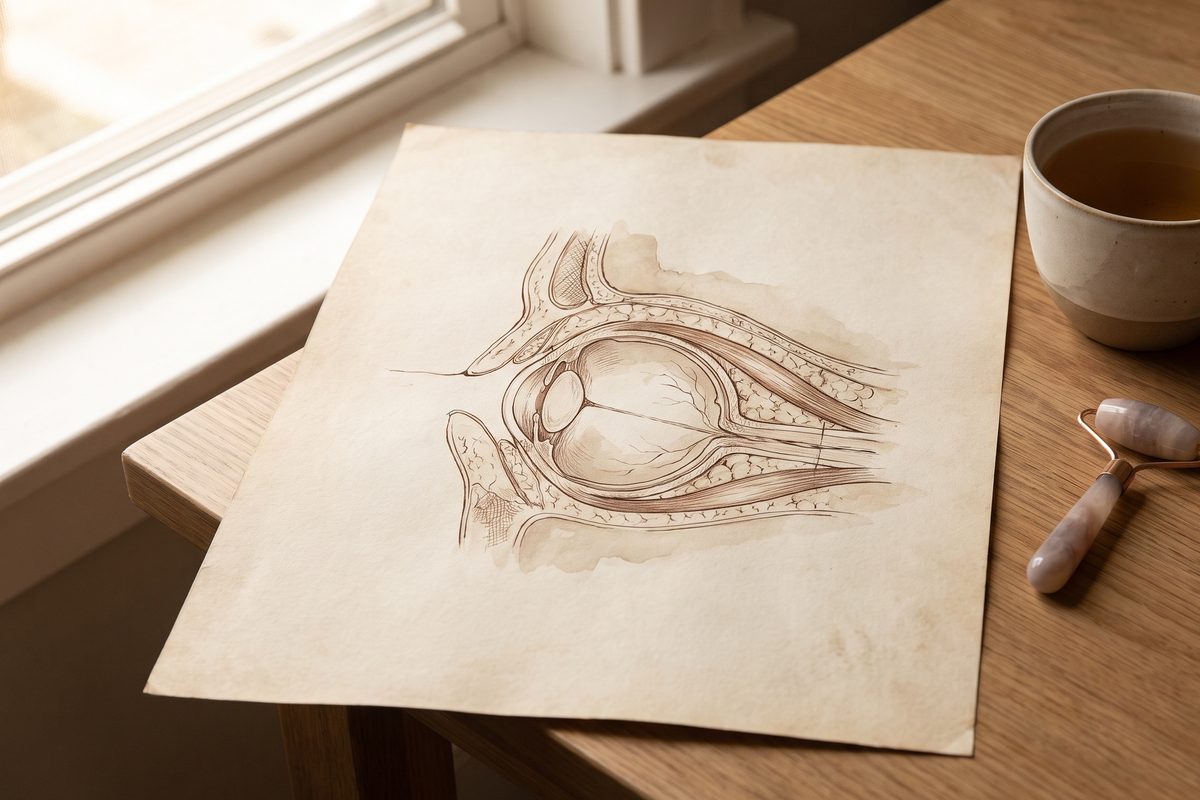
What kinds of eye bag are there?
Six, and they often overlap. A review of under-eye darkness lists heredity, excess pigment, pigment left after eczema or allergy, periorbital oedema, visible vessels, and shadowing from loose skin and the tear trough. Reviews of the bag itself add fat and cheek tissue. In plain words:
1. A fat bulge. Orbital fat pushes forward as the tissue holding it back weakens. A review of the surgical literature notes that protruding orbital fat gives lower lid bags, which are traditionally corrected by excision.
2. Fluid and puffiness. It changes between days with sleep, salt and allergy, and it is not the same thing as a bulge that stays.
3. A tear trough hollow. A groove along the inner lower lid and the cheek edge casts a shadow that reads as a bag. The shadow comes from missing support, not from something that has grown. The article on hollowing after weight loss explains how this appears.
4. Loose, crepey skin. Thin skin wrinkles and shows what lies beneath it.
5. A malar mound or festoon. A soft mound or fold lower on the cheek, below the lower lid. A systematic review describes the cause of these malar bags as diverse, and a surgical paper defines festoons as redundant, swollen folds of lower lid skin with little fat prolapse. These are the kinds that most often turn out to be surgical.
6. Pigment. Darkness in the skin itself, which often runs in families and is a pigment problem rather than a volume one. The article on dark circles covers it.
How can I tell which kind I have?
Not reliably from a mirror or a photograph, which is the point of this page. A few clues help. A bag that is the same every day points away from fluid. A bulge that does not move when the light changes points to fat or a mound. Darkness that lightens when you tilt your head or when light comes from another angle points to a shadow rather than to pigment. Most faces carry more than one kind at once, and the mix decides the answer.
The article on energy devices and eye bags explains why heat-based treatment answers only some of these. This page is about the other question: which kind you have.
What does a doctor check at an eye bag consultation in Setia Alam?
The check is about telling the kinds apart before anything is recommended. In proper light, the under-eye area is looked at with the skin gently stretched and from different angles, which separates a fixed bulge from a hollow that casts a shadow. Pigment is told from shadow by how it behaves when the light moves. Skin thickness and crepiness are assessed, and a history is taken for the fluid pattern, sleep, salt, allergy and any earlier treatment in the area.
The consultation can end with a recommendation to do nothing, or to treat something other than what you arrived worried about. Dr Ong Jin Khang carries out this assessment in person in Setia Alam. What a first consultation looks like describes the process in general.
Some findings stop the aesthetic conversation altogether, such as eyes that have become more prominent, a lid that has newly dropped, or one eye that looks different from the other. Those go to an eye doctor first.
It helps to bring daylight photographs, a list of anything used on the area (eye creams, retinoids, earlier injections) and a note of how your sleep and allergies run. None of it is required, and all of it shortens the work of telling the kinds apart.
Which kinds of eye bag can an aesthetic clinic help?
Mainly the hollow and the thin skin, and only after the kind is confirmed. For a true hollow, the clinic's eye bags and dark circles page describes carefully placed dermal filler that restores missing support, conservatively and at the right depth. For thin, crepey skin, skinboosters improve skin quality over a course. Fluid is mostly a matter of sleep, salt and allergy, and the honest advice is habits before procedures.
Two things the clinic does not do. It does not fill pigmented circles, because filler can make them look heavier. And it does not treat a bulge of prolapsed fat with an injectable, since filler placed around a bulge only makes the area heavier.
Does under-eye filler work, and how safe is it?
For a true hollow, trials show an effect, and they also show the usual short-term effects. A meta-analysis of 31 reports and 2,556 participants found a pooled satisfaction rate of 91.0 percent, with swelling in 19.2 percent, bruising in 18.4 percent, a lump or contour irregularity in 5.3 percent and bluish discolouration in 0.9 percent. A randomised trial of 333 people found a responder rate of 87.4 percent at three months against 17.7 percent in untreated controls, and 63.5 percent were still responders at 12 months. That trial was funded by the maker of the gel, so it shows what that product did, not what every filler does.
The honest summary is higher risk. The tear trough sits on the published lists of higher risk zones for filler, and the article on hollowing after weight loss states the risks in full, including the rare severe ones. Anyone considering filler there should hear that part first.
Which kinds of eye bag need an eye surgeon?
A bag that is truly prolapsed fat, and most malar mounds and festoons. In the surgical series of festoons read for this page, 54 eyes in 27 people were treated with skin excision and followed for a mean of 11 months, and the recurrence rate was 3.7 percent. It is a small, retrospective series, so it shows what surgeons report, not a promise of results. A review of tear trough surgery found that almost all authors agree on releasing the ligament together with adding volume, and that it is hard to pick one technique that suits everyone.
The right person for these is an oculoplastic surgeon. Dr Catherine Chow, a consultant oculoplastic surgeon, explains what lower eyelid surgery addresses and when a bag is fat, and sets out the recovery, week by week, and the risks.
What about the eyelid skin itself: XERF, Ultherapy and polynucleotides?
Eyelid skin is not treated with XERF or Ultherapy at present. The smaller XERF tips made for the area around the eyes are due at this clinic, with no date yet. For loose or crepey eyelid skin, polynucleotide skinboosters are used now, after assessment, and a lid that folds over the lashes is a surgical matter. The article on loose eyelid skin without surgery sets out what is known and what is not.
Why is the under-eye area assessed so carefully?
Because the margin for error is small. The skin of the eyelid is the thinnest on the body, with less of the structural layer that gives other skin its resilience, so the same treatment produces a stronger response here than a few centimetres away. Behind it sits the lid margin, which is why the area is treated more conservatively than the rest of the face.
A wrong read also costs more here than elsewhere. Filler placed around a bulge makes the area heavier, and filler over pigment can make it look darker. That is why the examination comes before any decision, and why the answer is sometimes to do nothing yet.
What if I have more than one kind of eye bag?
Most people do, and the order of the questions matters. Fluid and allergy come first, because they change from day to day and can imitate a fixed bag. A hollow and thin skin can be considered together, since one is a volume question and the other a skin quality question. A bulge of fat or a festoon comes last and goes to a surgeon, because nothing placed over it removes it.
The reviews read for this page point the same way. One says treatment of malar bags must be individualised by extent and content, and the other says the aim is to identify the primary cause of under-eye darkness and its contributing factors. The order given here is reasoning from those principles, not a published protocol.
Where is the clinic, and how do I reach it?
The Retreat Clinic is in Setia Alam, five minutes from Setia City Mall, on Jalan Setia Dagang. After hours the clinic answers on WhatsApp only. If you want an opinion on which kind of eye bag you have, the examination described above is where that starts, and the WhatsApp button on this page reaches the clinic. This page does not give prices or promise a result.