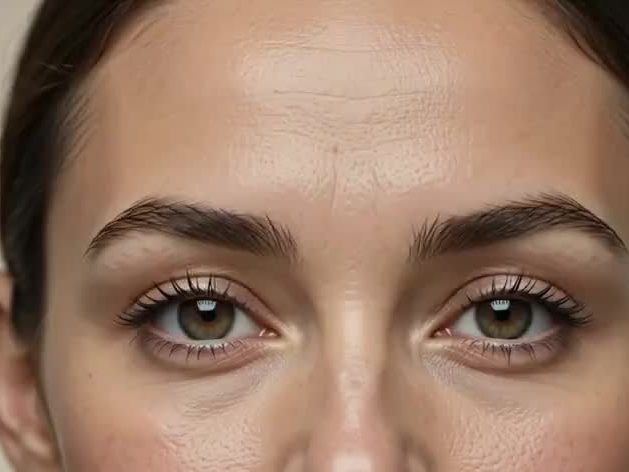

What arrives in the room after a fast loss
Somebody loses a substantial amount of weight across several months, the outcome everyone wanted, and then books a consultation about their face. That sequence is common enough now to have a shape.
The description barely varies. Cheeks and temples emptier, the chin less supported, the area around the eyes shadowed. A 2024 systematic review of facial soft tissue change after massive weight loss records that same distribution.
Why the face hollows more than the body does
Fat is the main driver, and facial fat does not leave proportionately. One imaging study, cited in that review and in a 2025 mechanism review in the Journal of Cosmetic Dermatology, followed five patients through medical weight loss: total body fat fell by 9.2%, the temporal fat pad by an average of 41.8% and the cheek fat pad by an average of 69.9%. Five patients is a direction, not a prediction for any one face.
The same review proposes reasons why facial fat might be selectively vulnerable, and its authors call that hypothesis awaiting further research, so it stays hypothesis here. Nothing I can point to shows a medication emptying the face independently of the loss itself.
Fat is not the only layer moving. Deflation of the superficial fat compartments, loss of deep support, resorption at the level of the bone and increased skin laxity turn up together, which is ordinary ageing arriving faster and younger. The honest ceiling on what any device does about the skin half is set out in loose skin after weight loss.
The first question is whether the weight has stopped moving
Before any of the face gets discussed, I want to know whether the loss has finished. Someone still losing will look different in three months, and filling a face mid-descent is how people end up with a result that suited one season only.
Where GLP-1 medication is involved, that is prescription-only treatment with its own assessment behind it, set out in what a medical weight assessment decides. The Malaysian clinical practice guideline on obesity places pharmacotherapy at a BMI of 30 and above, or 27.5 with comorbidities, only as an adjunct to lifestyle change.
What the hollow under the eye actually is
Point at the shadow and most people call it an eye bag. After a fast loss, what is usually there is a groove running from the inner corner of the eye along the rim of bone that carries the socket. The literature calls that the tear trough.
That difference decides what can sensibly be offered. The American Academy of Ophthalmology teaching article on this region is candid about the limits. Fillers give volume and do not address skin quality. Skin there that is thin and inelastic usually makes a poor candidate, and hyaluronic acid placed in a tear trough can produce a bluish discolouration, the Tyndall effect. Where the groove is subtle, surgery may not be the better answer either.
The risk that gets stated before anything else
This is the part of the consultation I do not compress, and the wider version sits in what a doctor weighs before agreeing to filler. Published complications after filler around the eye run from superficial irregularities of the skin, through granuloma formation, to vascular occlusion causing skin necrosis, and at the far end, blindness.
The anatomy is why. The region carries a dense network of vessels with complex connections, including a route from the angular artery into the ophthalmic artery system, which opens a path back towards the eye. The tear trough sits on the published list of high risk zones alongside the glabella, the temple and the nasal dorsum.
Central retinal artery occlusion is the worst of it because the blindness is permanent. Between January 2015 and September 2018 there were 48 new published cases of partial or complete vision loss after filler injection. Blindness is estimated at fewer than one in ten thousand injections, an estimate rather than a measurement, and the literature notes that adverse events are underreported. None of that makes the area untreatable, and none of it says any clinic has solved it.
Where this stops being my question
Some faces after fast weight loss have a hollow that behaves like a hollow. Others have an eyelid problem that only became visible when the padding around it went. Lid position, the skin above the lid and what the socket is doing behind it belong to an ophthalmologist, and in this region to an oculoplastic surgeon.
Dr Catherine Chow, a consultant oculoplastic surgeon, sets out why a tear trough groove needs a different answer from an eye bag bulge, and when filler is the wrong tool for it, and her account of where surgery, filler and energy devices each honestly belong around the eye is the fuller picture from the side that operates. Anything involving the lid itself is assessed there. When only one eye looks sunken, that is a different medical question from hollowing after weight loss, and she explains why a single sunken eye needs its own assessment, from an old fracture to sinus disease.
What the consultation actually settles
The sequence is dull and it holds. Establish whether the weight has settled. Read which layers have changed. Separate a groove from a bulge, and both from an eyelid that needs an eye doctor. Then decide whether anything should be done this year at all.
That ophthalmology article puts the last part better than I would: knowing when to say no is one of the most important tenets in cosmetic medicine. After a large weight loss that is especially live, because the loss is real and the wish to undo it is reasonable. What is worth having is usually smaller than what was imagined on the way in.