
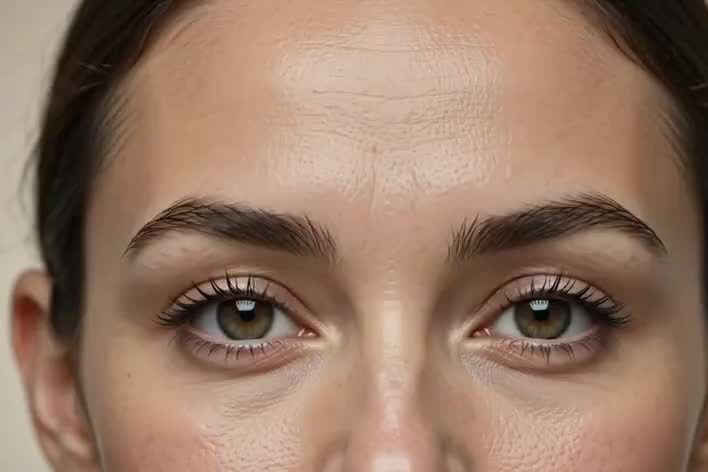
What filler actually does inside tissue
A gel is pushed through a needle or a cannula into soft tissue. That tissue also carries arteries. If material enters an artery directly, or presses hard enough on one from outside to close it, the tissue that artery feeds loses its blood supply. Cells begin to die. That is a vascular occlusion, and it is the complication that gives the rest of this article its shape.

Most vascular occlusions from filler affect the skin: a patch of pallor or mottling appears during or shortly after treatment, and with prompt management the skin recovers. The subset that involves the eye is smaller and the outcome is different. The arteries of the central face connect with the circulation that supplies the eye through vessels including the dorsal nasal, supratrochlear and supraorbital arteries. That anastomosis is normal anatomy, present in every person. It is why a treatment performed on the face can, rarely, affect vision. This is not a theoretical concern invented by cautious doctors. It is reported in the clinical literature and it has been reviewed systematically. A 2024 review by Doyon and colleagues in the Aesthetic Surgery Journal gathered published cases of vision loss following filler going back over a century and drew out the patterns in site, technique and outcome.
Which sites appear most often, and what the record says about recovery
In the published cases of filler-related vision loss, the nose appears more often than any other injection site. The forehead and the glabella follow. Frequency and prognosis, however, point at different areas. Among the reported cases with a recorded visual outcome, those involving the forehead carried a poorer record of recovery than other areas. The site that appears most often in the case series is not the same site with the worst prognosis.
Most reported cases of filler-induced vision loss did not recover. That sentence is the honest reading of the literature. It should sit alongside the observation that the total number of published cases, accumulated over more than a hundred years of practice, represents a small fraction of the treatments performed. The two facts coexist and neither cancels the other.
What the literature cannot tell you
Here is the paragraph the rest of the internet tends to skip. Almost everything known about filler-related vision loss comes from published case reports, which collect the events that went wrong. They do not count the treatments that passed without incident. There is no agreed denominator. Without a denominator there is no rate. Anyone quoting a percentage risk of blindness from filler is quoting something the published literature does not contain. The number does not exist in the data.
This is not a reason to dismiss the risk. It is a reason to be precise about what is actually known. The honest position is: a serious complication exists, the anatomy that makes it possible is present in everyone, certain sites appear more often in the reported cases, and the absolute frequency cannot be stated from the available evidence. A doctor who tells you the risk is one in some-large-number is offering false precision. A doctor who tells you the risk is zero is wrong.
Technique reduces risk. It does not remove it.
Standard practice includes using a cannula in planes where it is appropriate, injecting in small amounts, moving slowly, and aspirating where aspiration provides useful information about the needle's position. Each of these behaviours lowers the likelihood of a problem reaching the artery. None of them makes the anatomy disappear. The risk is structural and it travels with every injection, including the ones performed here.
Hyaluronic acid filler can be dissolved with hyaluronidase, an enzyme, and that changes the clinical meaning of a disappointing result significantly. A cheek that has been overfilled, or a lip that has migrated, can be corrected. For vision loss the picture is different. The evidence for rescuing vision with retrobulbar hyaluronidase is thin, the technique is still debated in the literature, and the window in which it might help is minutes rather than hours. Reversibility is a meaningful feature of hyaluronic acid filler. It is not a safety net for the most serious complication.
The three grounds for declining a request
The first is a diagnosis mismatch. Skin that looks tired in the mirror reads as a volume problem, but laxity, pigmentation and surface texture are different diagnoses with different tools. Adding volume to a face that does not need it produces a result that looks worse, not better. The fuller argument lives in why skin looks tired, and the choice between tools is laid out in the neuromodulator versus filler versus biostimulator guide. No point re-running either here.
The second is a bone request. A reference photo of another face is, in structural terms, a request for a different skeleton. Dermal filler is placed on and around existing bone. It does not remodel bone or change facial proportions the way a different bone structure would. The result can look harmonious and well-placed, or it can look like product sitting where bone is not. The distinction matters before any plan is made.
The third is site and gain. Some areas carry a risk profile that is out of proportion to what the treatment would achieve for a given patient, given what is known about the published cases. The decision is not that those areas are never treated anywhere, by anyone. It is whether the risk-to-gain calculation for this person, at this site, with this diagnosis, is one that holds up. Filler is the treatment that gets declined more often than any other in this clinic, and that is not despite taking vascular risk seriously. It is because of it.
What to check before any filler appointment
In Malaysia, dermal filler is a medical procedure. It should be performed by a registered medical practitioner holding a Letter of Credentialing and Privileging for the procedure. The MOH practitioner list is publicly searchable. The guide to checking an aesthetic doctor's credentials in Malaysia walks through the steps. Credential and setting are both relevant because the serious complication, if it occurs, needs to be recognised and responded to immediately.
A useful question to bring to any consultation: what would make you decline this request? A doctor who cannot answer that question, or who has never declined a filler request, is not the doctor you want holding the syringe. An assessment that can end in no is the assessment worth attending.
One further piece of reading, and it comes from the other side of the same problem. Dr Catherine Chow is a consultant oculoplastic surgeon and a colleague I have published with on periocular injection, and she has written about the rare complication around the eye that is worth understanding before any filler goes near it. She sees the outcome of this from a position no aesthetic clinic occupies, which is the reason to read it.