
What do these brand names actually mean?
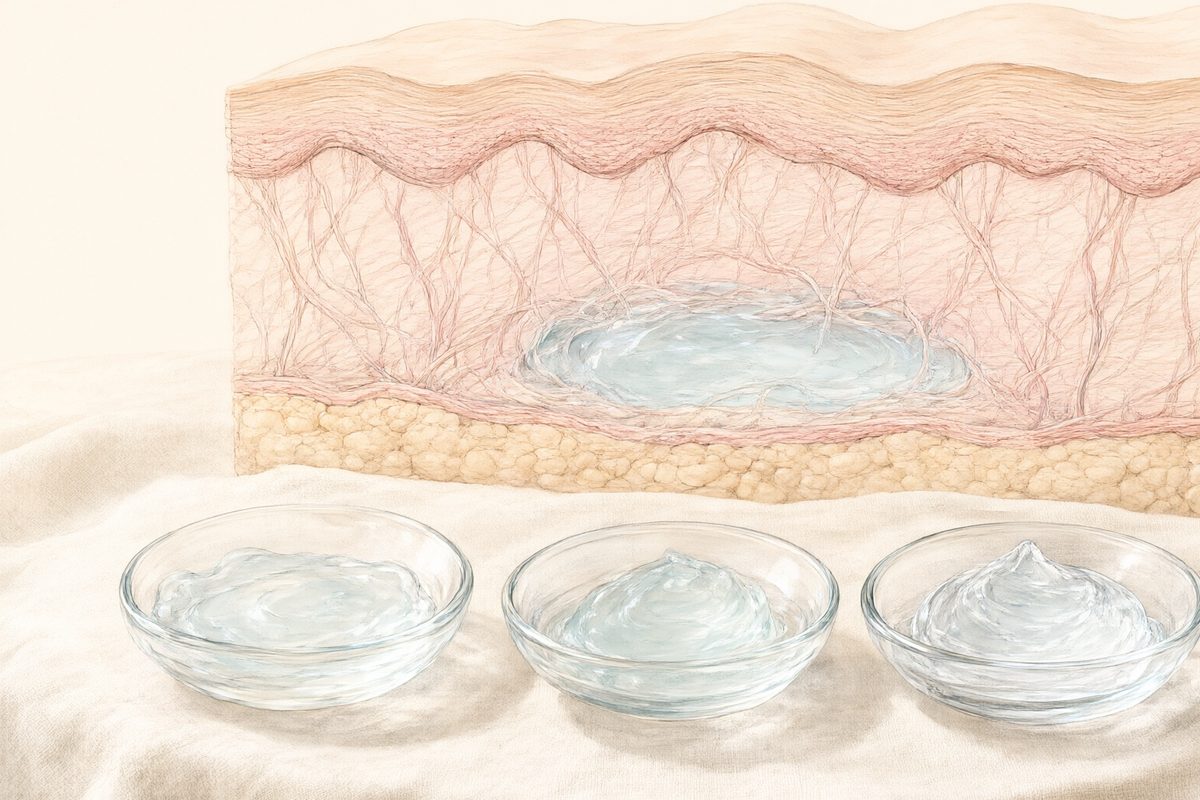
A brand name is a maker's name for a family of products. Juvéderm, Restylane, Belotero, Teosyal and Yvoire come from five different companies, and each is a range of hyaluronic acid (HA) gels. HA is a sugar that skin already contains. It binds water and swells when it is made into a gel, which is what smooths a line or fills a hollow.
Fillers made of other materials exist, collagen among them, and so do the collagen-stimulating particles called biostimulators; the comparison guide sets those classes side by side. This article stays with HA.
What is the same in every hyaluronic acid filler?
The body breaks HA down on its own, through its own hyaluronidase and reactive oxygen species. To make a gel last longer, some HA fillers are chemically linked into a network, a step called cross-linking, and many gels use the same linking chemical, BDDE. A higher degree of cross-linking is one of the main factors in how long a gel persists. The US Food and Drug Administration (FDA) gives about 6 to 12 months for HA fillers as a group. A 2026 systematic review of studies with at least 12 months of follow-up found 50 to 86% of the HA still present at 24 months on 3D volume measurements, and one study reported 6 to 9 months. How long a gel lasts depends on the product, the area and how it is measured.
What differs between the brands?
What differs is how the gel is made, and so how it behaves. Each maker names its methods: NASHA and XpresHAn for Restylane, Hylacross and Vycross for Juvéderm, cohesive polydensified matrix for Belotero and RHA for Teosyal. The names describe how the HA chains are linked and processed. Galderma, for example, describes NASHA as a firm gel and XpresHAn as a soft, flexible one. In a laboratory comparison of gels from several makers, the gels ranged from soft and flowing to firm and less flowing, and each spread through tissue accordingly.
Two cautions apply. The concentration on the box does not predict how a gel behaves: in a 2019 comparison of 18 products, HA concentration alone did not predict swelling or cohesion. And advice on choosing between gels rests largely on injectors' experience because, as that paper puts it, clinical data on product performance are lacking.
What do Voluma, Volift, Volbella, Lyft and Kysse mean?
Inside a brand, line names mark different jobs. The Malaysia Medical Device Register descriptions, filed by the companies that hold the registrations and read on 30 September 2026, show how far apart the lines sit. Juvéderm Volbella is described for fine lines, medium-sized skin depressions and lip enhancement, injected in the superficial or mid dermis or the lip; Volift for deep skin depressions and face contouring, in the deep dermis; and Voluma for restoring facial volume. Restylane Lyft is described for facial contours, folds and the lips, in the deep dermis or the top of the fat layer, and Kysse for the lips, just under the lip lining. Yvoire Volume Plus is described for severe facial wrinkles and folds, in the deep dermis or the fat layer beneath it, and for the lips.
Belotero and Teosyal name their ranges the same way, by strength or use: Belotero Soft, Balance, Intense and Volume; Teosyal RHA 1 to 4 and the Puresense range, including Kiss and Ultra Deep. On the register, Belotero Balance is described for moderate facial wrinkles and folds and for lip enhancement, and Teosyal RHA 3 for deep facial wrinkles, the cheeks, the facial contour and the lips. A line name says what a gel is made for. It does not rank it.
Juvéderm or Restylane: is there a right answer?
Not in general. The FDA says it approved different products for specific areas of the face and hands, and that approved uses vary by product. Comparisons between brands exist, but each tests particular products in a particular area, and a result in one area cannot be assumed to hold in another. The 2026 durability review concluded that how long a gel lasts depends on its manufacturing technology, how much the tissue moves and the anatomical area, and that individualised product selection remains essential.
So the first questions are about the face: what has been lost or folded, where, and at what depth. The gel comes last. The risks of any filler, including the serious one, a blocked blood vessel, are set out in the article on what a doctor weighs before filler.
Can a hyaluronic acid filler be dissolved?
In most cases, yes. Hyaluronidase is an enzyme that digests HA, and doctors use it to dissolve HA fillers after assessing the area. It does not dissolve fillers made of other materials, and the FDA warns that fillers not made of HA can be difficult or impossible to remove.
Gels differ in how much enzyme they need. In a laboratory study of 12 HA gels, some responded to 2.5 units per 0.2 mL and others needed more than 20; a later study of 22 gels found minimum doses from 2.5 to 140 units per 0.2 mL. These laboratory results cannot serve as a dosing chart, but they show why a record of which gel went in matters. The enzyme also carries its own risk of allergic reaction.
How can you check a filler box in Malaysia?
A filler is a medical device. Section 5(1) of the Medical Device Act 2012 (Act 737) says no medical device may be imported, exported or placed in the market unless it is registered. The Medical Device Authority's public register at mdar.mda.gov.my can be searched by brand name, registration number or company name. If a name returns nothing, the register says the device is unregistered, expired, suspended or cancelled, though a different spelling can also give a blank, so try a shorter word or the registration number.
Opening an entry shows the device name, registration number, registration holder, validity dates, brand, description and intended purpose. Some entries carry a generic name, such as soft tissue injectable implant, with the brand in a separate field, so search the brand and match the registration number rather than the words on the box. A familiar name is not proof: the FDA has warned that unapproved versions of a well-known brand were sold in the US, including online.
Then the box. Several register entries list traceability labels inside it, for example one for the patient and one for the doctor's records. A syringe label normally shows the product name, batch number and expiry date, the three items the FDA's summary for one HA filler lists. The FDA also advises reading the patient labeling for the filler being injected, and not buying filler online.
Registration covers the device. The doctor and the premises need their own checks: the doctor's registration and Letter of Credentialing and Privileging are on public registers, and the guide to checking an aesthetic doctor and the regulation hub walk through each. A brand on the box does not make a procedure lawful either: breast and buttock filler are on the Ministry of Health's list of illegal procedures, whatever the product.
Ask which product it is, what its registration number is, and where its label will be recorded.