
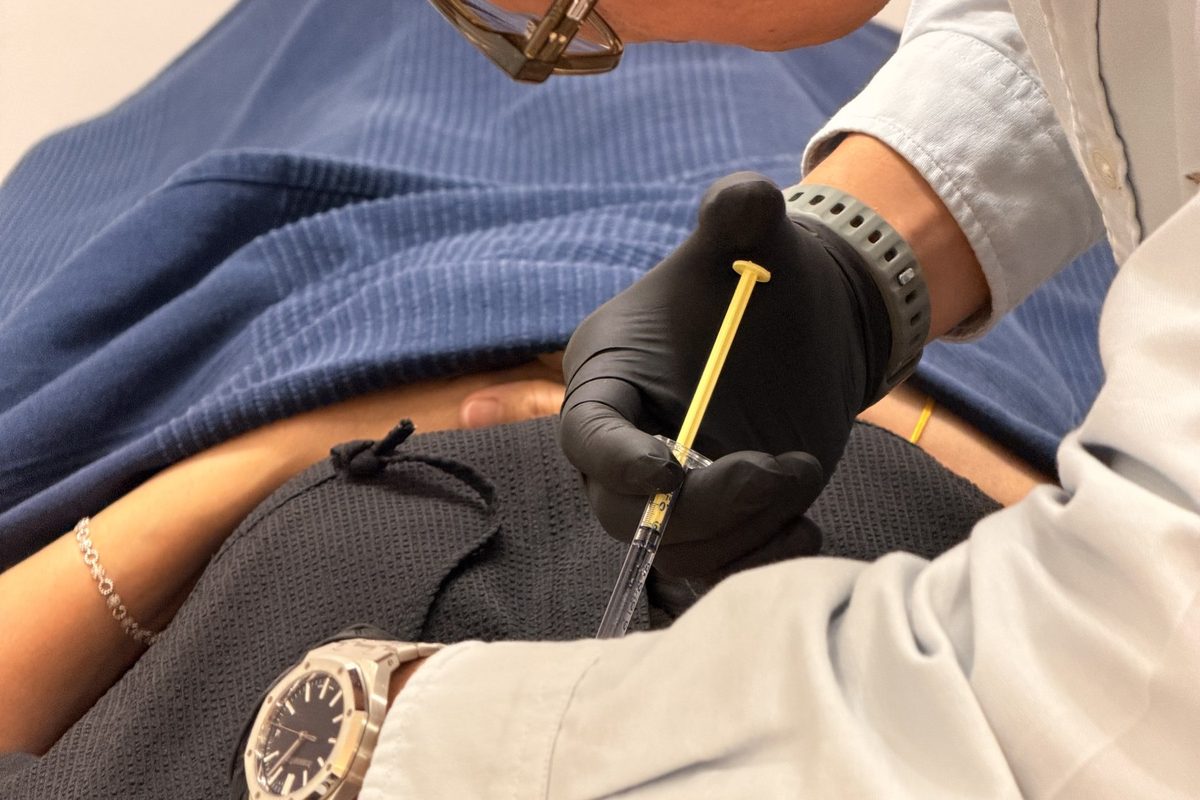
The same goal is not the same road
Patients often arrive having done their research. They know they want collagen. They have seen the words biostimulator, PRP, and microneedling in the same breath, sometimes in the same sentence, and they reasonably assume that if these things share a destination they are roughly interchangeable. Pick the most popular one. Pick the cheapest. Pick the one your friend had.
The destination is similar. The roads are not. And one of them, once taken, does not offer a clean way back. That asymmetry is the piece of information that most consultations either rush past or skip entirely, and it is the one that matters most when setting expectations before any needle goes in.
The four roads side by side, before the essay takes them one at a time. The class comparisons at neuromodulator vs filler vs biostimulator and ultrasound lifting vs radiofrequency vs RF microneedling vs threads go further, and the cost guide explains how each class is priced and why fees vary.
| Road | Mechanism | What it changes | Can it be undone? | Suits |
|---|---|---|---|---|
| Poly-D,L-lactic acid biostimulator | Synthetic microparticles trigger a controlled response; the body lays down collagen around them as they dissolve over months. | Structural volume and tissue density, gradually, across a course. | No. Hyaluronidase does not act on the polymer or the collagen it stimulates; complications are managed, not erased. | Genuine volume loss in the mid-face or temples; significant laxity; a patient comfortable with a slow, durable change. |
| Platelet-rich plasma or fibrin | Growth factors concentrated from the patient's own blood signal fibroblasts to become more active. | Skin quality: fine lines, tone, thickness. Not structural volume. | No collagen can be undone, but nothing foreign is deposited, so the risk profile differs. | Skin-quality complaints without structural loss; scalp work by the same logic. |
| Microneedling | Controlled micro-injuries at a set depth trigger the wound-healing cascade. | Surface and upper-dermal texture, pores, fine lines, early scarring. No volume. | Self-limiting; no depot of material to manage. | Good structural support with uneven surface texture; a complement in a layered plan. |
| Energy (radiofrequency) | Controlled heat at depth contracts existing collagen and triggers new collagen over months. | Tightening of early to moderate laxity. Not volume, not resurfacing. | No material to reverse; the response is the body's own remodelling. | Early laxity of the lower face and neck; see the radiofrequency essay. |
Road one: PDLLA biostimulators
Poly-D-L-lactic acid, or PDLLA, is a synthetic polymer that has been used in medicine for decades, most familiarly in dissolvable sutures. In aesthetic medicine, it is injected as a suspension of fine microparticles. Over the longer term the particles act as a trigger rather than as the active agent themselves. What they set off is an immune response, a controlled, localised inflammation that signals the body to lay down new collagen around the particles as they slowly dissolve over months.
The result is a gradual increase in structural volume and tissue density. It does not behave like a filler in the sense of immediately occupying space. The change builds over weeks and continues for months after the final session. For patients with genuine volume loss in the mid-face or temples, or with significant skin laxity, PDLLA can deliver a structural improvement that surface treatments cannot reach.
Here is the no-eraser fact: if a hyaluronic acid filler creates an undesirable result, a clinician can inject hyaluronidase, an enzyme that dissolves HA, and the situation is largely corrected within days. PDLLA does not respond to hyaluronidase. The material and the collagen it has stimulated are not soluble in that way. Managing a PDLLA complication, whether a nodule or an uneven distribution, requires a different and more intensive approach, and there is no guarantee of a complete return to baseline. The dermatology and aesthetic-surgery literature is clear on this. What follows from it is a reason to choose PDLLA deliberately, with a proper understanding of the tissue it will change and the patient's anatomy before the first session. You can read more about how biostimulators work on the treatment page.
Road two: PRP and PRF
Platelet-rich plasma and platelet-rich fibrin are prepared from the patient's own blood. A small draw, a centrifuge, a separation process that concentrates the growth factors held in the platelet fraction. When injected back into the skin or scalp, those growth factors signal fibroblasts, the cells responsible for producing collagen and elastin, to become more active.
PRP is a liquid suspension. PRF is a slower-release fibrin matrix, which means the growth factors are delivered over a longer period after injection. Both are autologous, meaning they come from the patient, which changes the risk profile considerably. The body does not treat its own concentrated platelets as foreign material the way it responds to a synthetic polymer.
The improvement PRP and PRF produce tends to be in skin quality rather than structural volume. Fine lines, overall tone and radiance, skin thickness. It is a skin-conditioning road rather than a volumising one. Timeline is gradual, typically across three sessions spaced a month apart, with ongoing improvement noticed over the months that follow. For patients considering hair loss treatment, PRP applied to the scalp works by the same growth-factor logic, stimulating dormant follicles rather than creating new collagen in skin per se, though the mechanism is closely related.
The reversibility question is different here. PRP and PRF do not deposit a synthetic material. The collagen produced is the body's own, built on a signal that has already passed. You cannot undo the collagen the body has laid down, but there is no foreign material to manage and the risk profile of an unwanted outcome is meaningfully different from a synthetic biostimulator.
Road three: microneedling
Microneedling creates controlled microinjuries in the skin using fine needles, either a stamp device or a motorised tip, at a set depth. The injury triggers the skin's wound-healing cascade. Collagen and elastin production follows as part of that healing process. It is perhaps the most mechanically intuitive of the three roads: damage the skin precisely, let it repair, watch the repair improve the tissue.
The effect is predominantly at the surface and in the upper dermis. Texture, pore size, fine lines, early scarring. Microneedling does not add volume in any meaningful structural sense, and it does not reach the depths that PDLLA or a surgical approach would address. Where it earns its place is in skin quality work, particularly in patients with good structural support but uneven surface texture, or as a complement to other treatments in a layered plan.
Devices with radiofrequency added, where the needle tip delivers energy into the dermis at the point of penetration, extend the reach and depth of the stimulus. But microneedling's reversibility question barely applies: the treatment creates no depot of foreign material, the healing response is self-limiting, and the risk profile is managed through depth, speed, and post-care rather than through anything analogous to hyaluronidase.
The diagnostic question that decides
Choosing between these roads is not a matter of which is most popular this season. The diagnostic question is: what does this patient's face actually need, and how do they respond to the idea that some changes are harder to walk back than others?
A patient with significant volume loss, a flattened mid-face or hollow temples, is a structural problem. Microneedling will not solve it. PRP will improve the skin quality over it. PDLLA, placed correctly, can address the underlying volume deficit. But that patient needs to understand they are committing to a process that unfolds over months and that the collagen stimulated is not a reversible deposit.
A patient whose complaint is skin quality, dullness, fine lines, early crepiness, without significant structural loss, may be well-served by PRP or microneedling, or by skinboosters addressing hydration and superficial tissue quality alongside collagen stimulation. The risk calculus is different. The timeline is different. The conversation before the first appointment should reflect that.
A patient who values knowing there is a straightforward correction available if they are unhappy with a result should probably not begin with PDLLA. That is not a warning against PDLLA. It is an acknowledgement that different patients hold uncertainty differently, and that a treatment chosen without that conversation is a treatment chosen on incomplete information. What no page can do is replace an individual assessment of anatomy and expectation.
A fourth road, energy
There is a fourth road to collagen that sits apart from these three, one that works through thermal and electrical energy delivered into the dermis and deeper tissue rather than through injectables or mechanical trauma. It is a large enough subject, with its own mechanism and its own patient selection logic, that it has its own piece: where radiofrequency fits among the roads to collagen. At the clinic that road is XERF, now available by assessment. Focused ultrasound is a separate road again, reaching one deeper plane rather than heating a broad field, and it has its own page at ultrasound skin tightening.
The point worth holding across all four is this: the roads to collagen are not interchangeable. The consultation before any of them is where the right one gets identified, not the marketing material, not the price list, and not what worked for someone else.