
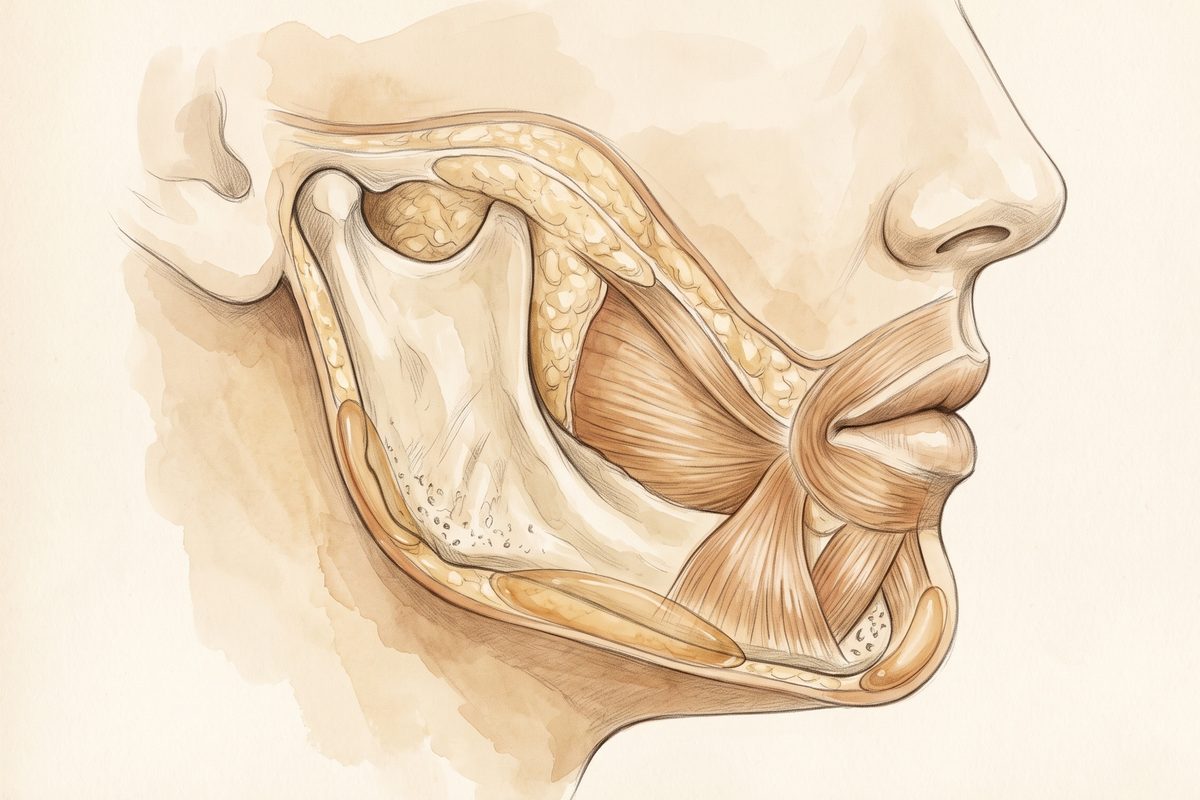
What can chin and jawline filler change, and what can it not?
Hyaluronic acid is a jelly-like substance the body already makes, and it holds water. Made into a cross-linked dermal filler, a firmer gel can be placed deep, on the bone of the chin, to add projection, and along the lower edge of the jaw to add definition. The US Food and Drug Administration (FDA) lists augmentation of the chin among the approved uses of dermal fillers in adults aged 22 or over. This clinic offers dermal fillers, and its treatment page names a soft or recessed chin and refining a jawline among the uses.
The chin is one of the filler sites studied in randomised trials with an untreated comparison group. In one trial of 140 adults aged 22 or over with mild to moderate chin retrusion, which means a chin that sits behind the profile, 81 per cent of the treated group improved by at least one grade on a rating scale at 12 weeks, against 6 per cent of the untreated group, and 74 per cent against 11 per cent at 48 weeks. A trial in Chinese adults with moderate to severe retrusion measured the profile itself. The angle between the point between the brows, the base of the nose and the front of the chin changed by 2.97 degrees in the treated group and 0.09 degrees in the untreated group at 24 weeks, and the change was still there at 52 weeks. A study of 121 people in Germany measured a gain of 2.5 mL of chin volume on 3D imaging and a change in the same angle of 1.9 degrees. So the change is real, and it is a matter of a few degrees.
The jawline looks similar. In a US trial of adults with moderate or severe loss of jawline definition, 69.0 per cent of the treated group improved by at least one grade at six months, against 38.0 per cent of the untreated group. That second figure is a reminder of how much a rating can move without treatment, and of why a result for a group is not a promise to one face. A photograph cannot settle it either, and what a before-and-after does not show you explains why this journal publishes none.
Several of the trials above were funded by, or include employees of, the companies that make the gels, which is common in this field.
What it does not do matters as much. The gel adds to soft tissue, so it does not move the jaw bone or correct a bite. It does not narrow a wide lower face, because filler adds and does not take away. It does not lift skin that has loosened, and it does not remove fat under the chin, which is a separate question covered in why a double chin is not always fat. A review of 24 chin studies concludes that the degree of retrusion decides which option fits, so a mild case and a severe one are not the same conversation.
Chin, jawline or masseter: which one is it?
These are three different structures, and a wish for a slimmer or sharper lower face can mean any of them. The chin is the bone at the front of the lower jaw with soft tissue over it, and its question is how far forward it sits. The jawline is the lower edge of the jaw running back to the angle, and its question is definition: whether a jowl and the dip in front of it blur the line. The masseter is the chewing muscle at the angle of the jaw, and its question is width.
Each has its own tool. Filler adds, so it suits the first two. A wide lower face that comes from a large masseter is a muscle problem, and it is answered by relaxing the muscle with botulinum toxin, not by adding anything. Masseter injections for jaw slimming and teeth grinding sets out how that works and how a muscle is told apart from fat, bone and a swollen gland.
The two can be planned together. In a randomised trial of 50 people with moderate to severe chin retrusion, adding botulinum toxin to the filler gave similar chin scores with less filler than filler alone, and the authors note that people with chin retrusion often have an overactive chin muscle. For jowls, a small study of 15 women found that filler at the angle and the back part of the jaw improved jowl scores at four weeks, and it reported tenderness when chewing for two to three days as a side effect. A jaw that has dropped because the skin has loosened is a lift problem and not a volume one, and what Ultherapy lifts covers that side.
A careful assessment looks at all three, and at the bite. A 2026 planning paper notes that advancing a chin has to take account of the growth pattern of the lower jaw, the way the teeth meet and the chin muscle, and not only the soft tissue in front of the bone.
How long does it last, and how much gel does it take?
Hyaluronic acid gel is temporary. A 2026 expert review, written with writing support funded by a filler manufacturer, gives a range of 4 to 18 months, depending on the product, the technique and the person. The trials above followed their results for up to a year, and a review of chin studies found reported durations from one to more than 18 months, with an average of 13 months. The FDA notes that every filler has its own expected duration, and that the safety of repeated use over a long period has not been evaluated in a controlled study.
The amount depends on the plan. A 2026 comparison of two firm gels used an average of about 1.9 mL across the chin, and the German study above measured a gain of 2.5 mL. Two of the studies above allowed an optional touch-up at four weeks. A jaw plan can need more, and in the small jowl study the average was 3.36 mL for the angle of the jaw alone.
What are the usual problems, and what does "gone wrong" mean?
Swelling, bruising, tenderness and firmness in the first days are usual. The FDA says most side effects occur shortly after injection and many resolve in a few days to weeks, and adds that some can appear weeks, months or years later. In one trial, which states that the manufacturer sponsored it, tenderness (81.1 per cent) and firmness (75.1 per cent) were the most common injection site responses, and one participant left the study after cellulitis of the face and inflammation at the injection site, both of which resolved without lasting effects.
What people search for as "chin filler gone wrong" is mostly a problem of shape. A systematic review of 24 studies and 2,738 patients lists lumps and nodules, which resolved with the enzyme in five studies, asymmetry and scarring, overcorrection and, in one study, movement of the product. The FDA lists migration, meaning movement of the gel away from where it was placed, and permanent hard nodules among the rare risks. A 2026 expert review, written with writing support funded by a filler manufacturer, argues that migration and the overfilled look are not inherent to hyaluronic acid gels and are linked to anatomical knowledge, technique, patient selection and counselling. A separate review of the overfilled face names the cumulative load of repeated treatments as one of the drivers.
Late lumps and swelling, and how they are dissolved, are covered in filler gone wrong: lumps, late swelling and dissolving explained. The next section stays with the serious risk at the chin.
Is there a serious risk at the chin?
Yes. The chin is often thought of as a low-risk site, and a 2023 case series begins by saying so before it describes tongue necrosis after chin filler, a rare complication. The cause was a blocked blood vessel. Arteries under the chin vary between people, and the authors suggest that a small opening in the jaw bone, which carries a branch of an artery, may also play a part. All of the patients recovered completely after high-dose hyaluronidase.
A 2018 case report describes the skin of the chin and upper neck turning ischaemic after filler involved the submental artery, with pain in the jaw and on swallowing. High-dose pulsed hyaluronidase was given within 24 hours, and the skin changes and the painful swallowing cleared within days. A 2026 report describes a woman who developed pain and mottled skin across the chin and neck about 24 hours after a low volume of filler. Treatment began at 25 hours and she had recovered fully by day 21, with no scarring or volume loss. The authors conclude that even minimal volumes can trigger a blocked vessel.
These are single reports. They show what the complication looks like and that treatment can work, and they cannot give a rate, because published cases collect the events that went wrong and not the treatments that passed without incident. A review of chin treatments describes serious vascular complications as rare. The FDA calls a blocked vessel the most concerning risk of dermal filler, with tissue death, loss of vision and stroke among the reported complications, and it advises urgent medical attention for unusual pain, a change in vision, or skin near the injection that looks white, grey or blue. For the chin, the reports above add pain on swallowing and mottled skin across the chin or neck, and one began a day after the treatment, so ask any clinic how a problem after hours is handled. The wider argument is in dermal filler risks in Malaysia.
Can chin and jawline filler be dissolved?
If the gel is hyaluronic acid, yes. An enzyme, hyaluronidase, breaks it down. A 2024 review of the enzyme's use for filler complications found limited controlled data but growing clinical experience, and an acceptable safety profile. It advises low or moderate doses for problems that are not emergencies, such as lumps that are not inflamed, and immediate high doses for a blocked vessel. Among the chin studies, five reported lumps that resolved with the enzyme.
Reversing is not always possible. The FDA warns that it may be difficult or impossible to remove filler material, especially permanent fillers and fillers that are not made of hyaluronic acid, and that removal can need injections, surgery or other procedures with risks of their own. That is why the class of gel is worth asking about before a chin is treated. Dissolving is also not a safety net for a blocked vessel: the case reports above needed pulsed high doses over hours.
When should you, or your doctor, say no?
An assessment that can end in no is the one worth attending. The Ministry of Health's guideline asks a doctor to apply strict patient selection, to explain the risks and the likely outcome, and to obtain valid consent. The three general grounds for declining filler are set out in dermal filler risks in Malaysia: the wrong diagnosis, a request for another person's bones, and a site where the risk outweighs the gain. At the chin and jaw they take particular forms.
The first is a problem that is really the jaw or the bite. When the cause is skeletal or a matter of how the teeth meet, a dentist, orthodontist or surgeon belongs in the conversation, because planning has to account for the bite and the growth pattern. A systematic review of 56 studies and 4,844 patients found that surgery, which moves the chin bone or places an implant, gives durable change in projection and high satisfaction, with its own complications such as infection, implant problems and persistent numbness. Filler gives rapid change with mostly temporary side effects. The review concluded that no technique is clearly better and that the choice is individual.
The second is a request for someone else's chin or jaw. Filler sits on the bone you have, and a long, narrow jaw seen in a photograph stands on a skeleton the gel cannot copy. On wanting to look like someone else explains why, and why a selfie is not your face shows how much a camera alone changes a face. A face that is already in balance, where the request comes from a filter or an angle rather than the mirror, is a third.
Some reasons are medical. The FDA says filler should be delayed while the skin is inflamed or infected, and asks people to tell the provider about a bleeding disorder, severe allergies or a history of anaphylaxis, and allergy to lidocaine, which is in some gels. It notes that inflammation near a filler site can follow a viral or bacterial illness, a vaccination or dental work, and that the safety of these products is unknown in pregnancy, while breastfeeding, in people under 22 and in people prone to keloid or thick scars.
Another is more gel on top of gel that is still there. A 2026 review of the overfilled face describes distortion at rest and unnatural movement, and names repeated treatments as one of the drivers. If a chin or jaw has been treated before, the first step is to look at what remains, not to add to it.
The answer is also no to filler bought online or injected at home, which the FDA advises against, to silicone, which the FDA says is not approved for any aesthetic use, and to anyone who cannot show that they are a registered doctor.
How do I choose a doctor and a registered product in Malaysia?
The Ministry of Health lists "filler injection, excluding silicone and fat" among the minimally invasive aesthetic procedures in its guidelines on aesthetic medical practice. The guidelines require a doctor to hold a Letter of Credentialing and Privileging (LCP) for each aesthetic procedure performed, and to provide the service in a healthcare facility that is licensed or registered. Three checks take a few minutes: the doctor on the Malaysian Medical Council register, the doctor's LCP, and the product. The guide to checking an aesthetic doctor in Malaysia walks through each step.
For the product, ask for its generic name and its registration number. The Medical Device Authority keeps a public register at mdar.mda.gov.my that can be searched by registration number or brand name, and it states that a device that does not appear in the results is unregistered, expired, suspended or cancelled. The brand on the box matters less than the class of gel and where it is placed, and what filler brand names mean explains the families.
Useful questions for any consultation: is the gel hyaluronic acid, how much is planned and where, who would treat a problem after hours, is hyaluronidase available, and what would make the doctor decline. This clinic offers dermal fillers, and every one of these questions is fair to put to it, as to any clinic. What a first consultation decides describes the visit.
What drives the cost of chin and jawline filler?
The fee follows the amount of gel the plan needs, which the published chin studies above put at about two millilitres and which a jaw plan can raise, the gel chosen for that depth, the doctor's time and consumables, and whether a review or touch-up visit is included. Two clinics can quote different fees for what sounds like the same request because the amount, the gel or the person placing it differs. A number is only honest after an assessment, and the guide to treatment costs in Malaysia lists what to ask any clinic.