The muscle doing the work
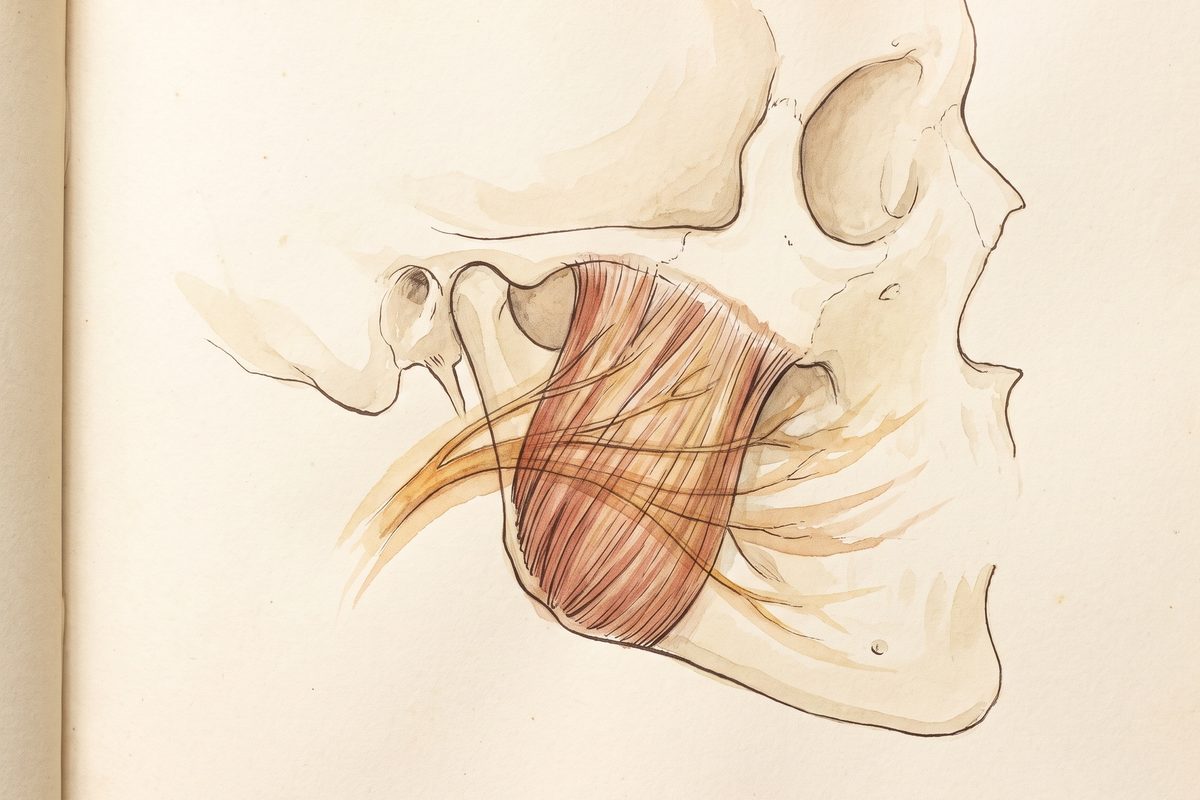
The masseter sits at the angle of the jaw, running from the cheekbone down to the lower jawbone, and it is a strong muscle for its size. Its job is to close the mouth and generate the force behind chewing. A muscle that is used hard and often, the way any muscle used hard and often does, gets bigger. Chronic clenching, grinding, habitually chewing on one side, heavy gum chewing, and in some people simple genetic predisposition, are all documented drivers of a masseter that has enlarged past what its owner needs for eating.
A bigger masseter widens the lower face, particularly when it sits on both sides, which is the square jawline some patients ask to have softened. It is a muscle problem with a muscle-sized solution, which is exactly what botulinum toxin is built to interrupt.
Why a wide jaw is not always the same problem
A square or full lower face can come from more than one place, and they are not interchangeable. Masseter muscle is one cause. A layer of buccal fat sitting over the jawline is another. The width and angle of the mandible itself, which is bone and answers to nothing an injection can do, is a third. And a genuinely enlarged parotid gland, the salivary gland that sits directly over the masseter, can look almost identical to a wide jaw from the outside, to the point that masseter hypertrophy is one of the more common things mistaken for a parotid problem, and the reverse happens too.
The reliable way to tell them apart is to feel the area while the patient clenches their teeth. A masseter mass becomes noticeably firmer and more prominent on clench, because that is the muscle doing its job. Fat does not change on clenching. Neither does bone, nor a swollen gland. This is the same principle that runs through why a double chin is not always fat: a full lower face is a description, not a diagnosis, and treating the wrong layer changes nothing about the layer that is actually responsible.
What the injection actually does to the muscle
Masseter injections use the same botulinum toxin used elsewhere on the face for expression lines. The mechanism does not change with location. As the mechanism piece on this journal explains it, the toxin "acts at the neuromuscular junction... it blocks the release of acetylcholine... the muscle rests. The repeated folding stops." In the masseter, the practical effect of that rested muscle is different from a softened frown line: instead of the skin above it settling, the muscle itself gradually loses bulk because it is no longer working as hard.
That is worth being precise about, because it gets described loosely as fat loss or as face slimming in the abstract. It is neither. The face narrows because a specific muscle has reduced in size, not because fat has been removed or because skin has tightened. Where the width was never coming from the muscle in the first place, relaxing it changes little, which is exactly why the differential diagnosis above matters before treatment rather than after.
The change is not immediate. The muscle begins to relax within about a week, but the visible reduction in bulk builds over the weeks that follow, typically reaching its fullest effect at around ten to twelve weeks. The effect on the muscle itself runs for roughly three to four months before it starts returning to its previous activity, and around half of patients seek a repeat treatment somewhere between four and seven months after the first.
The teeth-grinding question, honestly
The same relaxed masseter that slims the jaw is also, mechanically, a weaker muscle to grind with, which is the logic behind using these injections for bruxism, the medical term for clenching and grinding the teeth. Some of the published data supports a real, short-term benefit. In one prospective study of thirty bruxism patients, self-reported pain fell from an average of 6.8 to 3.4 out of 10 within four weeks, alongside a measurable drop in bite force and in the thickness of the masseter itself. A separate meta-analysis pooling ten studies found bite force fell significantly more within the first month after botulinum toxin than after either an oral splint or a saline injection.
That is the encouraging half of the picture. The other half is that a closer look at how these trials have been reported found real cause for caution. A 2025 review of the trial literature found spin bias, meaning the paper's own conclusion overstated what its data actually showed, in close to 90 percent of the randomised trials examined, most often by extrapolating a short-term result further than the data supported. The same review states plainly that "the results for masseter injections remain controversial" and that it is "not possible to have certainty about the efficacy and safety" of the treatment for bruxism pain and events, even though pain reduction was observed across trials at points ranging from two weeks out to a year.
There is also a more basic honesty worth naming: bruxism itself does not have a well understood single cause. Stress, sleep architecture, medication and bite mechanics have all been implicated, and the injection acts only on the muscle doing the grinding, not on whatever is driving it. Relaxing the muscle is a symptom-level intervention, not a cure, and a dentist and a properly fitted night guard remain part of the honest answer whether or not injections are used alongside them.
Side effects, and who this is not for
The masseter is a large, forgiving muscle by the standards of the face, but it is not risk-free to inject. The common effects are transient: soreness at the injection sites and a period of reduced chewing strength or jaw fatigue while eating, most noticeable with harder foods, while the muscle is at its weakest. Less commonly, an uneven dose or an asymmetric muscle to begin with produces a smile that looks slightly uneven, or a bulge in part of the muscle as it reduces unevenly rather than as a whole. Rarely, the muscle can show paradoxical bulging, a localised swelling that looks like the opposite of the intended result, or the skin and soft tissue over the jaw can sag once a genuinely large muscle has thinned underneath it.
The standard exclusions for any botulinum toxin treatment apply here as they do to expression-line work: pregnancy and breastfeeding, a neuromuscular condition such as myasthenia gravis, a previous reaction to the drug, and active infection at the injection site. None of this is specific to the masseter. It is the same medicine, in a different, larger muscle, and the same caution applies.
What this looks like at The Retreat Clinic
At The Retreat Clinic, masseter injections sit within the same anti-wrinkle injections treatment used for expression lines. As the treatment page states it, "the same injections slim the masseter muscle along the jaw. A strong masseter widens the lower face, and relaxing it lets the muscle reduce gradually, softening a square jawline. For some patients it also eases the clenching and grinding they do at night, a functional benefit that arrives alongside the cosmetic one." The treatment itself is dosed by muscle, following the same assessment-first approach used everywhere else on the face, and the mechanism behind it is the same regardless of which muscle is being treated.
What that assessment is actually checking, before any dose is drawn up, is whether the width in front of the doctor is genuinely the masseter doing the work, rather than fat, bone, or a gland that only looks like it. A treatment aimed confidently at the wrong layer still fails, however well it is dosed.