
Which signs after filler need urgent care?
Some signs are an emergency, and they are quick to list. The US Food and Drug Administration says to seek immediate medical attention for unusual pain, vision changes, or a white, grey or blue appearance of the skin near the injection site, and for signs of a stroke such as sudden trouble speaking, a drooping face, numbness, a severe headache or dizziness.
The cause of these signs is filler entering or blocking a blood vessel, which starves the tissue of blood. Guidelines call it rare but devastating, a time-critical emergency, and advise arranging immediate transfer to an emergency department. Go straight away, to an emergency department, and tell them you had filler. How that happens and how the risk differs by site is in dermal filler risks, and I will not repeat it here.
Why can a lump or swelling appear weeks or months after filler?
Because filler stays in the tissue, and tissue reacts over time. The FDA states that side effects from a filler may appear weeks, months or even years after injection. A 2024 consensus from a board that reviews these events describes rare late-onset reactions, most between three and four months after injection and occasionally as early as 24 hours.
Early swelling and bruising are a separate matter. Many settle within days to weeks, and what to expect in the first days is covered in redness after a treatment: normal, or not?. What this article concerns is the change that comes later, or the one that does not go away.
What are the kinds of late lump, and what causes them?
The 2024 consensus offers three explanations, and it is honest that they are hypotheses. The first is the gel itself: the structure of the filler, especially HA of low molecular weight, may set off an immune response. The second is infection, whether introduced at the time of injection or from a dormant film of bacteria, called a biofilm, waking up later. The third is the person's immune system, out of balance because of an autoimmune disease or a viral infection, which can prolong a reaction to a foreign material.
The same paper lists risk factors. On the patient side: recent dental treatment, current medical status and an active autoimmune disease. On the product side: molecular weight. On the procedure side: sterile technique and trauma. So the questions a doctor asks when you come back are practical ones: what you had, when, whether you have been unwell, and whether you have had dental work.
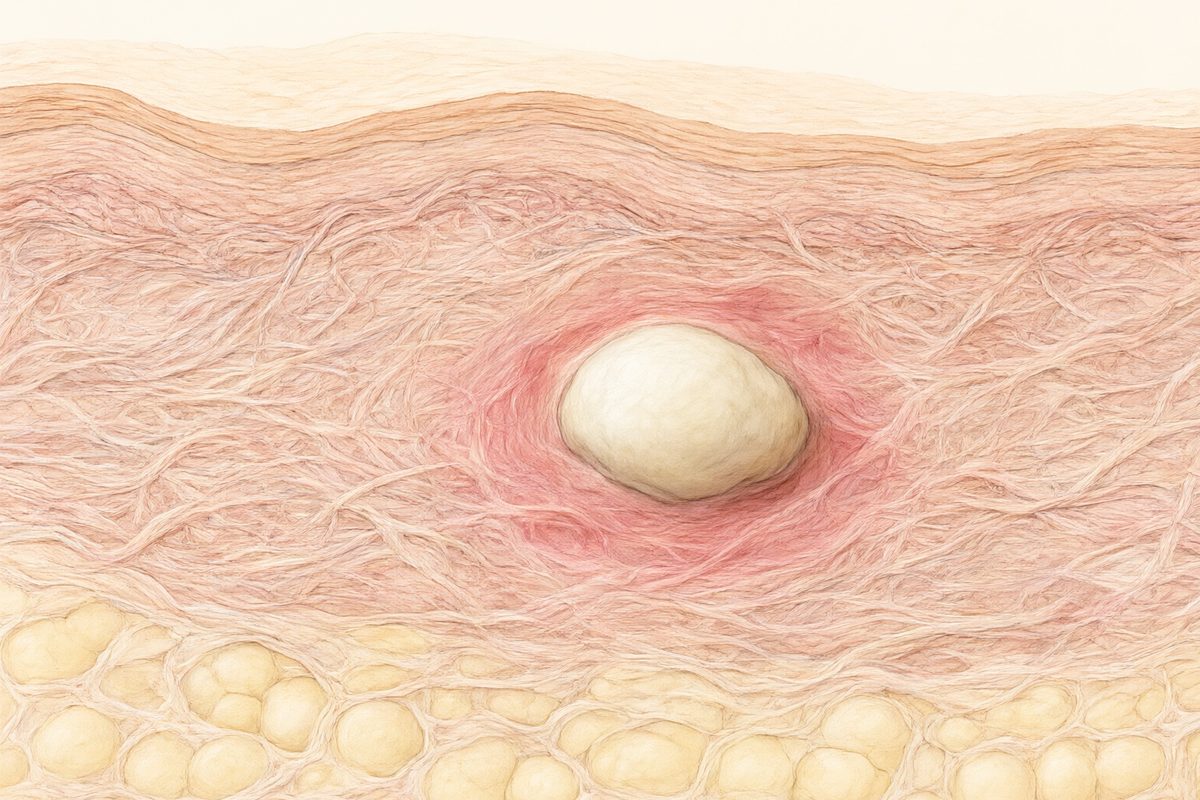
A doctor also separates lumps that are red, warm and tender from those that are firm and quiet. The first suggests inflammation or infection. The second may be filler that has settled unevenly or a firm nodule, and a nodule is a small hard lump. Filler is a foreign material, and when the body walls it off, the result can be a lump called a granuloma. The FDA notes that nodules and granulomas may need injections, oral antibiotics or surgical removal.
What can hyaluronidase dissolve, and what can it not?
Hyaluronidase digests hyaluronic acid, and only hyaluronic acid. If the gel in your face is HA, a doctor can use it to break the gel down. If it is not, the enzyme does nothing to the material. The FDA states that it may be difficult or impossible to remove filler that is permanent or not made of HA. What each gel is made of is explained in what filler brand names mean, and body filler is dealt with in breast and buttock filler in Malaysia.
Even with HA, dissolving is a decision and not a reflex. The 2024 consensus recommends hyaluronidase for late reactions that are not inflammatory and have no infection. For inflammatory reactions it says that watching and waiting, or steroids, may suit better, and for infection it says hyaluronidase is not the first choice: infection needs drainage, a culture and antibiotics. It stresses assessing each person individually.
The wider literature shows that doctors disagree. In a survey of 18 highly experienced physicians in ten countries, 16 favoured antibiotics first for delayed inflammatory reactions, for three to six weeks, most avoided steroids unless the reaction was disfiguring or stubborn, and 13 recommended hyaluronidase injected into the lump, some after waiting anywhere from two days to two weeks. That is a small survey of expert opinion, and I cite it for the disagreement, not as a rule.
Dissolving also changes the shape of the face. It removes filler you may have wanted, and it takes time to work, so a doctor will choose the amount and timing carefully. Hyaluronidase is a prescription medicine. This article gives no dose and no method, and it is not something to buy or try yourself.
Where does an emergency change the answer?
When the problem is a blocked vessel, hyaluronidase is used as urgent treatment. A 2026 review found it the only intervention consistently linked with better outcomes in filler-related eye emergencies, while the exact route and dose are debated, and a 2021 consensus says the evidence for injecting behind the eye is unproven. That is for an emergency team, in a hospital. It is also the reason an emergency needs care straight away and not a wait-and-see week.
Who should treat a filler problem in Malaysia?
A registered doctor. In the Ministry of Health's Guidelines on Aesthetic Medical Practice, filler injection, excluding silicone and fat, is a procedure for a registered medical practitioner who holds a Letter of Credentialing and Privileging. Someone who can inject filler should also know how to assess a complication and when to send you on. If you are in Shah Alam or the Klang Valley and worried about a lump, a doctor who does not know what was injected has to start by asking.
So keep the record. Note the date, the area, the product name if you were told, and who did it. Do not have more filler put over a lump. If you were told a lump is normal, and it is red, hot, painful or growing, go back or see another doctor. The lip and nose specifics are in lip filler and nose filler.
What is the honest limit of all this?
Most of what is known about late reactions comes from consensus statements, reviews and expert opinion, and not from large trials that count how often each problem occurs, so I give no rate. What the papers agree on is that there is more than one kind of late lump, that the treatments differ, and that a diagnosis has to come before the enzyme. That is the same principle as everywhere else in medicine: it is the diagnosis that decides the treatment.