
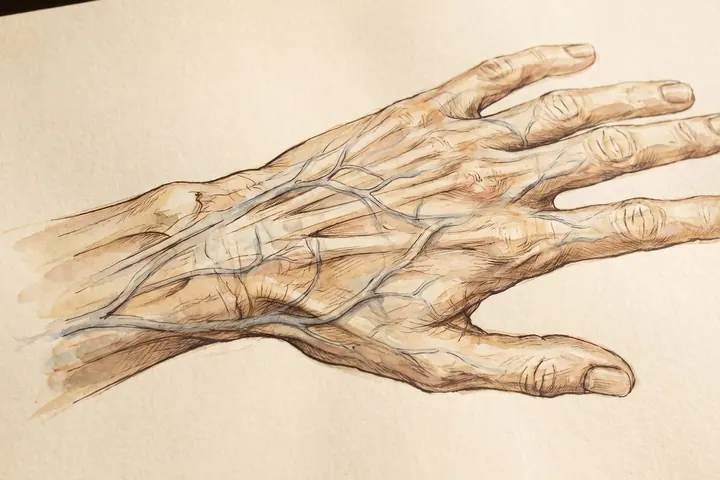
Why do hands look older than the face?
Because the back of the hand has little to hide behind. The skin is thin and the layer of fat under it is slight, so when volume falls, what lies beneath shows. The sun adds to it, since the backs of the hands are exposed for years with no shade.
A review in Cureus describes the pattern: the skin loses elasticity and becomes more translucent, the veins, joints and tendons appear more prominent, and the bones become more noticeable. The authors put it down to intrinsic and extrinsic factors, meaning age and genes on one side and sun and the environment on the other.
Frequent washing and sanitiser probably dry the skin and make fine lines more obvious. That part is a reasonable expectation rather than something this article can cite.
What makes a hand read as old?
Several things at once. Volume loss is the biggest, because it makes the veins and tendons stand out. Thin skin shows crepey lines. Sun spots, the flat brown marks properly called solar lentigines, collect on the back of the hand because it is among the most sun-exposed parts of the body. DermNet describes them as benign, flat and caused by chronic ultraviolet exposure.
Nails and joints can add their own signals, such as changes in the nails or thickened knuckles. Some of that is ordinary ageing, but some can be a sign of something else, covered below.
The useful point is that these are separate problems with separate answers. Volume, skin quality and pigment do not respond to the same thing, which is the same logic behind why the diagnosis decides the treatment for brown marks.
Does sun protection help the hands?
It is the one step with a randomised trial behind it, though the trial was not about hands alone. In Nambour, Australia, 903 adults under 55 were randomised, and those told to use broad-spectrum sunscreen daily showed no detectable increase in skin ageing over 4.5 years. Their skin ageing was 24% less than in the group who used it when they chose (relative odds 0.76, 95% CI 0.59 to 0.98). The authors note that some outcome data were missing and that the power to detect moderate effects was modest.
The practical gap is the hands themselves. They are washed many times a day, so sunscreen on the backs of the hands wears off. How the SPF number behaves in Malaysian heat is covered in sunscreen in the tropics; reapplying after washing is the part that is easy to skip.
What about retinoids, and treatments for brown spots?
DermNet lists topical retinoids and hydroquinone among treatments for solar lentigines, alongside cryotherapy, laser, intense pulsed light and peels, and says combination therapy gives the highest rates of resolution. It gives no figures, so this article gives none. Retinoids are a prescription class of medicine, so they are a conversation with a doctor, and they can irritate skin that is already dry.
Which method fits depends on what the mark is, how dark it sits and how the skin tends to react. Pigment treatments can leave a darker mark on skin prone to it, so the diagnosis comes first (how pigmentation is assessed).
What does hand filler do, and what are the risks?
Hand rejuvenation injects a volumising product, usually hyaluronic acid or calcium hydroxylapatite, under the skin of the back of the hand to fill the hollows. Fat grafting is the other option. The Cureus review reports good results with low complication rates and high satisfaction, and says the superficial dermal layer is probably the most suitable plane because it holds no important structures. Veins and tendons run close to the surface on the hand, which is why technique and plane matter.
The numbers from one trial give a sense of both sides. In an 18-month open-label study of 75 people given a hyaluronic acid filler, every treated hand improved by at least one grade on a hand volume scale at 3 months, and more than 65% of participants still did at 18 months. The same study found 29.3% had a treatment-related side effect: inflammation at the injection site in 21.3%, lumps or nodules in 9.3% and swelling in 5.3%, mostly mild or moderate and lasting about 45 days on average. There were no serious or vascular events, but it had no control group, was small, and was funded by the manufacturer.
Lumps after filler are a known problem in general and are covered in filler lumps and late swelling, and the broader risk list is in dermal filler risks. The calcium-based products are described in the biostimulator types article. Results are not permanent, and none can be promised.
When is a hand change medical rather than cosmetic?
Some changes should not be treated as ageing until a doctor has seen them. The NHS lists a new mole, or a mole that changes in size, shape or colour, or becomes sore, bleeding, itchy or crusty, and a new or unusual mark that has not gone away after a few weeks (NHS on melanoma symptoms). It also names a dark area under a nail that an injury does not explain. DermNet advises a biopsy when a dark mark is hard to tell from melanoma in situ.
A sore that does not heal, swelling in the joints, or a tremor that is new belong in the same group. They are medical questions, and a laser or filler is not the answer to them. The reason a check comes before any laser is explained in mole removal and why a check comes first.
What can I do with this?
Start with the simple parts: sunscreen on the backs of the hands, reapplied after washing, and a moisturiser. Look at which of the three problems bothers you: volume, skin texture or marks. Then decide whether anything needs treating at all. Leaving your hands as they are is a reasonable choice.
If you would like a doctor to look at a specific change, a first consultation is the place to ask.
Common questions
Why do my hands look older than my face?
The back of the hand has thin skin and very little fat, and it gets years of sun with no shade. As volume falls and the skin thins, veins and tendons show, and sun spots and fine wrinkling stand out. A review in Cureus describes the skin losing elasticity and becoming more translucent, with veins, joints and tendons appearing more prominent.
Does sunscreen help the hands look younger?
It helps protect against further ageing; it does not reverse what has happened. In a randomised trial of 903 adults, daily broad-spectrum sunscreen users showed no detectable increase in skin ageing over 4.5 years, and 24% less ageing than people who used it when they chose. That trial measured skin ageing in general, not the hands alone.
What are the side effects of hand filler?
In an 18-month study of 75 people given a hyaluronic acid filler, 29.3% had a treatment-related side effect: inflammation at the injection site (21.3%), lumps or nodules (9.3%) and swelling (5.3%). Most were mild or moderate and lasted a mean of 45 days, and none were serious. The study had no control group and was funded by the manufacturer.
When is a change in my hands a medical problem?
See a doctor about a new or changing dark spot, a mark or sore that has not healed after a few weeks, a dark streak under a nail with no injury, or swelling in the joints. A tremor that is new also needs a doctor. These are medical questions, and a cosmetic treatment should wait until they are answered.
Sources
- Har-Shai L, Ofek SE, Lagziel T, et al. Revitalizing hands: a comprehensive review of anatomy and treatment options for hand rejuvenation. Cureus, 2023 A review. As the hands age, the skin loses elasticity and becomes more translucent, and the veins, joints and tendons appear more prominent. Treatment methods are dermal fillers and fat grafting. The superficial dermal layer is probably the most suitable place to inject volume because it is free of anatomical structures. Low complication rates and high satisfaction are reported.
- Hughes MC, Williams GM, Baker P, Green AC. Sunscreen and prevention of skin aging: a randomized trial. Annals of Internal Medicine, 2013 903 adults under 55 in Nambour, Australia. The daily broad-spectrum sunscreen group showed no detectable increase in skin ageing over 4.5 years, and skin ageing was 24% less than in the discretionary-use group (relative odds 0.76, 95% CI 0.59 to 0.98). Some outcome data were missing and the power to detect moderate effects was modest.
- Greiner-Krüger D, Leys C, Lipko-Godlewska S, et al. VYC-17.5L is safe and effective in improving skin quality and volume deficit of hands: an 18-month open-label study. Journal of Cosmetic Dermatology, 2026 75 participants (94.7% female, mean age 53.9) received a hyaluronic acid filler in both hands, about 2 mL per hand. All hands improved by at least one grade on a hand volume scale at month 3, and more than 65% of participants still did at month 18. 29.3% had a treatment-related adverse event: injection site inflammation 21.3%, nodules or masses 9.3%, oedema 5.3%. Most were mild or moderate, with a mean duration of 45.1 days; there were no serious or vascular events. There was no control group, and the study was funded by the manufacturer.
- DermNet. Solar lentigo A common, benign, flat, pigmented mark on sun-exposed skin, most often the back of the hands, caused by chronic ultraviolet exposure. Listed treatments include topical retinoids, hydroquinone, cryotherapy, laser, intense pulsed light and peels, and sun protection reduces the risk of new ones. Biopsy is advised when a mark is hard to tell from melanoma in situ. No efficacy figures are given.
- NHS. Melanoma skin cancer: symptoms A new mole, or a mole that changes in size, shape or colour, or is sore, bleeding, itchy or crusty, needs a GP. So does a new or unusual mark on the skin that has not gone away after a few weeks, and a dark area under a nail that an injury does not explain.



