
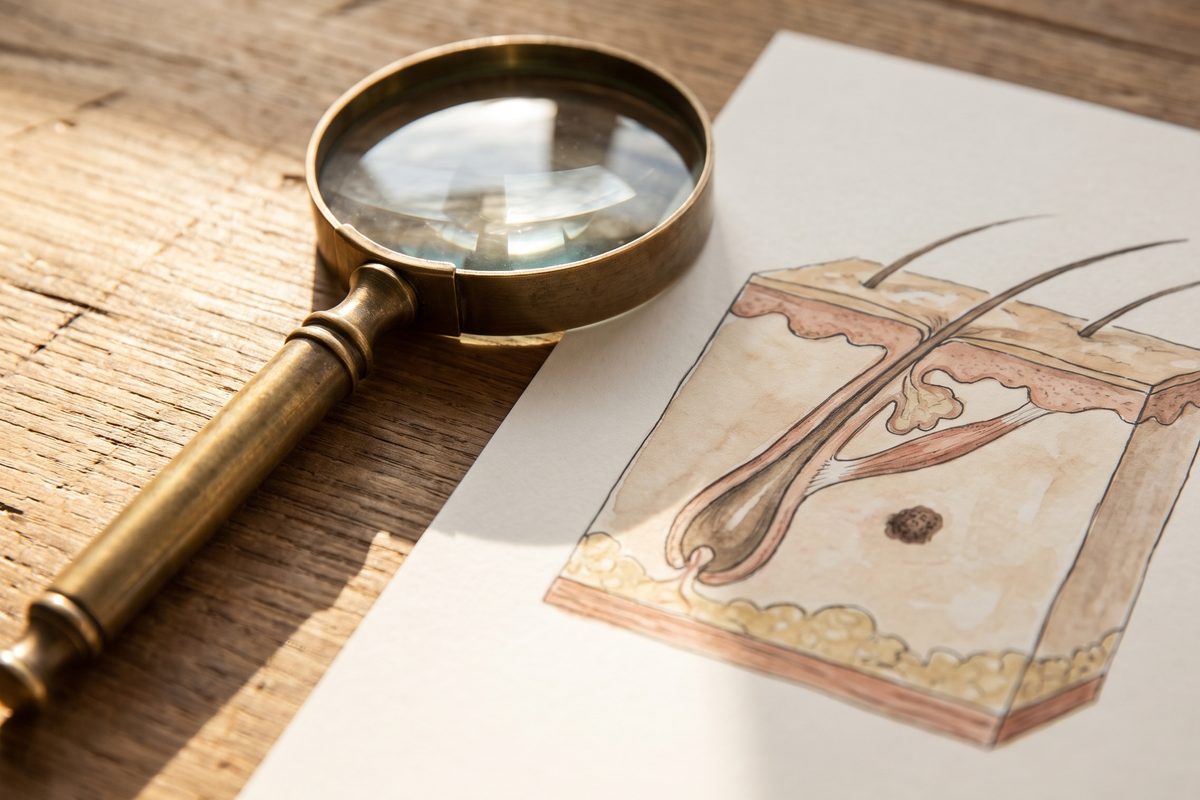
Is mole removal a cosmetic decision?
Only once the mole has been examined. Most moles are harmless, and the NHS says they usually need no treatment unless they change size, shape or colour. Melanoma can look like an ordinary mole, though, and the American Academy of Dermatology says an early one could be mistaken for one. So the first question about a mole you want gone is what it is, and how to remove it comes second.
What does a mole check look for?
Change and irregularity. The NHS lists a mole that has changed in size, shape or colour, a mole that is painful or itchy, one that is inflamed, bleeding or crusty, and a new or unusual mark that has not gone away after a few weeks. The AAD's ABCDE rule adds asymmetry, where one half is unlike the other, an irregular or poorly defined border, more than one colour, a width over about 6 millimetres, although smaller melanomas exist, and evolving, meaning it looks different from your other spots or is changing.
A doctor also has a tool you do not. A 2010 review of laser treatment for pigmented lesions calls dermoscopy, looking at the mole through a lit magnifying lens, a routine first-level technique. It says that if there is any doubt a lesion is benign, a biopsy for histology is obligatory. Histology means a pathologist studies a sample under the microscope. The review puts the essential question plainly: whether the lesion has atypical features or malignant potential.
Why does a laser before a check cause trouble?
Because it can destroy the evidence. A German report describes two patients whose melanomas were first taken for benign moles and treated with laser vaporisation. The tumours came back. The authors write that laser removal complicated and delayed the correct diagnosis, and might have worsened the prognosis after recurrence of an incompletely removed tumour. Two cases cannot give a rate, so none is offered. They show what the order of events can cost.
Which methods remove a mole, and what does each give up?
Each method trades something. A 2026 systematic review and meta-analysis pooled 46 studies and 4,201 moles. Surgical excision, cutting the mole out, had the highest clearance at 96.4% and the lowest recurrence at 2.1%, and it hands a pathologist the whole mole. Laser methods scored better on appearance, at 8.8 and 8.4 out of 10 for two laser types against 6.2 for excision, but they recurred more often: 12.9% and 14.3%. Electrosurgery recurred in 16.1% and dermabrasion in 22.7%.
Depth mattered too. Intradermal moles, the ones that sit deeper in the skin, recurred more often than junctional ones. The authors conclude that excision is the most reliable route to complete removal and to histology, that laser gives a better look with a higher chance of return, and that the choice should weigh depth, cosmetic priorities and preference. A 2021 randomised trial of shave against elliptical excision for intradermal moles found the same shape: recurrence, 11.7% overall, occurred only after shave excision, which was less uncomfortable and better liked but left more involved margins.
These figures describe moles already judged benign. They say nothing in favour of skipping the check.
Does Malaysian law say anything about lasering a mole?
It says something about who may run the laser. The Medical Device (Designated Medical Device) Order 2026 took effect on 1 June 2026 and designates medical lasers, listed by type and wavelength, and operating a designated device needs a permit under the Medical Device Act 2012. The Order, explained sets that out.
The Schedule does not name moles. The purposes it lists include pigmentation, vascular lesions and scars. For the erbium YAG and fractional CO2 lasers they also include treating actinic keratosis, a precancerous skin lesion, and removing warts by tissue ablation, and each laser has a line for any other aesthetic purpose set by the manufacturer within its intended use. So the Order does not settle whether a particular mole treatment falls under it. It does give you a fair question for any provider: does the person holding the laser have the permit? Which aesthetic procedures only a doctor may perform explains the Ministry of Health lists.
Where do I go for mole removal in Shah Alam, Klang, Puchong or Petaling Jaya?
To a doctor who will examine the mole first, and the postcode does not change that. A mole that has changed, itches, bleeds or looks unlike the rest belongs with a dermatologist or a GP, and skin specialist or aesthetic doctor shows how to check either one on its public register.
Dr Ong is an aesthetic doctor, and a changing mole is a question for a GP or a dermatologist, not for a laser. Whoever you see, three questions are fair. Who will examine this mole, and with what? Which method is being chosen, and why? If the mole is removed, will the tissue be sent for examination?
What about skin tags, eyelids and nails?
A skin tag is a different growth, and skin tags and when a laser is the wrong tool covers it. Even there, the first step is to confirm it is a skin tag. A mole or lump on the eyelid is another matter, and eyelid lesions need a proper diagnosis explains why.
A dark line beneath a fingernail or toenail, or a band of darker skin around a nail, is on the AAD's list of melanoma signs, and the AAD notes that melanoma can appear on the sole of the foot. Those places are easy to overlook and are worth a look from a doctor.
A mole is small. Looking at it properly is the part that cannot be skipped.