
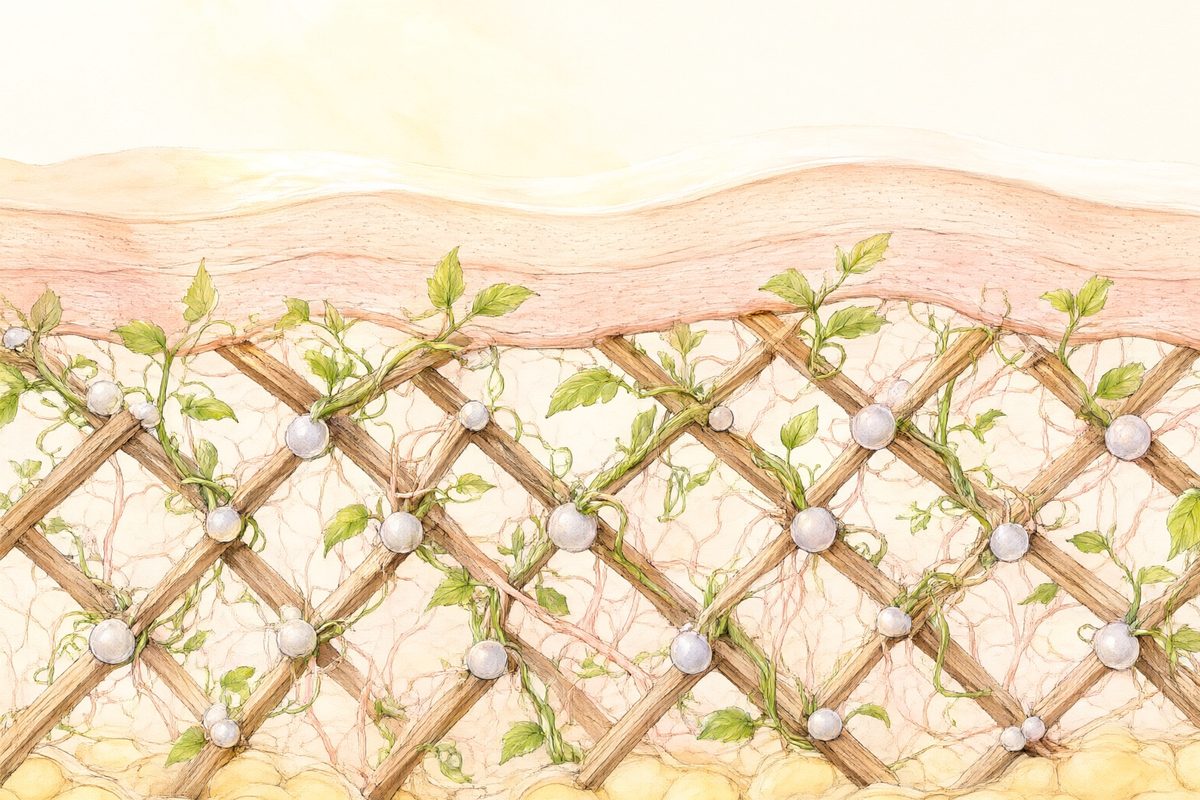
What is a biostimulator, and is it a collagen injection?
A biostimulator is an injected particle that prompts the skin to lay down new collagen as it is slowly absorbed. The US patient label for a PLLA product puts it plainly: the beads fill a wrinkle at first, and as they biodegrade the body may produce new collagen. A 2025 clinical guideline describes PLLA and PDLLA as provoking a sub-clinical inflammatory response, below the level of visible inflammation, that raises type I collagen at the injection site.
So collagen injection can mean two different things. Some fillers do contain collagen, and the FDA tells patients who are allergic to collagen to say so before treatment. A biostimulator contains none. Asking for the name of the material settles which is meant.
Which brand sits on which material?
Many of the names people search for sit on four materials. Register entries, filed by the companies that hold them, and the published papers agree on which is which.
PLLA is the material in Sculptra: a man-made polymer also used in absorbable stitches, supplied as a dry powder and mixed with sterile water before injection. The FDA describes a series of injections over several months, with the effect becoming apparent over several weeks. The 2009 US label says the time it takes to resorb in humans is not known, and that in rabbits the particles were still visible more than a year after injection.
CaHA is the material in Radiesse: a mineral found in teeth and bones, made into microspheres 25 to 45 microns across and suspended in a gel of water, glycerin and carboxymethylcellulose. The gel gives fullness at once and is absorbed, while the microspheres stay and prompt collagen. CaHA shows up on X-ray and CT scans, which patients are told to mention to other doctors.
PCL is the material in Ellansé (often typed Ellanse) and Gouri. In Ellansé, PCL microspheres 25 to 50 microns across sit in a carboxymethylcellulose gel; a 2017 paper, most of whose authors consult for the maker, describes macrophages absorbing the gel over 6 to 8 weeks while the microspheres stimulate collagen. The register describes Gouri as a liquid form of PCL.
PDLLA is a close relative of PLLA: polylactic acid comes in two forms that differ in the arrangement of the molecule, the L form (PLLA) and the D,L form (PDLLA). AestheFill carries PDLLA in carboxymethylcellulose. The register describes Juvelook and Lenisna as PDLLA mixed with sodium hyaluronate, which it calls a carrier, and a 2025 laboratory comparison describes the Juvelook carrier as non-cross-linked hyaluronic acid. A 2024 consensus on one PDLLA product says clinical trials of PDLLA in aesthetic indications remain limited.
How long do biostimulators last?
The figures below come from different sources and were measured in different ways, so they do not form a ranking. The FDA gives about 18 months for CaHA and up to 2 years for PLLA. A 2026 systematic review of 14 studies reported up to 25 months for PLLA and 12 to 18 months for CaHA. For PCL, the 2017 paper gives expected longevities of 1, 2, 3 and 4 years for the four Ellansé versions, and the 3 and 4 year figures are extrapolated rather than measured. A Brazilian expert consensus on one PDLLA product advises maintenance treatment about every two years.
The visible effect and the particle are different things. A 2024 review describes PDLLA and CaHA fillers as usually persisting for up to two years and, in individual patients, for more than five, broken down by hydrolysis and enzymes in the body. Several of the papers cited here disclose that their authors speak for, or consult to, makers or distributors.
Can a biostimulator be dissolved?
Not in the way hyaluronic acid filler can be. Hyaluronidase digests hyaluronic acid, and none of these four materials is hyaluronic acid. The published papers say so material by material: no enzyme reverses CaHA, PDLLA nodules do not respond to straightforward enzyme treatment, PCL fillers cannot be removed at once by an enzyme, and a 2026 scoping review separates PLLA nodules from nodules caused by HA, which can respond to hyaluronidase. The FDA puts it generally: fillers not made of HA can be difficult or impossible to remove.
Two qualifications. Where a product is mixed with HA, the enzyme can act on the HA but not on the particles: in a Brazilian series of 55 complications, hyaluronidase helped only where CaHA had been combined with HA. Whether it helps in a given case is for the doctor to judge. And for CaHA, sodium thiosulfate has been studied as a way to speed breakdown, but the 2024 review calls it slow-acting and not effective in an emergency.
What is done about a lump depends on its kind, and lumps are reported with each material. A 2026 review calls nodules one of the most frequently reported complications of CaHA, and says most palpable nodules are self-limiting and many soften over time; a 2020 series of PCL treatments describes nodules and granulomas as rare potential complications. Options include massage, breaking a lump up with a needle and saline or sterile water, injected medicines, antibiotics if infection is suspected, and surgical removal, and a lump that persists can need a prolonged course of treatment. Side effects from any filler can appear weeks, months or years after injection, and any filler can block a blood vessel, which the FDA highlights as the risk that can cause serious and sometimes lasting harm. How often lumps occur across the whole category is not known: a 2026 review protocol notes that no systematic review has yet covered adverse events across all the major biostimulators.
Do biostimulators help sagging skin?
My view is that biostimulators do help laxity. How much they help depends on where the skin starts. Severe laxity may improve too, but the expectation has to be managed.
The published evidence is modest, and the studies cited here concern only CaHA and PLLA. A 2017 pilot of diluted CaHA in 20 people with neck and décolleté laxity found more collagen on biopsy and better skin elasticity. A 2019 randomised trial of PLLA against saline for skin quality, in 40 women, reported increases in skin elasticity and hydration in the PLLA group at 12 months. A 2018 expert consensus describes diluted CaHA for laxity as an off-label use and says further trials will add clarity. Studies of this size cannot say how much a face with advanced laxity will improve. How laxity is assessed, and what else is used for it, is set out on the page on sagging skin and jawline laxity.
What to ask before any biostimulator
Which material is it, and which product? How is it prepared, and how deep does it go? What is the plan if a lump appears? Is there any health reason to wait? Active skin infection or inflammation at the site is a standard reason to defer, and the FDA notes that filler safety in pregnancy and breastfeeding is unknown. Ask, too, for the registration number and match it on the Medical Device Authority's register; the guide to checking an aesthetic doctor covers the rest.
How biostimulators sit beside PRP and microneedling is compared in three roads to collagen, and how far ahead a course needs to start is in collagen-building courses before an event.
A biostimulator is a slow decision, because the particles cannot be undone with an enzyme. It deserves a slow conversation first.