
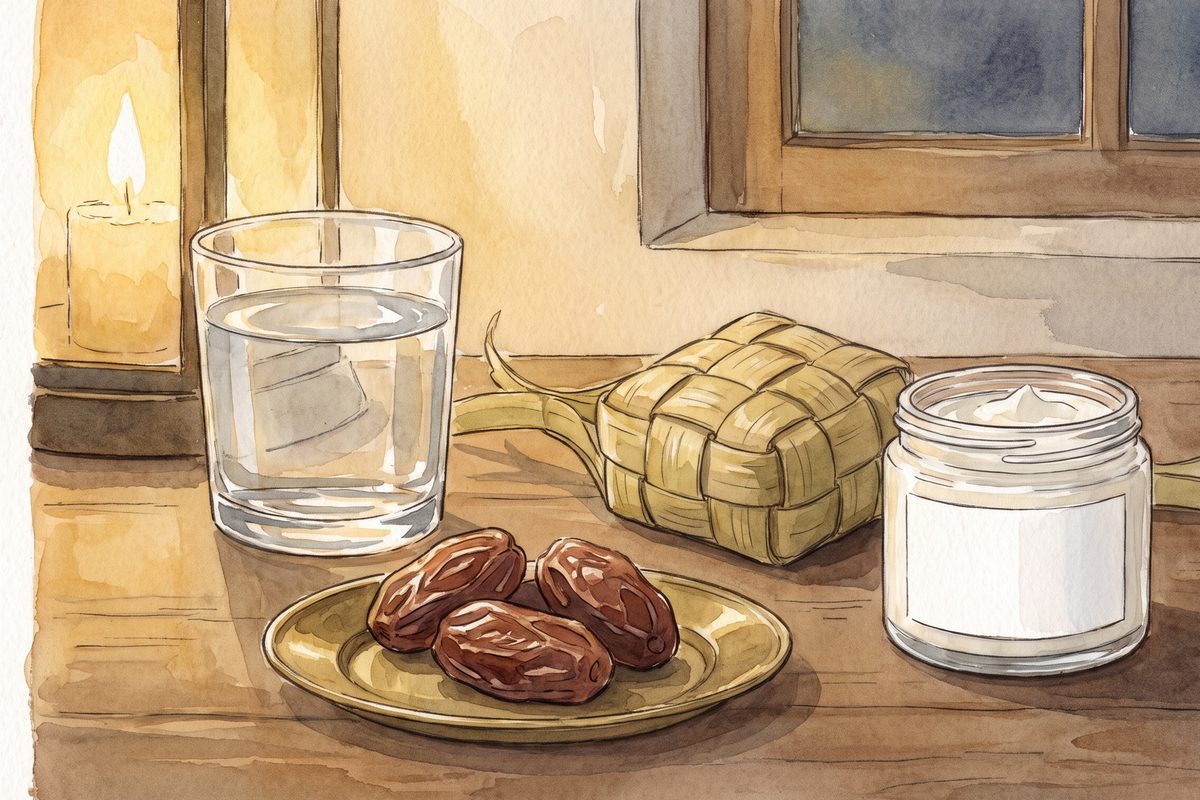
Why does skin look dry and dull in Ramadan?
The honest starting point is that no study has measured skin dryness in people who were fasting in Ramadan. What can be said comes from neighbouring evidence, and it points at three things that tend to arrive together: less sleep, a changed daily rhythm and heat.
Sleep first. A meta-analysis of 24 studies and 646 people found that total sleep time fell from about 7.2 hours a night before Ramadan to 6.4 hours during it, around an hour less. That matters for skin. In a 2015 study of 60 healthy women, poor sleepers had higher water loss through the skin, and good sleepers had 30% greater recovery of the skin barrier three days after a standard injury, faster recovery from sun-induced redness and lower ageing scores. In a laboratory study of extreme sleep loss, observers rated faces as paler, with more fine lines, darker eye circles and puffier, redder eyes. Neither study was done on people fasting. They show what shorter sleep can do to the skin.
Fluids second. Fasting means no drinking in daylight hours, and the question is whether that shows on the skin. A systematic review of six studies found that extra water intake may slightly increase hydration of the skin's outer layer, most clearly in people who drank little before, but the evidence is weak. Dehydration can be one reason skin looks flat. It is a modest one, and no more than one among several.
Dull is also a description of light bouncing off a skin surface that has dried or become uneven, or is carrying fine pigment. I would treat it as a sign to check sleep, sunscreen and moisturiser before reaching for anything stronger.
Will I get oily or break out during the fasting month?
Shiny skin by mid-afternoon is ordinary in Malaysian heat and humidity, fasting or not. There is no Ramadan-specific study of oil production. A lightweight gel or lotion moisturiser can hold the moisture without feeling heavy, and skipping moisturiser to control shine can leave the skin drier.
Breakouts are less predictable than people expect. The only study is a small before-and-after study of 40 people with acne in Egypt, and their acne scores and markers of inflammation were lower after Ramadan. It had no comparison group, so it cannot show that fasting improved acne. It does show that breaking out is not inevitable. If a breakout does arrive, look first at what changed on the skin itself: a new product, a heavier makeup routine, more sweat, a mask worn for longer. Skin purging after a new product covers how to tell a passing breakout from a reaction, and adult acne covers what a doctor checks when it persists.
No study has examined whether particular iftar foods affect acne, so no claim is made about them.
What skincare routine fits around sahur and iftar?
These are practical suggestions, not studied timings. Keep the routine short enough to do when tired.
At sahur or on waking: a gentle cleanse or a rinse, then a moisturiser, then sunscreen, which is the step that matters most for anyone outdoors during the day. The tropical sun does not take a break in the fasting month, and the sunscreen article covers why cloud and glass are not shields and how much to apply. If you are out and about in the afternoon, reapply.
After iftar or before bed: cleanse off sunscreen, sweat and makeup, then moisturise. This is also the slot for anything prescribed for the night. DermNet NZ advises applying a retinoid at night, with a moisturiser and sunscreen by day.
If you use prescribed skin medicine, do not stop it or change the dose because of the fast without asking the doctor who prescribed it. Whether to fast is a matter for the reader and their own guidance. A clinic can speak to the skin and the calendar, and nothing beyond that.
What should I avoid starting before Raya?
Anything new that can redden, peel or darken the skin. DermNet NZ says starting a retinoid commonly causes redness, peeling and dry skin along with sun sensitivity, and that is the expected result of a correctly used product, not an accident. A strong acid, a new peel or a new at-home device carries a similar risk. If the redness and flaking arrive in the week of the festive photos, the photos pay for it.
The rule I would use is to start a new active either well before the date or after it, and to allow the weeks that a peel or a laser takes to settle. The planning guides, the event planner and how far ahead to plan, give the timeline for each type of treatment, and chemical peels explains why depth decides the downtime.
Procedures during the month are a separate question, answered in aesthetic treatment during Ramadan: what changes.
What helps before the festive photos?
The same plain things, done steadily: sleep as regularly as the month allows, a moisturiser that the skin tolerates, sunscreen on every outdoor day, and a short routine. A gentle one now beats a sophisticated one that irritates.
A skin concern that was there before the month, such as pigmentation, acne or marks, has its own timeline and its own diagnosis, and a fortnight is rarely enough for it. If it matters for a date, the sooner it is looked at, the more options there are. The acne page sets out where to start for breakouts, and the haze season article covers itchy, irritated skin.
When does skin need a doctor rather than a routine?
When a rash is itchy, spreading or blistering; when a breakout is painful, deep or leaves marks; when a patch is changing or does not heal; or when the skin does not settle after a few weeks of simple, gentle care. These are worth seeing a doctor for at any time of year.
The honest complication
The evidence for Ramadan and skin is thin. There is no study of everyday skin dryness during fasting, only one small uncontrolled study of acne and good evidence about sleep that was not collected on the skin of fasting people. What is left is a sensible reading of neighbouring evidence, and nobody can promise how a face will look in a photograph. A rested, moisturised, sunscreened skin with nothing new on it gives the photograph a fair chance.