
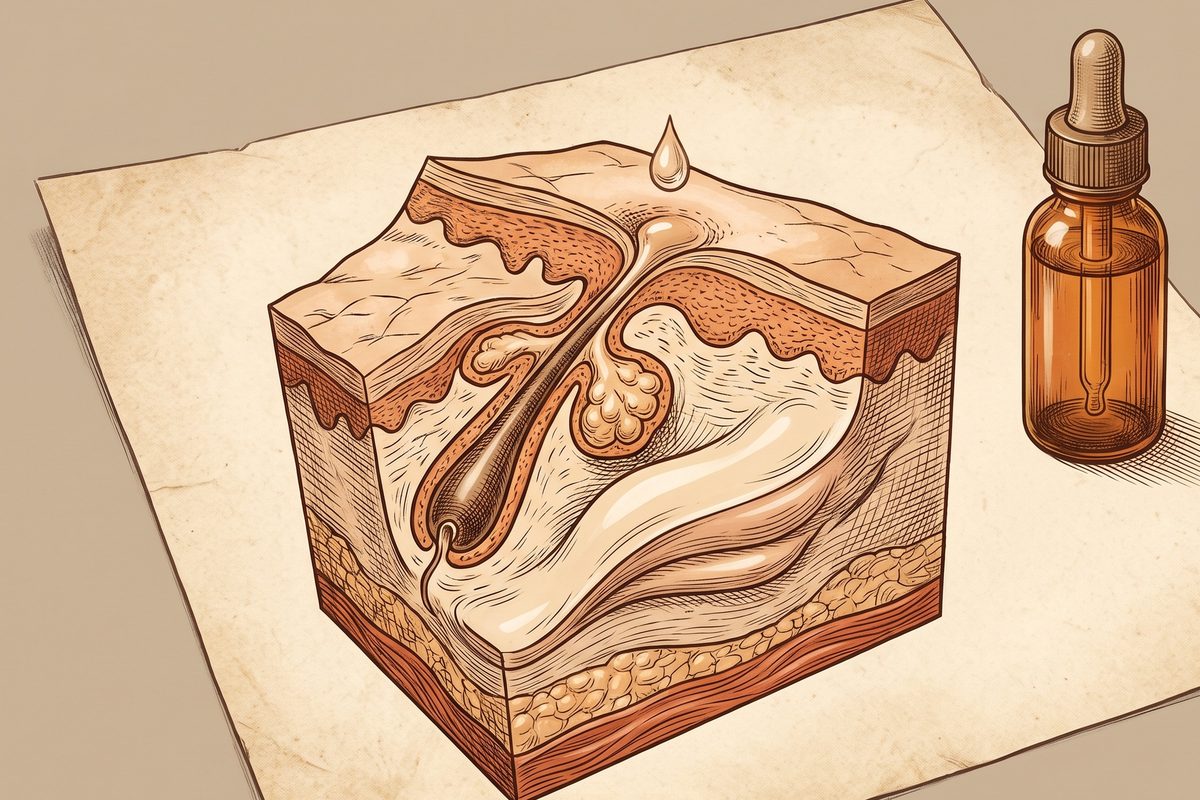
What does skin purging mean?
Purging is not a diagnosis. It is the word patients and social media use for a breakout that follows a new product, a stronger active or a facial, with the hope that it is the skin clearing itself and will pass. Sometimes that is right. Often it is not, and the word makes it hard to tell.
It also has thin evidence behind it. A search of PubMed in October 2026 for purging together with acne or retinoids found no acne paper that uses the term. What the literature does document is narrower and more useful: topical retinoids produce irritation within the first few weeks, and acne treatment takes time to work. The rest of this article works from those two facts.
When can a breakout after a new product be a temporary flare?
The most believable case is a retinoid. Retinoids are vitamin A medicines used for acne, and the American Academy of Dermatology lists the ones used for acne, from adapalene, which is sold without a prescription in some countries, to prescription retinoids. They change how the lining of the pore behaves, and the popular explanation is that spots already forming under the surface come up faster. That explanation is repeated widely but has not been tested in the sources cited here, so treat it as a plausible story rather than a proven mechanism.
What the sources do support is the shape of a flare that is still part of the treatment. A 2015 review of 34 studies found that topical retinoids cause varying irritation in the first few weeks, and that most reactions were mild to moderate. The American Academy of Dermatology lists worsening acne, with dryness, peeling and burning, among the possible side effects of combination acne medicines. The clues that fit a temporary flare are the place and the look. The spots are where you already break out, they look like your usual spots, and the skin is not burning, blistering or swelling.
The timing matters as well. The American Academy of Dermatology says it takes at least 6 to 8 weeks before you start to see fewer breakouts, and DermNet NZ says improvement with a topical retinoid may take 12 weeks or longer. A flare in the early weeks sits inside that window. One that keeps getting worse past it is not behaving as the sources describe, and that is my reading, not a published cut-off.
How is it different from irritation or an allergy?
Irritation is a barrier problem. DermNet NZ describes irritant contact dermatitis as inflammation from agents that damage the skin barrier, usually confined to where the product touched, with burning and pain more common than itch. Retinoid dermatitis (redness, peeling and dry skin) is the version DermNet lists for retinoids, and it is more likely with stronger retinoids: DermNet puts adapalene as the least irritating and tretinoin as the most. Irritation is not a breakout, though a sore, flaky face can have pimples on top of it.
An allergy is a different mechanism. Allergic contact dermatitis is a delayed reaction that typically appears 24 to 72 hours after contact, is itchy, can spread past the area of contact and settles over several days once the product is stopped. DermNet lists allergy to topical retinoids as rare, and the American Academy of Dermatology says irritation from a retinoid does not typically mean an allergy. Irritation and allergy can look alike on a red, scaly cheek, which is a reason to have the skin examined and not guess. A patch test is how a doctor settles it.
A simple sorting question helps. Burning or stinging and a tight, shiny, peeling face point to irritation. Itch, spread and a rash that began a day or two after first use point to allergy. Spots in your usual places, looking like your usual spots, fit a flare. These are pointers, not a diagnosis.
Could the product itself be causing the acne?
Yes, and this one is called acne cosmetica. The American Academy of Dermatology says it can take anywhere from a few days to 6 months to appear, which is why the new moisturiser is rarely blamed. It tends to clear once you stop using what is causing it. A 2013 case-control study of 910 patients and 910 controls found that overall cosmetic use was not linked to more acne, but some individual products were, so the problem lies with particular products, not with skincare in general.
A facial can bring a different, slower pattern. In one 1999 study of 37 people, everyone traced their spots to a facial beauty treatment taken 3 to 8 weeks earlier. The spots were mostly deep nodules on the cheeks, slow to heal and leaving dark marks behind. The authors described it as inflammatory and unlike classic acne cosmetica. That is not purging by any definition. What should happen before any facial sets out why acne is assessed before it is treated with one.
If a new product is the suspect, the American Academy of Dermatology advises looking for oil-free, non-comedogenic or "won't clog pores" on the label, and the same body warns that switching to a new acne product every few days can itself irritate the skin and cause new breakouts.
Could it be fungal acne?
Sometimes what looks like acne is not. Malassezia folliculitis is an infection of the hair follicle by a yeast that normally lives on the skin. DermNet NZ describes small, uniform, itchy bumps and pustules, most often on the upper back and chest and sometimes on the forehead, chin and neck. It is monomorphic, which means the spots all look alike, and there are no blackheads or whiteheads. DermNet lists a hot, humid climate, high sebum, sweating, occlusion from emollients and sunscreens, and antibiotic use as risk factors, and hot, humid weather is the everyday climate here.
The reason it matters is that it is easily mistaken. A 2025 review calls it an underdiagnosed mimicker of acne that often leads to inappropriate antibiotic use, and an earlier review found it can persist for years without resolution on typical acne medicines. It needs antifungal treatment, and recurrence is common. A breakout that is itchy, uniform and ignores everything you try should be looked at for this, which a doctor can often settle by examining the skin and, if needed, a scraping.
When should you stop, and when should you see a doctor?
Stop a new product and see a doctor, without waiting out the weeks, if the skin burns or stings badly, blisters, swells, weeps, or the rash spreads beyond where the product went. The same goes for swelling around the eyes or lips, or for a reaction that appeared within a day or two and itches. These are not features of a flare.
See a doctor, too, if a flare is still worsening at around 6 to 8 weeks, if the spots are deep, painful nodules, if dark marks are following them, or if the pattern is uniform and itchy. The American Academy of Dermatology notes that retinoid irritation can often be reduced by using a smaller amount, using it less often or applying moisturiser first, but only with a dermatologist's help. In Malaysia a doctor can also tell you which retinoids are over the counter and which need a prescription, as covered in what Malaysian law lets you buy.
For the background to acne in general, acne treatment in Setia Alam covers the types and triggers, and adult acne and what a doctor checks first covers the adult pattern.
The honest complication
The word purging offers comfort at the moment skin most needs examining. If the breakout is a flare, waiting is reasonable. If it is irritation, more of the same product deepens the damage. If it is an allergy or a fungal folliculitis, waiting only delays the right answer. No photograph or label decides this, and the evidence for the lay idea of purging is thin.
Seeing a doctor about it
A doctor looks at where the spots are, how they look, how long they have lasted and what went on the skin, then decides whether it is a flare to ride out, a reaction to treat or a different condition altogether. What a first consultation decides sets out how that assessment goes.
Waiting is sometimes right. Guessing is rarely.