
What happened when a patient came in with dark lips?
A patient came in with new darkening of the face and lips. He had been injecting PT-141 for ten days. He stopped, and he is now on a slow path of reducing the darkness.
I had never heard of the drug. That is a fair thing for a skin doctor to admit, because PT-141 is not a skin drug and not one I use. It is a libido injection, and the people who read about it are rarely reading with a dermatologist's eyes. This article is what I read afterwards, so that the next person who searches "does PT-141 darken skin" finds the answer before the injection and not after.
The Retreat Clinic does not offer, prescribe or treat with PT-141 or any peptide, and does not treat sexual dysfunction. This page is education only.
What is PT-141 and what is it used for?
PT-141 is the research name for bremelanotide, a synthetic peptide that switches on melanocortin receptors. Vyleesi is the licensed brand. In the United States it is approved as a 1.75 mg injection under the skin of the abdomen or thigh, given at least 45 minutes before sex, for premenopausal women with acquired, generalised hypoactive sexual desire disorder. The label allows no more than one dose in 24 hours and says more than eight doses a month is not recommended.
The same label says it is not indicated in postmenopausal women or in men, and not to enhance sexual performance. Everything outside that, including a daily course, a libido injection for a man and any PT-141 nasal spray, sits outside what the label describes.
Does PT-141 darken your skin?
Yes, it can. Section 5.2 of the US label is headed "Focal Hyperpigmentation", and it reports involvement of the face, the gums and the breasts. It also says patients with dark skin were more likely to develop it. The advice is to consider stopping the drug if hyperpigmentation develops.
The label does not name the lips. I will not stretch it to cover them, and I make no claim about any single patient's cause beyond what the label and the mechanism below allow. What the label does establish is that face darkening and gum darkening are a recognised effect of the drug, written into its own prescribing information.
Why does a libido drug change your pigment?
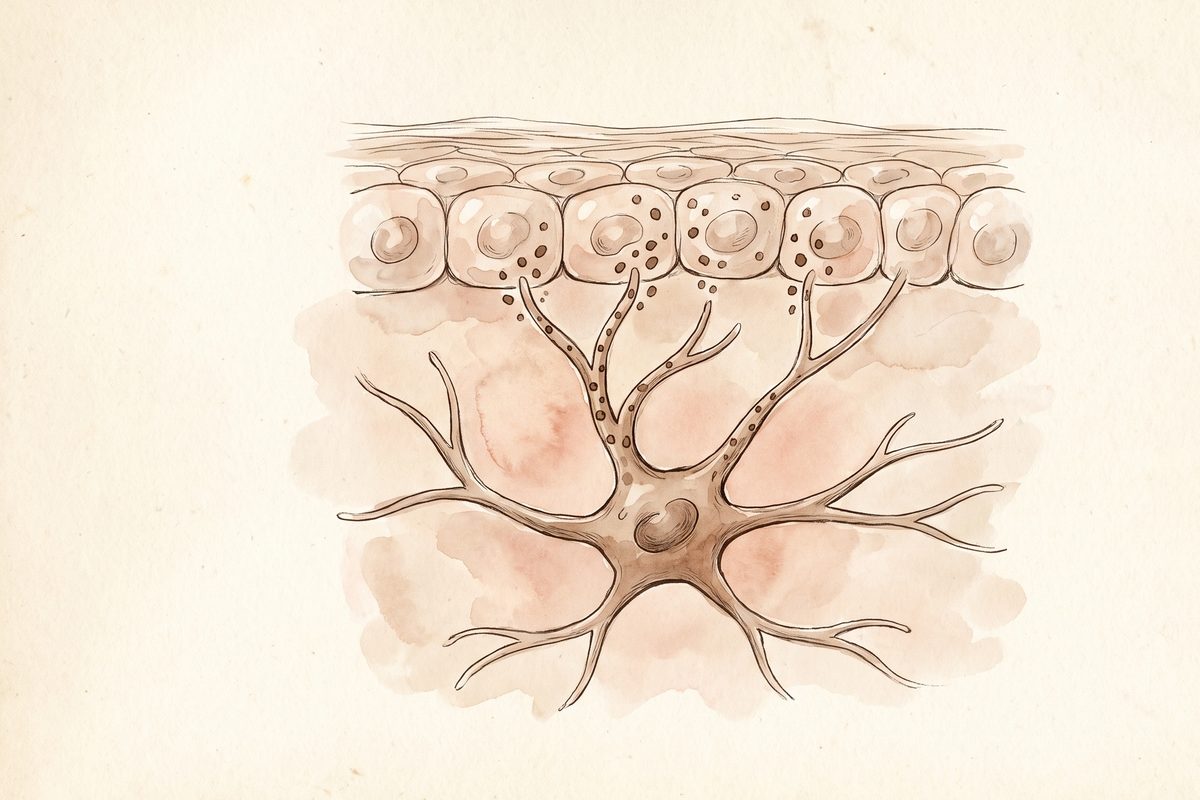
Bremelanotide does not act on one receptor. The label describes it as a melanocortin receptor agonist that activates several subtypes, and gives the order of potency as MC1R, MC4R, MC3R, MC5R, MC2R. At the doses used, the label says binding to MC1R and MC4R matters most. Nerve cells carrying MC4R sit in many parts of the brain. MC1R sits on melanocytes, the cells at the base of the epidermis that make melanin and pass it up into the skin cells above. The label states it directly: binding at MC1R leads to melanin expression and increased pigmentation.
So the pigment is the drug working, and it is not an allergy. The label also says the mechanism by which Vyleesi improves desire in women is unknown, which is worth knowing before anyone assumes the brain effect can be had without the skin effect.
The history explains why both effects arrive together. A 2026 review describes Melanotan II as originally developed as a tanning agent, with increased libido and spontaneous erections in men seen as side effects, and says this led to bremelanotide. An earlier review describes a small crossover study in men in which Melanotan II produced erections. A tanning drug became a sexual-desire drug, and its receptor family still includes the pigment one.
How common is hyperpigmentation on PT-141?
The label gives three figures, and the gap between them is the lesson. In the phase 3 placebo-controlled trials, focal hyperpigmentation was reported in 1% of patients who received up to 8 doses a month, and in none of the placebo group. In another clinical study, 38% of patients developed it after daily dosing for 8 days. Among those who continued for 8 more consecutive days, a further 14% developed new focal pigmentary changes.
Frequency and dose matter, then, and so does skin colour: the label says patients with dark skin were more likely to be affected. Many Malaysian patients fall in the group that line is about. The trials behind these numbers were in women, and I did not find an equivalent figure for men.
PT-141 side effects beyond the skin
The pigment is one of several effects on the label. In the pooled phase 3 trials, nausea occurred in 40% of treated patients against 1.3% on placebo, flushing in 20.3%, headache in 11.3% and vomiting in 4.8%. The drug transiently raises blood pressure after each dose, by up to about 6 mmHg systolic and 3 mmHg diastolic, usually settling within 12 hours, and it is contraindicated in uncontrolled hypertension or known cardiovascular disease. Its half-life is about 2.7 hours. It can also lower the exposure to oral naltrexone, so the label says to avoid using the two together.
These are figures for the licensed injection, taken under the label's conditions. A vial bought online has no label to check against.
PT-141 for men: what happened to the erection drug?
This is the question most men searching for a libido injection are asking. Early work on Melanotan II in men with erectile dysfunction showed erections, and intranasal PT-141 was then studied in men in phase 1 and phase 2A studies, where flushing and nausea were the most common adverse events. Today the licensed product is the women's injection, and its label says it is not indicated in men.
The men's programme stalled in 2007. On 30 August that year the two companies developing it announced that the FDA had questioned the overall efficacy and clinical benefit of the intranasal product and had named blood pressure increases as its greatest safety concern, and that plans for phase 3 trials were delayed. The product that reached the market years later was the women's injection. The practical point is narrower. A man who injects PT-141 is using a drug outside its label, and the one thing the label is clear about is what the drug can do to pigment.
PT-141 for women, and where the nasal spray fits
PT-141 for women is the licensed use, in the form described above: an injection, at a fixed dose, with a monthly limit. The nasal route appears in the research literature, mainly from the men's studies. A nasal spray sold online is not the licensed injection, and nobody can tell you from the bottle what dose reaches you or what else is in it.
A 2026 review in Cureus describes the wider pattern: online biohacking and wellness spaces promoting experimental peptides, bought on the grey market and self-injected, with uncertain identity, purity, potency and sterility, outside any clinical supervision. The same worry is raised in the melanotan literature, where a 2010 review in the British Journal of Dermatology describes unregulated products bought over the internet, the risk of blood-borne infection from shared needles, and the potential impurity of the product.
Is PT-141 legal or approved in Malaysia?
As of 8 October 2026, no product containing bremelanotide is registered with the Drug Control Authority: a search of the NPRA QUEST3+ register by active ingredient and by product name, for bremelanotide, Vyleesi, melanotan and afamelanotide, returned nothing, while a control search for sildenafil returned registered products. Any PT-141 sold in Malaysia, by injection or nasal spray, is therefore an unregistered product.
In Malaysia a medicine must be registered with the Drug Control Authority before it is sold. A product bought from an overseas website or a social media seller has not been through that check, which means no one in the country has verified what is in the vial.
Melanotan II and the moles
Melanotan II deserves its own warning, because its effects reach past the face. A 2009 case report in Archives of Dermatology describes crops of new pigmented moles, some atypical, and darkening of the existing ones after self-administered Melanotan II. They lightened after it was stopped, and the authors raised the possibility of a higher melanoma risk in predisposed people. A 2012 case report describes tanning and darkened moles within three weeks of starting Melanotan 2 in a young patient with a family mole syndrome, and one enlarging lesion that proved to be a dysplastic naevus, a mole with abnormal cells, and not a melanoma. The moles became paler within three months of stopping.
The licensed relative, afamelanotide (sold as Scenesse), is approved to increase pain-free light exposure in people with erythropoietic protoporphyria. Its label warns of generalised increased pigmentation and darkening of existing moles and advises a full body skin examination twice a year.
I found no equivalent mole data for PT-141, and the Vyleesi label does not discuss moles. The sensible reading is that a drug on the same receptor family earns the same habit: someone who has used one should have their moles looked at, and a mole is examined before any laser goes near it.
Does the darkening fade after stopping PT-141?
The honest answer is that it sometimes does and that nobody can promise it. The label says resolution of the focal hyperpigmentation was not confirmed in all patients after discontinuation, and it gives no timeline. The melanotan case reports above recorded lightening within weeks to months after stopping, but those are single cases of a different drug.
Sun and heat drive pigment in general, so protection matters while the skin settles. Why pigmentation comes back, and the Malaysian heat trigger explains that part. In practice the path is slow, and a slow path is the one my patient is on.
What a skin doctor checks when the darkening is from a drug
The first tool is the history, taken further back than most patients expect: every injection, supplement, nasal spray, peptide and cream in the last three months, with dates and doses, and the vial or packaging if it still exists. Patients often leave out what they bought privately, so the question is asked plainly and without judgement.
The second is the examination. Where does the pigment sit, in the epidermis or deeper? A Wood's lamp or a dermatoscope helps where it is useful. The doctor also asks whether this is the drug at all, since melasma, sun damage and the marks left after inflammation can look alike, and melasma, sun spots and Hori's naevus and post-inflammatory marks in Malaysian skin are different problems with different answers. Moles are looked at in the same visit.
How is drug-induced hyperpigmentation treated?
The rule for hyperpigmentation treatment when a drug is the cause is that the drug stops first and the skin is given time. Whoever prescribes or supplies the drug should be told, and where no one prescribed it, the decision to stop is still the first step.
After that comes daily sunscreen and sun avoidance, which protects the pigment from being driven darker. Topical lightening agents, chosen by class under supervision and for a defined period, can follow. A pigment laser comes last, if at all, and only once the cause has stopped. In darker skin a laser can leave its own pigment behind, which pigment laser side effects on Asian skin sets out, and a laser is never used on a mole that has not been examined. How the clinic approaches pigmentation starts from the diagnosis for the same reason.
In the case that prompted this article, I told the patient what the evidence shows: there is a chance it may not reduce, and we will try. I started him on a brightening serum built from tranexamic acid, niacinamide and hyaluronic acid, with hydroquinone to be added later if it is needed, once his skin has been primed. That is the order a skin doctor keeps: the cause stopped, the skin protected, the gentler agents first, the stronger prescription agent only when the skin is ready for it.
Some darkening clears slowly, some does not clear completely, and the aim is to say so at the start.
The short version
PT-141 is a melanocortin drug, and pigment cells carry a melanocortin receptor. Darkening of the face and gums is in the label of the licensed injection, more likely in darker skin, and it was not confirmed to resolve in every patient. Know what a drug does to your skin before you inject it, and bring the whole history to the doctor if the skin changes.
A dose is over in hours. The pigment it called up can stay much longer.