
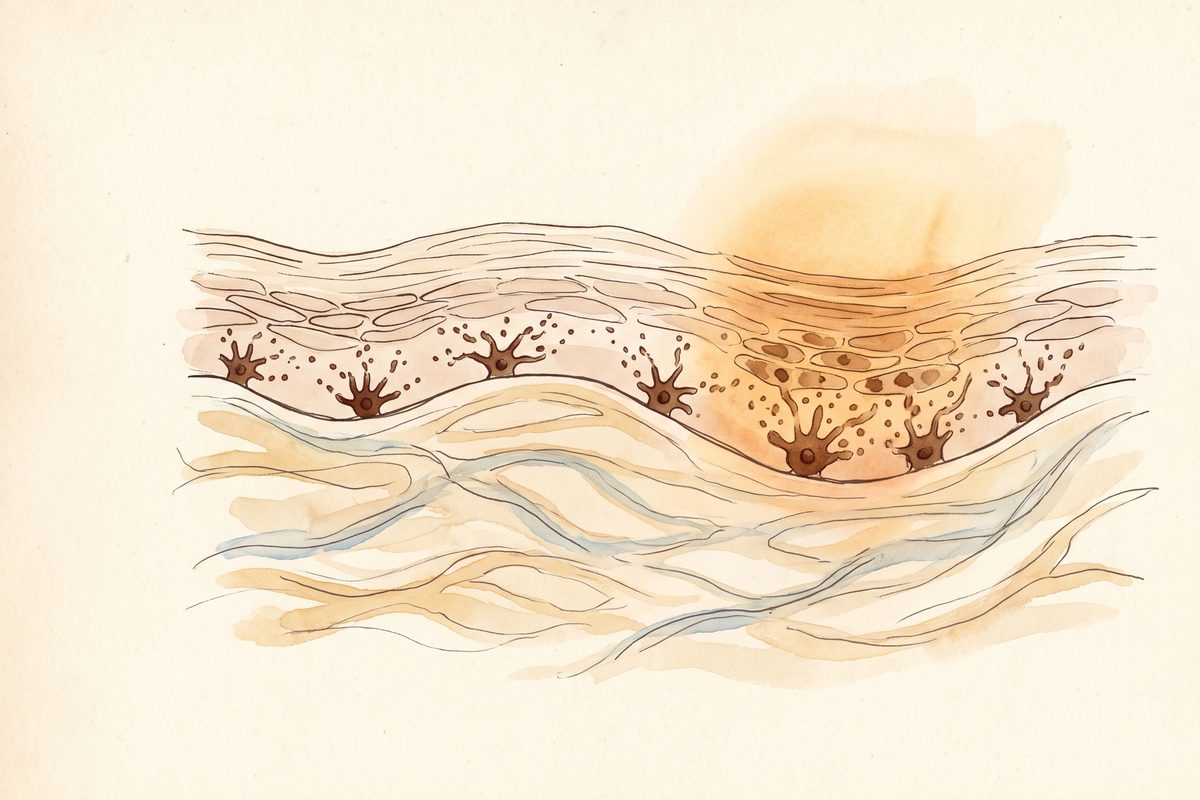
Why can a pigment laser make Asian skin darker?
A pigment laser sends energy into a target that absorbs it. In skin with more melanin, the melanin in the surface layer competes for that energy. The 2026 JAAD review says increased epidermal melanin, acting as a competing chromophore in Fitzpatrick types IV to VI, raises the risk of post-inflammatory hyperpigmentation, hypopigmentation, blisters and scarring. The skin then answers heat and injury the way it answers a spot of acne, by making more melanin. The mechanism is set out in why dark marks linger longer in richly pigmented skin and is not repeated here.
That is why a dark patch after laser can be a reaction to the treatment and not a return of the original pigment. The reasons the original pigment returns are different, and covered in why pigmentation comes back.
One caveat on the evidence. The JAAD review defines skin of colour as Fitzpatrick types IV to VI, while most Malaysian skin falls across types III to V, so the findings fit closely and not exactly. The scale is itself a rough guide, as the article on the Fitzpatrick scale explains, and the studies cited here mostly involve Chinese patients.
How common is darker pigment after laser?
No dependable rate exists for picosecond lasers in Malaysian skin. What exists is indirect. A 2007 study in Lasers in Surgery and Medicine followed 37 Chinese patients through 119 sessions of fractional resurfacing, a resurfacing device and not a pigment laser. Generalised hyperpigmentation was reported in 7.1 per cent of the higher-energy, lower-density group and 12.4 per cent of the lower-energy, higher-density group, a difference that was not statistically significant. A 2025 meta-analysis in Lasers in Medical Science, covering 21 studies of picosecond and nanosecond lasers, found hyper- and hypopigmentation much more obvious in Asian than European patients, and significantly less with picosecond lasers than nanosecond.
Read those as direction and not as odds. They come from small samples, different devices and different settings, and the JAAD review itself flags the lack of large prospective trials in darker skin and of standard parameters. What reduces it: in the 2007 study both energy and density shaped the risk, and localised marks around the mouth appeared where no air cooling was used. How long a mark lasts varies, and can be long: the acne-marks article gives the reported durations for the same mechanism.
If it happens, the usual response is the one described there for the same mechanism: settle the inflammation, protect the skin from the sun every day, and use a topical depigmenting regimen, which works over months. Treating the darkened patch with more energy, at the wrong time, risks feeding the same reaction.
Can laser leave pale or confetti-like spots?
Yes. Hypopigmentation is a loss of pigment, and it can appear as small pale patches in a mottled or confetti pattern. A series in the Journal of Clinical and Aesthetic Dermatology treated 23 Chinese patients three times a week for two months, and all 23 developed bilateral confetti-like hypopigmentation. Of 13 followed for four months, none had repigmented. A separate series of 14 Chinese women with mottled depigmentation, published in Lasers in Surgery and Medicine, had received 6 to 50 low-fluence Q-switched treatments, and the authors note it can appear after only a few sessions. Five were treated with narrowband UVB with good results.
Both are selected series at closely spaced schedules, so they show that the risk exists and give no rate for an ordinary spaced course. The papers describe an association and do not settle the mechanism. What reduces it is spacing treatments and not repeating them at short intervals. Recovery is measured in months: none of the 13 followed for four months in the first series had repigmented, so a new pale spot is a reason for review and not for another session. The 2025 meta-analysis found hypopigmentation less frequent with picosecond than nanosecond lasers.
Can laser make melasma worse?
It can. The European Society of Laser in Dermatology position statement says lasers can worsen some conditions and must be considered with great caution for melasma and post-inflammatory hyperpigmentation, with the disorder recognised first and parameters chosen for the skin phototype and pigment depth. A 2026 systematic review in Cureus of 52 melasma studies found picosecond lasers did not significantly outperform control groups, recurrence was high, and certainty was very low. Transient erythema and localised burning were common, and no serious adverse events were reported. The full sequence of photoprotection, topicals and conservative energy is in can laser make melasma worse.
Can a pigment laser blister or burn Asian skin?
It can, and it is uncommon. The same JAAD review lists blisters and scarring among the risks in skin of colour and says ablative modalities carry higher complication rates than non-ablative ones. No reliable rate exists for a pigment laser. A single 2025 case report describes second-degree burns after intense pulsed light in a man with Fitzpatrick type IV skin, with erythema, blisters and desquamation, healing over four months with minimal residual hyperpigmentation. It shows the risk is real and cannot say how often it happens.
Conservative energy and sequential lower-energy treatments are what the review lists to reduce it, and the 2007 study adds cooling. Treatment near the eyelid needs its own protection, covered in eye protection during laser treatment. Blistering that is not settling needs to be seen.
Why do a test patch, settings and sun care matter?
They are how the risks above are lowered. A test spot checks how the skin reacts before a full treatment. A 2025 survey in Archives of Dermatological Research found 96.9 per cent of 66 dermatologists cite darker skin as a reason to do one, and the authors call for standardised protocols. It is a common practice, and it is not proof of safety. On settings, the JAAD review points to conservative energy and lower-energy sequential treatment, and the live article on the Fitzpatrick scale explains why no number belongs in an article. On sun care, the same review says strict photoprotection is part of the plan, and heat is a trigger too, as covered in the article on why pigment returns.
The right laser for the right diagnosis matters first. The position statement is plain that precise recognition of the disorder is mandatory. The picosecond laser PicoSure is one tool, and how Pico actually works covers where it fits. See pigmentation for how different pigment problems are assessed.
When should you call, and what should you ask before you book?
Call the clinic that treated you for blisters or crusting that are not settling, pain that is building, a patch that is getting darker and not easing, new pale spots, or spreading redness, and see the redness after a treatment article for the ordinary healing pattern. Pain, blur or light sensitivity in the eye needs an eye doctor the same day. Before booking, ask what the pigment is diagnosed as, what device and why, whether a test spot is done, how many sessions and how far apart, and what sun care is expected.