
What is Ozempic face, and is it a diagnosis?
Ozempic face is a nickname, not a diagnosis. No medical body defines it, and it is used loosely for a face that looks thinner, more hollow or more lined after weight loss. "Mounjaro face" is the same idea under a different brand name.
Both nicknames sit on medicines that are prescription-only in Malaysia: semaglutide, sold as Ozempic and Wegovy, and tirzepatide, sold as Mounjaro. Because the label has no definition, I prefer to describe what has actually been measured.
What has been measured about the face after weight loss?
The clearest numbers come from a survey. A 2026 paper in Dermatology and Therapy asked 1,226 people in a virtual treatment programme about their skin, hair and nails. Among the 325 who had lost more than 20 percent of their body weight, 72 percent reported sagging skin and 50 percent reported reduced facial volume. Among 395 who lost 10 to 20 percent, the figures were 44 and 37 percent. Among 380 who lost less than 10 percent, they were 15 and 13 percent.
The message is a gradient: more weight lost, more reports of change. The survey was voluntary and self-reported, so it shows how people felt, not measured volume on scans. It also cannot say whether the medicine itself, or simply the amount lost, drives the difference.
A 2026 review of 40 studies in Aesthetic Plastic Surgery describes facial volume loss, thinner dermis and reduced elasticity, and lists older age, a long history of obesity, rapid loss, poor hydration and low protein intake as risk factors for a worse result. The authors say the mechanisms still need study.
Why does the face change when weight comes off?
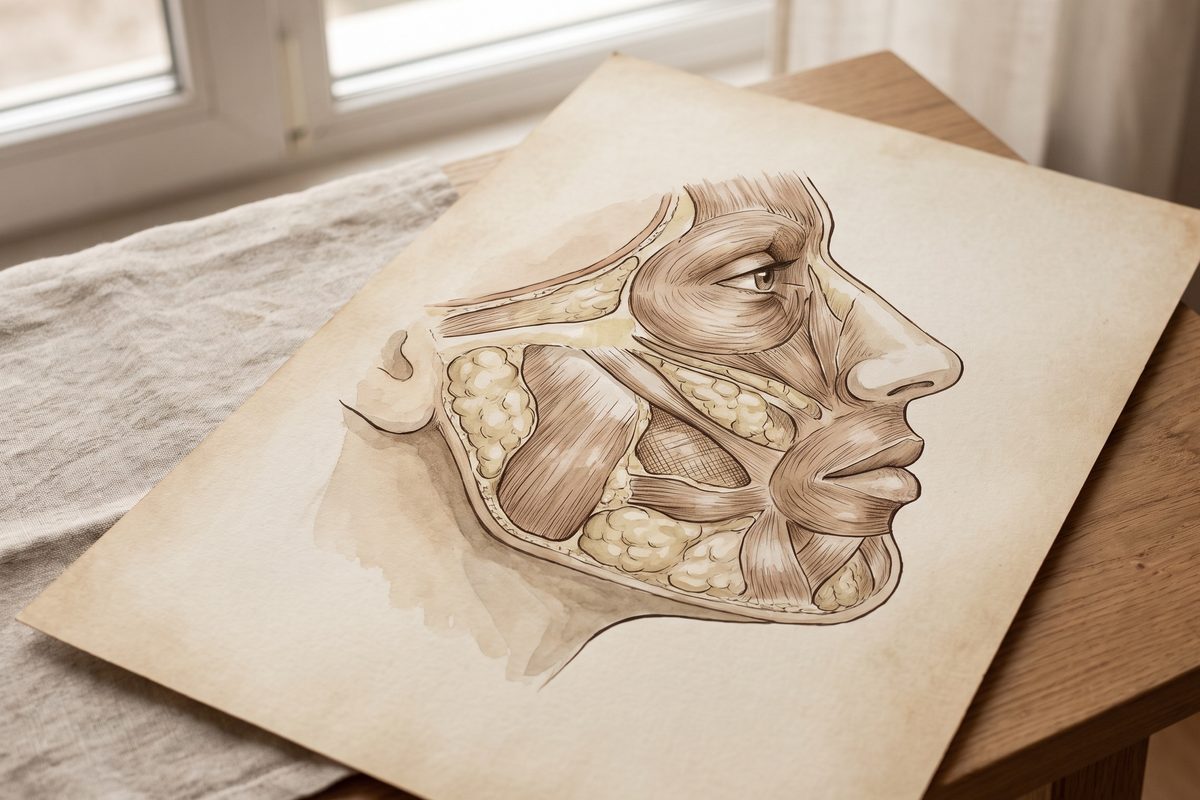
The face holds fat in separate pockets, and those pockets shrink as weight falls, so the skin over them has less to sit on. Skin that has stretched for years may not tighten fully. The cheeks, temples and area under the eyes are where many people notice it first, which is covered in hollow eyes after fast weight loss.
This is not a special effect of one medicine. Anyone who loses weight quickly can see it, as the American Academy of Dermatology notes. Whether GLP-1 medicines add anything beyond the weight lost is not settled, and I would not say the medicine ages the face. The honest position is that the papers describe an association with the amount lost, and mechanisms are still being studied.
The body has the same question below the neck, where skin that has lost its support is discussed in loose skin after weight loss.
What helps, and what can each option not do?
Several options exist, and none is required. The order below is not a ranking.
Pace and nutrition. The review lists gradual loss, enough protein and hydration as measures, and the prescribing doctor sets the pace. Unlike the others, it acts before the change happens.
Volume replacement. Fillers add volume where it has been lost. A filler replaces volume, and it does not tighten skin. Results last for a limited time and depend on the material, the place and the person.
Collagen-stimulating injections. Biostimulators are particles that ask the skin to build collagen over months. They act slowly and cannot be undone with an enzyme the way hyaluronic acid filler can, as the article on biostimulator types explains.
Energy devices. Ultrasound and radiofrequency devices heat the skin to remodel collagen. They can improve early or mild laxity, and they cannot remove skin. How far they help when laxity is advanced is the subject of severe laxity: what improvement means.
Surgery. A surgeon is the right person when skin excess is large. For most people this is the last step, not the first.
A 2025 commentary lists these same categories and says openly that data on timing and combinations is thin. Nothing here reverses the change, and results vary.
When is it worth asking a doctor?
It is worth asking when you are bothered by the change, when the loss is still continuing, or when you are unsure whether something else is going on. A doctor can separate volume loss from skin laxity, since they are treated differently, and can check that the pace of weight loss and protein intake are sensible.
If you want to talk it through, The Retreat Clinic in Setia Alam can assess the face and explain the options, and none of them is needed. Some people are content with their face once weight settles, and that is a reasonable place to stop.
The name is only a nickname. The useful question is which of the changes, if any, bother you, and what each option can honestly do.