Is Botox the medicine, or a brand?
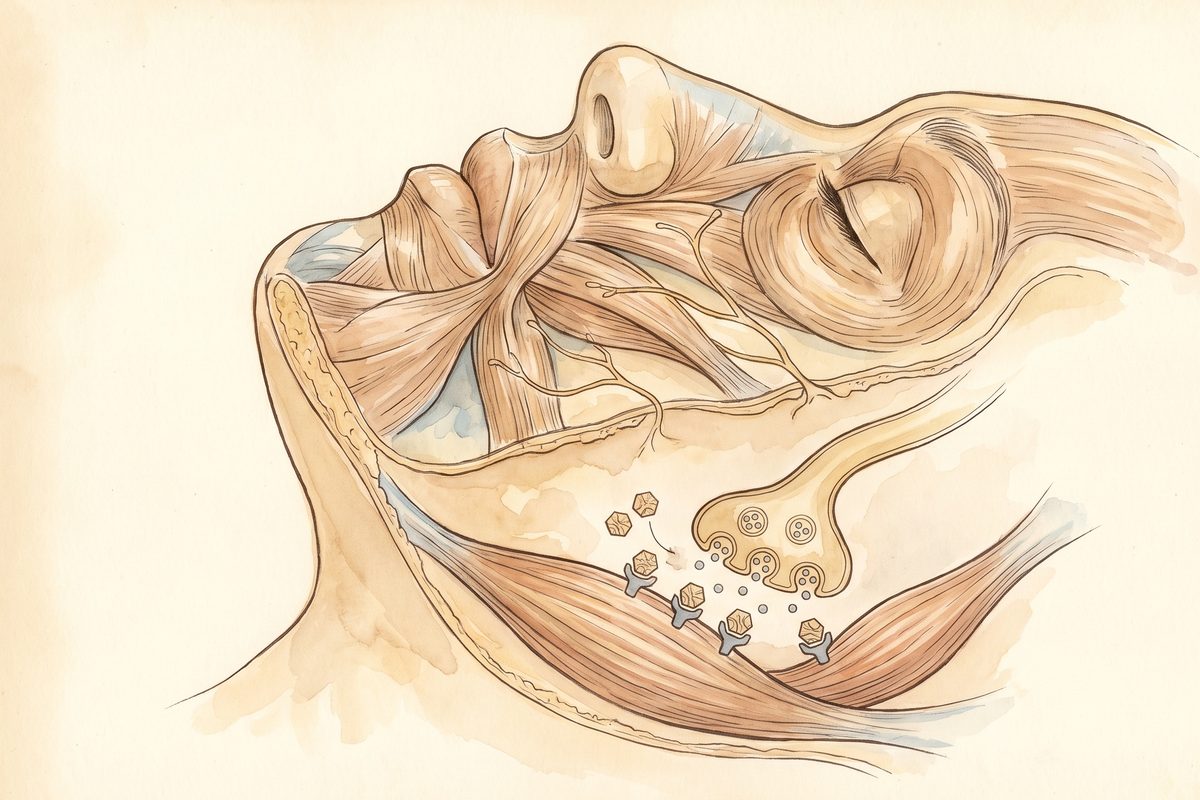
Botox is a brand, a trademark of Allergan, an AbbVie company. The medicine is botulinum toxin type A, a protein made by the bacterium Clostridium botulinum that blocks the release of acetylcholine, the chemical signal a nerve uses to tell a muscle to contract. The World Health Organization counts seven types of botulinum toxin, A to G, and every product in this article is type A. Many people say Botox for the whole treatment, whichever product is in the syringe. What the treatment does and does not do is set out in botulinum toxin, explained without the myths.
What is the same, and what differs?
All are type A toxin, and it works the same way at the nerve ending. A 2022 review in Facial Plastic Surgery adds that each licensed type A toxin has its own characteristics, some of them of clinical relevance. Four things differ.
The maker. On the register, Botox is made by Allergan in Ireland, Xeomin by Merz in Germany, Dysport by Ipsen in Wrexham, and Nabota, Neuronox and Letybo by Daewoong, Medytox and Hugel in South Korea. "Korean Botox" is a phrase for a toxin made in South Korea: three of the six registered toxins are Korean-made.
The protein package. Botox's Malaysian package insert describes a complex of about 900 kilodaltons, the neurotoxin with accessory proteins. Dysport's insert names a toxin-haemagglutinin complex, and the NPRA's evaluation summaries put Nabota and Letybo at about 900 kilodaltons too. Xeomin's insert describes the 150 kilodalton neurotoxin alone, free from complexing proteins, and says the foreign protein content is considered one of the factors in secondary treatment failure. Whether that changes what a patient sees is not settled in the sources I read. A 2012 review says complexing proteins may act as adjuvants and that antibodies do not always make a patient stop responding, and the US labels of Botox Cosmetic, Xeomin and Dysport each warn that comparing antibody rates between studies or products can mislead.
The other ingredients. All six Malaysian package inserts list human albumin. Xeomin adds sucrose, Dysport adds lactose, and the other four add sodium chloride.
The units. Each maker measures potency in its own units, and each of the six inserts says its units are specific to that product and not interchangeable with another brand's. For frown lines the inserts give a standard total of 20 units for Botox, Xeomin, Nabota and Letybo (whose NPRA evaluation summary is titled Botulax) and 50 units for Dysport. Each number is counted on that maker's own scale, so one product's unit is not equivalent to another's.
Do the differences change the result?
The comparisons I read found similar peak results in frown lines. In a randomised trial of 381 people, response rates at four weeks were 96.4% for Xeomin and 95.7% for Botox, judged from photographs by independent raters, and Xeomin was found non-inferior, meaning not worse by more than a margin set in advance. The NPRA's evaluation summaries for Nabota and for Letybo (Botulax) each rest on trials against Botox with the same non-inferiority design. A 2025 randomised trial at the University of Pennsylvania compared four type A toxins in 143 women and found the peak effect similar across all four, with differences in how fast the effect began and how much of it remained at six months that applied to some pairs and not to others.
These are averages from trial groups at fixed doses. They do not say which product suits one face. The choices left are the doctor's: which muscles, how much and where. How long the effect lasts is covered in how long anti-wrinkle injections last, and the side effects of the class are set out in anti-wrinkle injection side effects.
Which toxins are registered in Malaysia?
On 30 September 2026, a search of the NPRA's Quest3+ register by active ingredient listed these botulinum toxin type A products:
- Botox (Allergan, Ireland): MAL19970915ARZ
- Xeomin (Merz, Germany): MAL16015033AZ (50 units) and MAL16015034AZ (100 units)
- Dysport (Ipsen, Wrexham): MAL20000731AZ
- Nabota (Daewoong, South Korea): MAL23086028AZ
- Neuronox (Medytox, South Korea): MAL20046092AZ, MAL20046093AZ and MAL20046094AZ (50, 100 and 200 units)
- Letybo (Hugel, South Korea): MAL24126017AZ
A search by the name Botulax returned nothing. The NPRA's December 2024 evaluation summary for MAL24126017AZ is titled Botulax, and the register now lists the same number as Letybo. If a box says Botulax, check its number against the register. A toxin sold under a name that is not on this list, including other Korean brands, should be checked the same way before anyone injects it.
The Ministry of Health describes a registered product as assured for safety, quality and efficacy. Registration concerns the product. It does not describe the person injecting it, how the vial was stored, or whether it suits you, and the registered uses are written in each package insert and are not identical.
How do I check a box, and what about fakes?
A registered medicine carries a MAL number and a hologram label. The Ministry of Health advises searching the number on the NPRA product search or in the NPRA Product Status app, and having a pharmacist check the hologram. Compare the entry with the box: the product name, strength and maker should match. Each entry on the register also carries the package insert and labels filed for it.
Check the number as well as the name. The clusters of botulism after cosmetic injections in England in 2025 and the United States in 2024 involved unlicensed or counterfeit product, and the article on fake anti-wrinkle injections sets out what happened and the warning signs. The person matters as much as the product, and checking a doctor's MMC number and LCP takes a few minutes.
The brand is easy to check. The dose and where it goes are decided at the examination.