
What are the most common side effects of anti-wrinkle injections?
Most are local. They come from the needle, or from the toxin acting at the place it was put. A 2009 pooled analysis of individual data from 1,678 people in nine registration studies of one botulinum toxin product, published in the Journal of the American Academy of Dermatology, found that overall adverse events did not differ significantly between toxin and placebo, and that no serious adverse event was treatment related. Treatment-related events, as judged by the investigator, were more frequent on the toxin (24 per cent against 16 per cent), and the authors attributed most to the physical injection or to the local effect of the toxin.
Read the limits with it: about half the participants were Asian, most were women, follow-up was one year, and the doses were the trial doses. The pages on anti-wrinkle injections and how they work cover the treatment itself.
How common is bruising, and how long does it last?
A bruise is blood that has leaked from a small vessel the needle passed through. It comes from the needle, so the toxin itself plays no part. A 2017 systematic review and meta-analysis of 16 randomised placebo-controlled trials, in Aesthetic Plastic Surgery, found injection-site haematoma more frequent than on placebo around the eyes (relative risk 2.14). That is a comparison, and it gives no usable percentage for your own chance. No dependable single rate exists.
A 2007 review in Seminars in Cutaneous Medicine and Surgery describes these transient effects as minor and spontaneously remitting, and a 2026 review in American Family Physician says minor bruising and swelling can occur. Neither gives a number of days, so none is stated here. A bruise that keeps spreading, or swelling that is tense and painful, is worth a call.
Do anti-wrinkle injections cause headaches?
They can. A 2026 prospective study of 102 adults reported headache in 13 (12.7 per cent), generally mild to moderate and short-lived, and more frequent in first-time recipients (45.5 per cent against 8.8 per cent of previously treated people). All of the headaches followed upper-face injections. A 2022 retrospective study of 186 patients found 10.2 per cent, with 17 of 19 starting within 24 hours and 16 of 19 settling within three days. The pooled frown-line trials point the same way, with headache more frequent on toxin than placebo (relative risk 1.53).
These are small studies from single centres, and they describe the pattern without explaining it. Why it happens is not established, so this article offers no mechanism. A headache that is severe, keeps building, or arrives with any change in vision or speech is a different question and needs a call the same day.
Can anti-wrinkle injections leave the face uneven?
Yes, and it is usually mild. A 2026 narrative review in Cureus lists facial asymmetry, perioral dysfunction and local reactions among the effects that were generally mild and self-limited. No reliable rate exists. The reason is partly anatomical: no two faces move identically, and each muscle receives its own share of the toxin. The other part is timing. The effect takes about two weeks to fully develop, so an unevenness on day three is not yet a verdict.
What reduces it is treating each side as its own muscle and judging the result after the effect has settled. Whether a small correction is right depends on the pattern, and it is a decision for a review after the full effect has arrived. It lasts as long as the treatment does, typically three to four months.
Why can a brow feel heavy or drop?
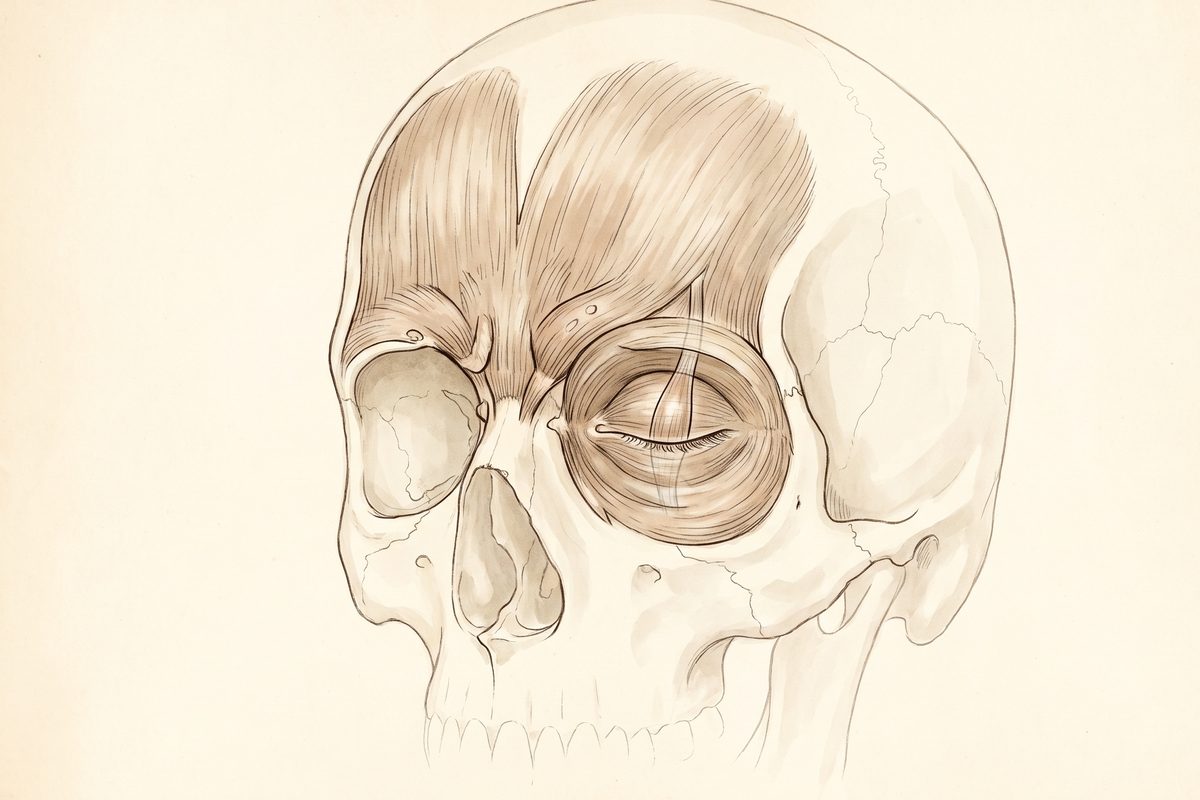
The forehead muscle, the frontalis, is the main muscle that holds the eyebrow up. Relax it too much, or too low, and the brow settles, pressing skin onto the upper lid so the eye feels heavy. The pooled trial data record a version of this: a heavy-eyelid sensation in 2.5 per cent of people treated for frown lines against 0.3 per cent on placebo, more often in Asian participants. The 2017 meta-analysis reports heavy eyelids as more frequent on toxin (relative risk 6.94).
No reliable rate exists for a true brow drop. American Family Physician calls brow and eyelid ptosis technique-dependent, with incidence falling as injector skill improves. Placement, dose and leaving the brow-lifting part of the muscle working are what reduce it, as set out in how anti-wrinkle injections actually work. It fades as the toxin does.
What causes a droopy eyelid, and how long does it take to settle?
The muscle that lifts the upper lid is the levator palpebrae superioris. If a small amount of toxin reaches it, it weakens and the lid sits lower. A 2021 review in the Journal of Cosmetic Dermatology gives a mean onset of 3 to 14 days after injection, with recovery as the paralytic effect wanes. Spread is real, but a 2012 review of diffusion says its clinical importance is disputed and that injection volume, concentration and dose are the factors a doctor can change.
The same review describes anatomical danger zones near the brow. Technique lowers the chance and cannot remove it. Recovery is usually complete as the toxin wears off, though a case series of 7 referred patients had ptosis lasting from 6 weeks to 13 months, so a droop that is not improving deserves a review. Eyelid position is where I hand over: Dr Catherine Chow, an oculoplastic surgeon, explains why a droopy eyelid follows toxin injections and how long it lasts, including the short-acting alpha-agonist eye drops that a doctor may prescribe while it settles. Eye pain or blurred vision is a separate matter, covered in when a treatment irritates the eye area.
Can anti-wrinkle injections change your smile or lips?
They can, usually when the lower face is treated. A 2026 Italian consensus describes lower-face treatment as challenging because of the important functional roles of the muscles involved, which raises the risk of adverse events. Its panel favoured a single injection point lateral to the marionette line to avoid diffusion into the muscle that pulls the lower lip down. A 2007 review lists lower-face asymmetry after perioral injection as uncommon to rare, and the 2026 Cureus review calls perioral dysfunction generally mild and self-limited.
No reliable rate exists. A crooked smile is a diffusion effect on a neighbouring muscle and lasts about as long as the treatment does. Tell the doctor early if speech, drinking or eating feels affected.
Can your body stop responding, and what else is rare?
The body can, rarely, make neutralising antibodies that blunt the effect. A 2024 literature review in Life found the overall incidence relatively low and driven by total cumulative dose and the number of treatment cycles, with little treatment failure from antibodies at aesthetic doses. No single percentage is reliable. Spacing is set out in how long anti-wrinkle injections last.
Other events are rarer still. The 2026 Cureus review calls double vision rare and systemic events uncommon but occasionally needing hospital assessment, and the pooled trials recorded no weakness remote to the injection site. Neuromuscular conditions such as myasthenia gravis are contraindications, so tell the doctor about any.
When should you call?
Call the clinic that treated you if an eyelid or brow drops, if the smile or lips feel wrong, or if a headache is severe or not settling. Seek urgent care for trouble swallowing, breathing or speaking, weakness away from the injection site, double vision, eye pain or a change in vision. Before any treatment, ask which muscles will be treated, what dose, when the result will be reviewed, and what happens if a lid droops.