
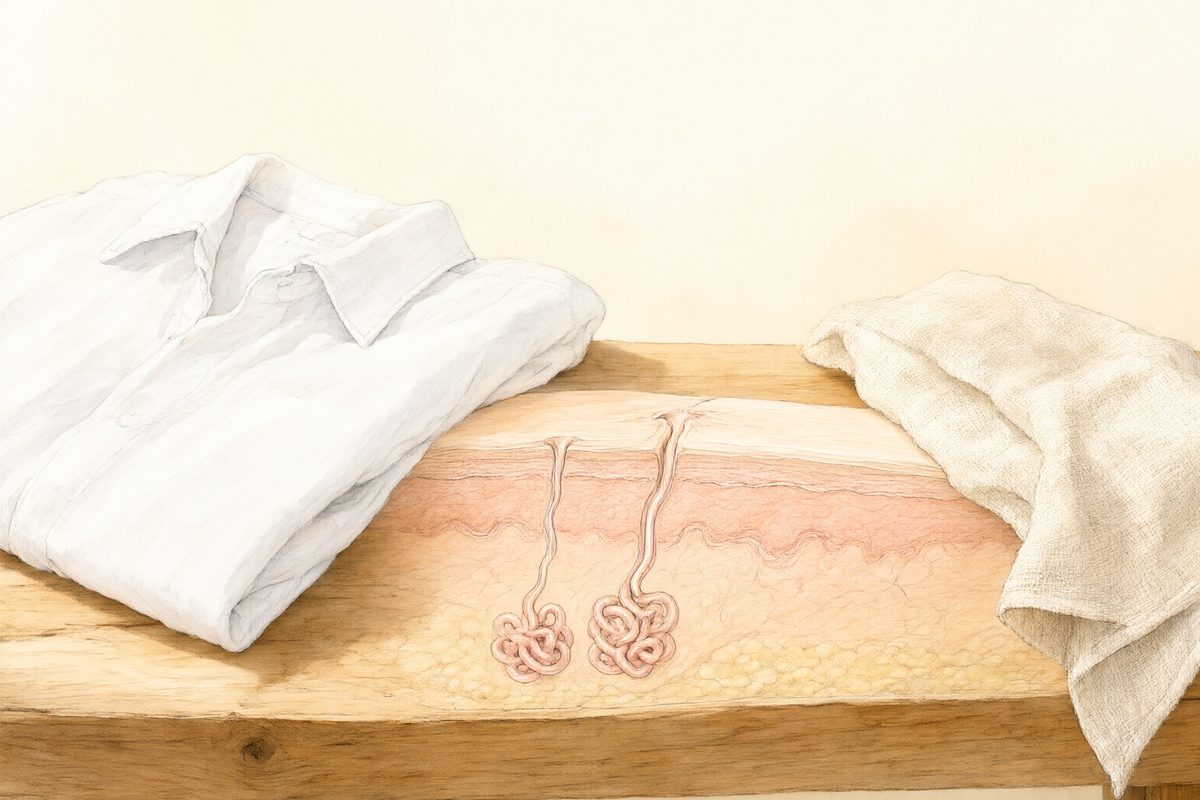
What is hyperhidrosis, and is it just sweating a lot?
Sweating is normal. People sweat in heat, when they exercise and when they are nervous, which is why the definition matters. Hyperhidrosis is sweating beyond what those triggers explain: sweating when it is cool or at rest, or that soaks through clothes with little cause. The main kind is primary focal hyperhidrosis. It affects the underarms, palms, soles or the face and scalp, usually on both sides equally, with no underlying cause found, and it often runs in families. About nine in ten people with hyperhidrosis have this primary kind, according to a 2019 dermatology review.
A United States survey of 8,160 people put the prevalence at 4.8%, and only half of those affected had ever raised it with a health professional, mostly because they thought it was not a medical condition or that nothing could be done. No Malaysian figure was found. It is not a trivial problem: among dermatology outpatients in Vancouver and Shanghai, anxiety affected 21% and depression 27% of people with hyperhidrosis, against 8% and 10% of those without.
How does botulinum toxin reduce sweating?
Sweat glands are switched on by nerve endings that release a chemical messenger, acetylcholine. Botulinum toxin injected into the skin blocks that release. The US label describes the result as temporary chemical denervation of the sweat gland, with a local reduction in sweating. For the underarms, the sweaty area is often mapped first with an iodine-starch test, which turns blue-black where there is sweat, and many small injections are then placed into the skin about 1 to 2 cm apart. The dose is counted in units, and units are not interchangeable between brands: the Botox insert gives 50 units per underarm and the Dysport insert 100.
How well does it work, and for how long?
The underarms have better evidence than any other site. A 2017 review of 50 studies, 32 of them randomised, found moderate-quality evidence of a large effect of botulinum toxin on underarm sweating compared with placebo. In one 320-person trial, 94% of the treated group had cut sweat production by half or more at four weeks, against 36% on placebo, and 82% against 21% at 16 weeks; the US label gives 91% against 36% at four weeks for the same trial. In a 322-person, 52-week trial, the US label reports 81% of those given 50 units per underarm reaching that mark at four weeks, against 41% on placebo. Placebo groups improve too, so some response to saline is expected.
The effect is temporary. In the 322-person trial, the median duration at 50 units was 205 days, a little under seven months. The Botox insert gives an average of 6 to 10 months after a first treatment, with 27.5% of people going a year or longer, and the Dysport insert says about 48 weeks for most people. It is a repeating treatment. The inserts advise repeating only when the effect has faded, and not more often than every two months (Botox) or every 12 weeks (Dysport). How long anti-wrinkle injections last explains why the timing varies between people.
What about the palms?
Palm injections work too, but the evidence is smaller, the procedure is more painful, and the labels list underarm sweating as the licensed use, so treating the palms goes beyond what the label covers. A 2026 review of 19 studies found relief lasting 3 to 12 months, averaging 4.9 to 9.5 months for botulinum toxin type A. Injection into the palm is described as frequently accompanied by considerable pain, and a 19-person trial found that a cooling spray with a lidocaine cream gave less pain than the spray alone. Hand muscle weakness is the recognised cost: the US label warns that weakness of hand muscles may occur, and palm studies report it in 23% to 60% of people, usually mild and temporary, with rare cases of impaired grip. One 19-person trial found grip strength unchanged at 28 days. For the face, the label warns that eyelid droop may occur.
What are the side effects?
Underarm treatment is usually well tolerated. Injection-site pain is very common, with bleeding or bruising at the injection sites, headache and flu-like symptoms in some people. Sweating in other areas can increase: the Botox insert reports it in 4.5% of people within a month, resolving in about 30% of them within four months, and the Dysport insert lists compensatory sweating as common. In the 320-person trial, adverse events were reported by 11% of the treated group and 5% of the placebo group, a difference that was not statistically significant. Botox side effects: the common, the rare, and what to do covers the wider list.
The US label carries a boxed warning that the effect of botulinum toxin can spread beyond the injection site, causing generalised weakness, drooping eyelid, and swallowing or breathing difficulty hours to weeks after injection, with reports of death. The label's warnings section adds that no definitive serious reports of this spread have been made for severe underarm sweating at the recommended dose (100 units in all). It should not be used by anyone with an infection at the injection site or an allergy to the product, and the Malaysian Botox insert advises against use in pregnancy unless the benefit clearly outweighs the risk. Botulinum toxin is a prescription-only medicine in Malaysia, a Group B poison under the Poisons Act 1952 that a registered medical practitioner may supply, or a pharmacist may dispense on a doctor's prescription, and the Dysport insert says it should be given only by appropriately trained physicians.
What else helps?
Guidelines put simpler steps first. In the 2019 dermatology review, antiperspirants are first-line treatment for primary focal hyperhidrosis. Products with 10% to 20% aluminium chloride hexahydrate are the first line for underarm sweating, some are prescribed for nightly use, and they can irritate the skin. Deodorants reduce odour and do not stop sweat. A Canadian expert guideline puts topical aluminium chloride first for mild underarm, palm and sole sweating, and botulinum toxin and aluminium chloride both first-line when the sweating is severe, scoring 3 or 4 on a four-point scale of interference with daily activities.
Iontophoresis, a weak electric current passed through water, is the main option for palms and soles. It takes 10 to 30 minutes over several sessions, and rarely causes skin cracking or blisters. The 2017 review found weak but consistent evidence for it in the palms. Prescription anticholinergic medicines also reduce sweating: topical ones for the underarms beat placebo in a 2026 meta-analysis of eight randomised trials of 1,921 people, with more side effects such as dry mouth, and tablets are kept for sweating that is generalised or has resisted other treatment, at the cost of the same kind of side effects. Which products are registered in Malaysia is a question for a doctor or pharmacist.
Beyond that, devices that damage the sweat glands (microwave energy, lasers), local surgery to remove underarm sweat glands and, as a last resort, cutting the nerves that carry the sweating signal from the chest exist. The last of these can cause compensatory sweating elsewhere. The 2017 review rated the evidence for its other treatments, which included anticholinergic medicines, curettage and the energy devices, as low or very low quality, and did not review nerve surgery.
When does sweating need a medical check for another cause?
Primary hyperhidrosis is a diagnosis reached after other causes are considered. Sweating that comes from another condition, called secondary hyperhidrosis, tends to be more generalised or asymmetric than the primary kind. Features that point to a secondary cause include sweating that is one-sided or all over the body, that begins at age 25 or later, that comes with night sweats, or that has no family history. Causes include an overactive thyroid, low blood sugar, menopause, infections including tuberculosis, anxiety, some medicines, some cancers and adrenal gland tumours. Sweating together with chest pain can be a symptom of a heart attack, which needs emergency treatment in hospital.
See a doctor if the sweating is prolonged, excessive and unexplained; comes mostly at night; began at age 25 or later; or comes with weight loss, fever, a pounding heartbeat or shortness of breath. The NHS lists these reasons to see a GP about excessive sweating: self-help is not working, it has lasted at least six months, it stops you getting on with daily activities, it happens at least once a week or at night, it runs in the family, or you take medicine for another condition. The Botox insert itself says patients should be evaluated for causes of secondary hyperhidrosis, such as an overactive thyroid or an adrenal tumour, so that sweating is not treated as a symptom while its cause is missed. Skin specialist or aesthetic doctor explains which door to try first, and how to check an aesthetic doctor in Malaysia covers the registers.
Injections for sweating at this clinic
This clinic offers injections for excessive sweating. Botulinum toxin is a prescription-only medicine in Malaysia, so a doctor assesses you first, and whether to treat is decided after that assessment.
A drier underarm is a reasonable goal. The first job is to make sure the sweating is not a sign of something else.