
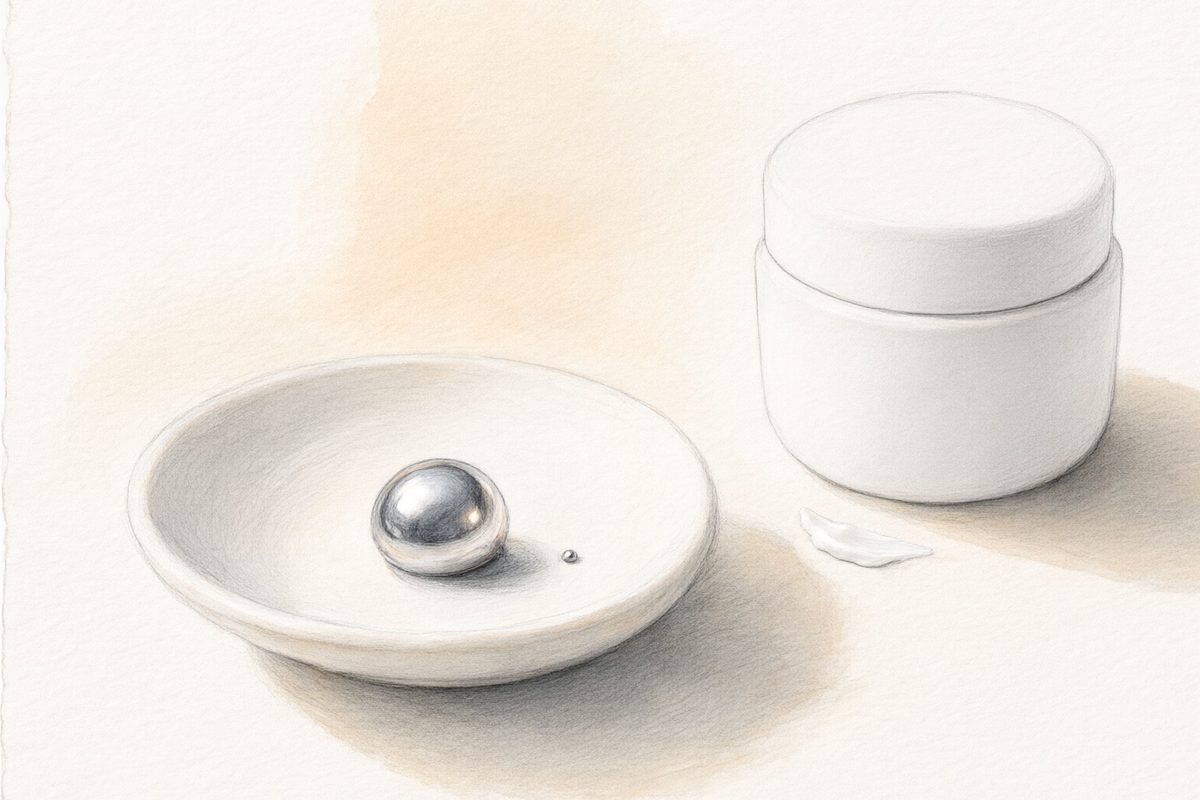
What mercury is doing in the jar, and to the body
Mercury salts are added to some skin lightening products because they suppress melanin production, the pigment-making process that gives skin its colour. That is the entire commercial logic: less melanin activity reads, over weeks, as lighter skin. The World Health Organization states plainly that mercury-containing skin lightening products are hazardous to health, and that they remain banned in many countries while continuing to circulate, including online, wherever demand for a fast result meets a weak enforcement gap.
The harm is not confined to the skin it is rubbed on. Malaysia's own Ministry of Health has stated that exposure to mercury can damage the kidneys and the nervous system, and that it may interfere with brain development in unborn children and very young children. A peer-reviewed case report describes a woman who developed a kidney disease called membranous nephropathy after using a mercury-containing lightening cream, with skin swelling and patchy discolouration on her arms, and testing found the cream itself carried mercury at a level thousands of times higher than international limits allow. That is one reported case, not a claim about every jar on a shelf, but it shows the kind of harm that a cosmetic sold for the face is not supposed to be capable of causing.
The other scheduled poisons found alongside it
Mercury is not the only substance Malaysian authorities have found in cosmetics pulled from the market. Hydroquinone and tretinoin turn up too, both recognised medicinal ingredients with legitimate, doctor-supervised uses, and both capable of harm when used unsupervised in an unregulated cream. The Ministry of Health has stated that unsupervised hydroquinone use can cause skin redness, discomfort, discolouration and hypersensitivity, and that by inhibiting pigmentation it also reduces the skin's own protection from ultraviolet light, raising the risk of skin damage from the sun. Unsupervised tretinoin use, the Ministry states, can cause redness, stinging, peeling and increased sensitivity to sunlight.
None of that makes either ingredient dangerous by nature. Both are used properly, at the right strength, for the right skin, under a doctor's supervision, in registered medicines. What makes them scheduled poisons in a cosmetic jar is exactly that: no supervision, no known strength, and no doctor deciding whether your skin can tolerate what is inside.
How to check a cream, rather than guess
Every cosmetic sold legitimately in Malaysia must first be notified to NPRA, a formal declaration a company makes to the National Pharmaceutical Regulatory Agency before it may manufacture, sell, supply or import the product. According to NPRA's own guideline, the company notifying the product is responsible for holding a file documenting the product's quality, safety and claimed benefit, and the guideline states directly that if a product later fails to meet the standards it declared, the company cannot rely on having been notified as any kind of legal protection.
That distinction matters for a reader trying to judge a jar. A notification means a company has declared the product to NPRA. It is not, on its own, an independent laboratory result on the specific batch in front of you, and it does not mean the ingredients list has been verified line by line before the product reached a shelf. The more useful check, and the one described plainly on NPRA's own site, is the Ministry's published list of cosmetic products whose notification has since been cancelled after a scheduled poison was detected. The public is advised there to avoid buying or using anything that appears on it. Checking a name against that list, and treating a seller who cannot produce any notification claim at all as the bigger warning sign, is a more honest use of ten minutes than reading a jar and guessing.
The red flags that do not need a lab to spot
A few patterns show up often enough in the products the Ministry has pulled that they are worth naming plainly. An unlabelled jar, or one with a label in a language and format that gives no batch number, no ingredient list and no notification claim, is the clearest one. A promise of visible results within days rather than the weeks a genuine skin change takes is another, since a genuine change in pigment takes weeks, and a cream that claims to beat that deserves the question of what is actually in it. A product sold only through a reseller on social media, with no traceable manufacturer and no way to verify a notification number, carries the same risk profile as one with no label at all, because there is nobody to hold accountable if the jar turns out to contain something it should not.
If you have already been using one
Stop using the product and see a doctor. That is the honest, complete answer, and it is deliberately short of specifics this article cannot responsibly supply. Nobody can tell you from a general article what a particular cream has done to your particular skin, how much of an ingredient you have absorbed, or whether a symptom you are noticing is related. A doctor can examine the skin, take a history of how long the product was used and how it was applied, and decide from there whether blood tests, referral or simple observation is the right next step.
Why this differs from what a doctor actually treats
Pigment problems are real, common, and worth treating properly, which is exactly why an illegal shortcut is such a poor trade. Melasma and the dark marks that linger after acne are two of the most common reasons someone reaches for a whitening product in the first place, and both are diagnosable conditions with their own mechanisms, not a general dullness that any lightening agent will fix. A doctor examining pigmentation is deciding which of several different processes is actually present, because the reasons pigment returns differ by condition, and because, in melasma specifically, the wrong intervention can make it worse rather than better. None of that diagnostic work happens in a jar bought without a name attached to it. A doctor who is willing to be checked on the public register before you book is the version of this decision that keeps you, not the seller, in control of what goes on your face.