What is Tixel, and why do its side effects differ from a laser?
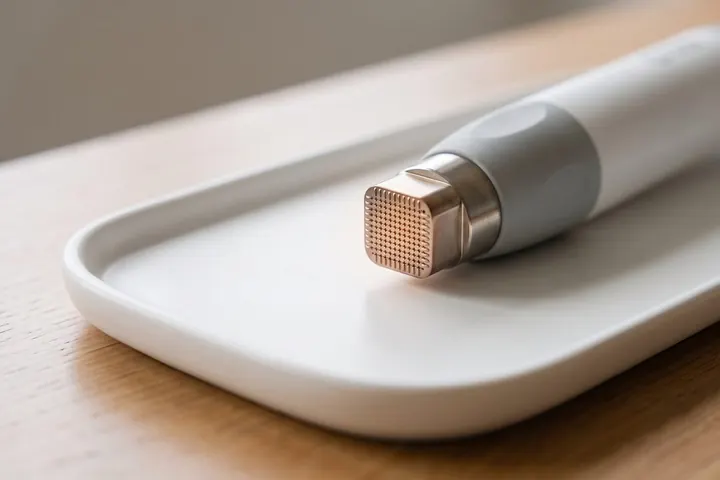
Tixel is a handheld device made by Novoxel, an Israeli company. It does not use light. A metal tip of 81 small pyramids is heated to about 400 degrees Celsius and brought to the skin for a very short, preset contact time. The heat passes into the skin and, at the stronger setting, evaporates tiny craters, a process the 2016 paper that described it calls thermo-mechanical ablation. A second tip type coagulates the tissue and leaves the top layer in place.
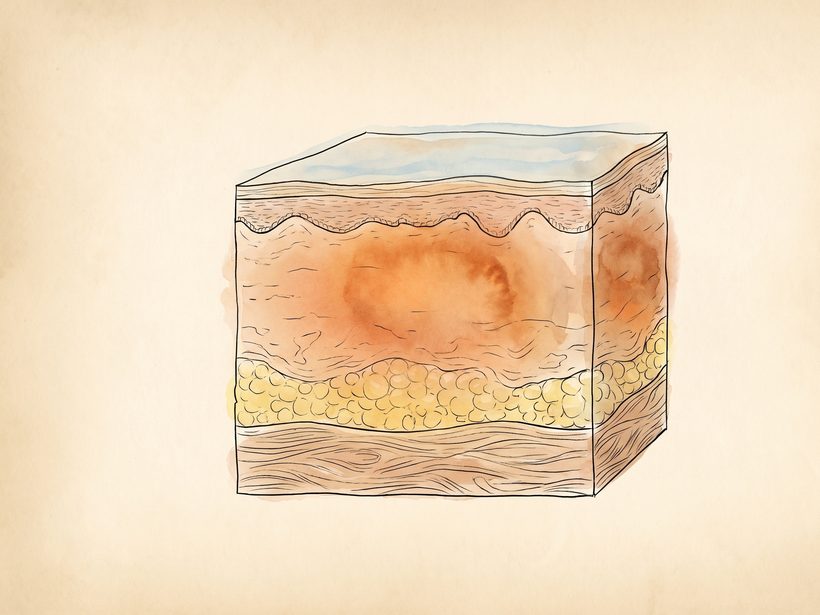
That mechanism explains the side effects. A grid of small controlled injuries produces redness, warmth and pinpoint crusts as the skin heals, which is the same logic as any fractional resurfacing device. The injury is shallow, around 100 to 170 micrometres deep in that early study, and that is why the recovery described below is short.
What is normal after Tixel?
In the first study of 26 people, redness took about 3.5 days to clear and downtime was between none and one day. A review of 150 patients found that make-up was possible straight away at the lower settings and after two days at the higher ones. A two-centre review of 24 patients put average downtime at 1.7 days.
A randomised comparison around the eyes is the more candid one. About 80% of people were back to work and social activity by two days. Crusts lasting beyond 48 hours were reported by 52% of the Tixel group, against 16% after a non-ablative laser. So crusting is common, and it is worth planning a few days around.
These are the figures from the studies and not a promise about any one person. Settings, skin type and the area all change the result.
Does Tixel hurt?
Pain scores were low to moderate. The 26 people in the original study, treated with no numbing or cooling, rated it 3.1 out of 10. In the randomised eye-area study the average was 4.01 for Tixel and 5.86 for the non-ablative laser it was compared with. That comparison tells you how the two felt in that study, and it does not rank them for you. Pain is personal, and the eye area is more sensitive than the cheek.
What are the less common problems?
In the 150-patient review there were four complications across 327 sessions: post-inflammatory hyperpigmentation in two patients, impetigo in one and dermatitis in one. The authors reported no permanent side effects. Darker patches after the redness fades are the effect to understand if you have skin that tans easily, and the reasoning behind them is set out in pigment laser side effects on Asian skin.
Who is represented matters here. The Tixel studies I read included skin types I to IV in the American prospective trials, II to V in the chart review, I to V in the 150-patient series and I to VI in the randomised study. The groups at the darker end were small, so the numbers for them are thinner.
What about the eye area?
Tixel has been used on eyelid and eye-area skin. A 2023 prospective study treated 51 people for lines around the eyes with four monthly sessions and a three-month follow-up, and its authors reported it as safe in that group. Other groups have treated the eyelids of dry eye patients, and a 2022 pilot of 40 patients measured dry eye scores, which is a different question from the one this page answers.
There is one finding worth knowing. In a 2024 multicentre study of 89 people with dry eye, 11.86% had a change of more than half a dioptre in mean corneal curvature at three months, and nearly 17% had a change in corneal astigmatism. The authors point out that this could cause errors in lens calculations if cataract surgery follows. That is a population with dry eye disease, and it does not show the same happens in healthy eyes. It does show that treatment close to the eye can have effects on the eye, which is why eye protection during laser treatment near the lid is more than a formality.
If an eye feels gritty, painful, red or blurred after any treatment near it, that needs an ophthalmologist and not a skin clinic. The clinic does not treat eye disease and does not treat eyelid skin with Ultherapy or XERF at present.
What is known long term?
Less than the search suggests. The longest follow-up in the studies I read was six months after the last session, and most were three. A 2024 systematic review of 21 articles concluded that few adverse events have been reported and that larger randomised trials are needed, with reporting that varies between studies.
So the fair summary is that short-term effects are mostly mild and well described, and the long-term record is short. I give no figure for the long-term risk because I could not find one.
Is Tixel approved?
The US Food and Drug Administration lists three 510(k) clearances for the Tixel family, in 2021, 2023 and 2024. I did not read the indication wording, so I do not describe what the clearances cover. I could not confirm the device's registration with Malaysia's Medical Device Authority. If a clinic offers it, asking for that registration and for the name of the doctor who will treat you is reasonable, and the checks are described in how to check an aesthetic doctor in Malaysia.
What The Retreat Clinic does and does not offer
The clinic does not offer Tixel. It also does not offer fractional CO2 laser or microneedling, whose recovery is compared in the fractional CO2 laser article. For skin laxity it offers XERF and Ultherapy, which work by different routes, and the difference between the monopolar radiofrequency devices is explained in Thermage vs XERF. Which one suits a face, if any, is decided at an assessment.
Common questions
What are the side effects of Tixel?
In the studies I read, the usual effects are redness, warmth, swelling and light crusting that settle within days. Rarer reports include darker patches of skin after the redness fades, a skin infection in one of 150 patients and dermatitis in another. No permanent effects were reported in that 150-patient review.
Does Tixel hurt?
Pain was rated low to moderate. Patients in a 26-person study without analgesia or cooling gave an average of 3.1 out of 10, and in a randomised eye-area study the score was 4.01. Individual experience varies with the setting used and the area treated.
Are there long-term side effects of Tixel?
I found no long-term safety data. The longest follow-up in the studies I read was six months after the last session, and a 2024 systematic review asks for larger randomised trials. No data is not the same as no problem, and it also does not show a problem.
Is Tixel safe around the eyes?
Studies have treated eyelid skin, including for dry eye, and report mostly mild effects. One 2024 study found measurable changes in the curvature of the cornea in some dry eye patients, which matters before cataract surgery. Anyone with eye symptoms should be assessed by an ophthalmologist first.
Does The Retreat Clinic offer Tixel?
No. The clinic does not offer Tixel, fractional CO2 laser or microneedling. This article is education on a question people search.
Sources
- Elman M, Fournier N, Barneon G, Bernstein EF, Lask G. Fractional treatment of aging skin with Tixel, a clinical and histological evaluation. Clinical, Cosmetic and Investigational Dermatology, 2016 A 400 C metal tip of 81 pyramids touches the skin briefly and makes micro-craters by evaporation. In 26 subjects with three sessions and no analgesia or cooling: pain 3.1 of 10, downtime 0 to 1 days, redness cleared in 3.5 days, no bleeding, scarring or post-inflammatory hyperpigmentation.
- Judodihardjo H, Rajpar S. Retrospective study on the safety and tolerability of clinical treatments with a novel thermomechanical ablation device on 150 patients. Journal of Cosmetic Dermatology, 2022 150 patients, skin types I to V, 327 sessions. Four complications: post-inflammatory hyperpigmentation in two, impetigo in one, dermatitis in one. Make-up possible straight away at lower settings and after two days at higher settings. No permanent side effects reported.
- Daniely D et al. Thermo-mechanical fractional injury therapy for facial skin rejuvenation in skin types II to V: a retrospective double-center chart review. Lasers in Surgery and Medicine, 2021 24 patients with skin types II to V. Side effects were transient and included erythema and hyperpigmentation; average downtime 1.7 days.
- Salameh F et al. Treatment of periorbital wrinkles using thermo-mechanical fractional injury therapy versus fractional non-ablative 1565 nm laser: a comparative prospective, randomized, double-arm, controlled study. Lasers in Surgery and Medicine, 2022 68 patients, skin types I to VI, randomised. Pain score 4.01 for Tixel and 5.86 for the laser. About 80% back to work and social activity by two days. Crusts beyond 48 hours in 52% after Tixel and 16% after the laser. Follow-up six months after the last session.
- Wang JV, Bajaj S, Orbuch D, Lapidoth M, Klein I, Gerstein YA. Safety and efficacy of a thermomechanical fractional injury device for periorbital rhytides. Dermatologic Surgery, 2023 Prospective study of 51 subjects, skin types I to IV, four monthly sessions around the eyes, three-month follow-up; the authors reported the adverse events they saw; this note makes no claim about results.
- Blanco-Vazquez M et al. Impact of thermo-mechanical skin treatment on refraction and keratometry in patients with dry eye disease and the implications for cataract surgery. Contact Lens and Anterior Eye, 2024 89 participants with dry eye had three eyelid-area sessions. At three months 11.86% had a change above 0.5 dioptre in mean keratometry and 16.94% in keratometric astigmatism; the authors flag possible errors in lens calculations for cataract surgery.
- Safir M et al. The effect of thermo-mechanical device (Tixel) treatment on evaporative dry eye disease: a pilot prospective clinical trial. 2022 40 patients aged 45 or over, three eyelid sessions two weeks apart; dry eye symptom and sign scores were measured at a mean follow-up of about two months; this note makes no claim about results.
- Estupinan B, Souchik A, Kiszluk A, Desai S. Comprehensive review of thermomechanical fractional injury device: applications in medical and cosmetic dermatology. Journal of Clinical and Aesthetic Dermatology, 2024 Systematic review of 21 eligible articles: few adverse events reported, limited randomised trials, heterogeneous reporting; larger randomised trials are needed.
- US Food and Drug Administration. 510(k) premarket notification database: Tixel System K202988 (2021), Tixel 2 System K223033 (2023), Tixel i K240512 (2024), Novoxel Ltd Three 510(k) clearances listed for the Tixel family; indication wording not read for this article.
Disclosure: In September 2026 Cynosure Lutronic, which makes XERF and PicoSure, gave Dr Ong its XERF Innovation Leader and XERF Clinical Visionary awards at the Malaysian launch of XERF. How he thinks about ties like these: The quiet we kept: what shapes what your doctor recommends.