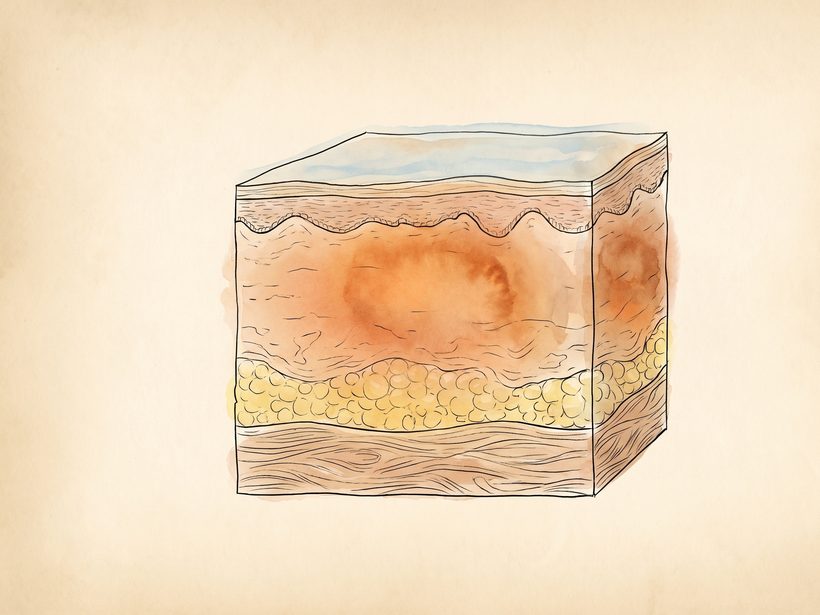
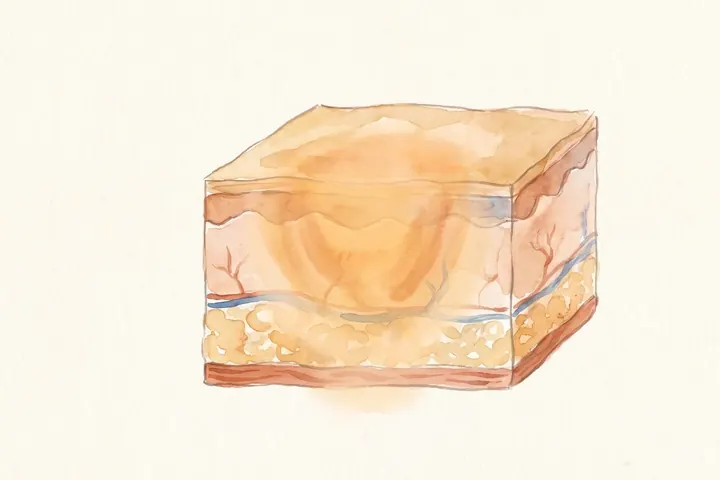
What are the side effects of Thermage?
Thermage is a monopolar radiofrequency device. Current passes through the skin to a return pad, the dermis heats, and cryogen cooling protects the surface. The US FDA cleared the FLX system in 2017 for the non-invasive treatment of wrinkles, as the article on what Thermage is and how it compares sets out. The Retreat Clinic does not offer Thermage. Dr Ong performs XERF, another monopolar radiofrequency device.
Heat that tightens skin can also redden it, swell it and, if it concentrates, injure it. The maker lists mild-to-moderate pain during treatment. After treatment it lists oedema, erythema or blanching, hives, bruising, blisters, burns, scabbing or scarring, surface irregularities, altered sensation, lumps or nodules and pigment change. It also reports rare reactivation of herpes simplex in the skin around the mouth. That is a list of what can happen, and it does not say how often. The maker's own page adds that it is not all a person needs to know.
What is normal after Thermage, and for how long?
In a review of more than 600 treatments with an earlier Thermage system at one office, redness and swelling usually lasted under 24 hours. Six patients had swelling for up to a week. DermNet describes redness and swelling as lasting one to two hours or, at most, a few days, and lists tingling or a burning sensation for a few days and soreness along the jawline.
Slower things were also recorded in that review. Tenderness of the neck lasted two to three weeks in three people. A few small pimple-like bumps resolved within a week, and one person had small nodules that cleared in 17 days. Altogether, 2.7% of treatments had a temporary side effect, and none had a permanent one. It is one office, retrospective, on an older system, and it says nothing about the FLX. Where the redness is calmer each day, that fits the expected path, which redness after a treatment describes in more detail.
Can Thermage cause burns?
Yes, rarely. In a 2003 study of 86 people treated around the eyes with an early system, second-degree burns followed 0.36% of radiofrequency applications (21 of 5,858), and three people had small areas of residual scarring at six months. That is per application, not per person, and it is an early system, so it cannot be read as a rate for the FLX.
The mechanism is the one the cooling is there to prevent. If the surface is not protected or contact is uneven, heat concentrates where it should not. Technique has changed since: a 2007 survey of 5,700 treatments by 14 physicians found 45% of patients found the original high-energy single pass too painful, against 5% with a lower-energy multiple-pass method, and judged the patient's own report of heat a valid way to choose the energy. A blister, broken skin or a pale patch is treated as a wound, and it needs a doctor.
Can Thermage cause fat loss or a dent?
It is described, and it is rare. DermNet calls dents in the skin a more serious complication, attributes them to overheating of tissue causing fat atrophy or excessive tightening, and gives the overall rate of side effects as under 1%. A 2022 systematic review of 121 articles on radiofrequency for the face and neck lists volumetric reduction of facial fat among its findings.
The maker's safety page does not mention fat loss, and no rate for the FLX was found. Among more than 600 earlier treatments, one slight cheek depression appeared and resolved within three and a half months. A face with little fat to spare has less to lose, which is one reason the area and the settings are a decision for the treating doctor.
Can Thermage cause numbness?
The maker lists altered sensation as a possible reaction after treatment, and DermNet lists tingling or burning for a few days. Neither gives a rate. A patch of changed feeling that is not settling, or that is spreading, is worth a call. No published figure for lasting numbness with the FLX was found, so none is given here.
Who should not have Thermage?
The maker states that the system is contraindicated in a person with an implantable pacemaker, and in a person with any other implantable electrical device, because the radiofrequency field or current may affect them. That is the one contraindication on its page. Metal implants such as plates or screws are not named there, so whether one near the treated area matters is a question for the treating doctor, and it should be asked before treatment.
The maker then lists what it has not studied. That is a different statement from a proven risk. The groups are: over skin fillers, in people who are pregnant or breastfeeding, in people with diabetes, in people with an autoimmune disease such as lupus, cold sores, herpes simplex or epilepsy, over tattoos or permanent makeup, and in children. For pregnancy and breastfeeding the maker says only that it is unstudied, so how long to wait is not stated here and belongs to the treating doctor. Around the eyes the maker requires plastic eye shields, and warns against metal ones.
The FDA clearance does not settle this. The 510(k) summary describes indications and technology and lists no contraindications, so these cautions come from the maker's own safety information.
What about darker skin and pigment change?
Pigment change is on the maker's list. A 2023 review of 35 articles on radiofrequency and radiofrequency microneedling in Fitzpatrick types III to VI found temporary darkening after inflammation in seven, mild prolonged darkening in one and permanent scarring in one, judged the risk low, and noted that many of the studies were weak. It covers the class, includes microneedling devices, and counts studies, not patients.
When should you call a doctor?
Call the same day for a blister, broken skin, a patch that looks white or grey, or pain that is increasing. Call within a few days if redness or swelling is not improving, if a tender lump appears, or if a hollow or dent is forming. A cold sore after treatment is also worth mentioning, because the maker lists herpes simplex reactivation. These timings are practical guidance and not drawn from a Thermage study, and the instructions of the doctor who treated you come first.
Early review limits damage, and a dent is easier to discuss early. How other devices compare is set out in the articles on XERF, Ultherapy and HIFU and OndaPro, and the comparison of Thermage and XERF shows how two monopolar devices differ.
What should you ask first?
Ask which device and generation will be used, who will treat you, what the energy is chosen by, how the surface is cooled, and what to watch for afterwards. Say if you have a pacemaker, any implant, a filler, a tattoo, cold sores, epilepsy, diabetes or an autoimmune condition, or if you are pregnant or breastfeeding.
Nobody can say that Thermage carries no risk. What can be said is what the maker lists, what the studies recorded, and what no one has measured yet.
Common questions
What are the side effects of Thermage?
The usual ones are redness and swelling, mostly clearing within 24 hours, and mild-to-moderate pain during treatment. The maker also lists blisters, burns, scabbing or scarring, surface irregularities, altered sensation, lumps or nodules and pigment change as possible reactions. The published rates come from earlier Thermage systems, not the FLX.
Does Thermage cause fat loss?
A dent from fat loss is described as a rare complication, which DermNet attributes to overheating of tissue or excessive tightening, and a 2022 review of radiofrequency lists volumetric reduction in facial fat among its findings. The maker's safety page does not mention fat loss, and no rate was found.
Who should not have Thermage?
The maker lists an implantable pacemaker or any other implantable electrical device as a contraindication. It also says it has not studied the system over skin fillers, in pregnancy, breastfeeding, diabetes, autoimmune disease, cold sores, herpes simplex, epilepsy, over tattoos or permanent makeup, or in children. Whether any of these applies to a given person is for the treating doctor to decide.
What are the long-term side effects of Thermage?
In the 600-treatment review, no permanent side effects were found, but it is a single-office chart review of an older system. An early periorbital trial recorded small areas of residual scarring in three patients at six months. None of the studies cited here followed people for years, so a long-term rate cannot be given.
Sources
- Thermage (Solta Medical). Thermage system, important safety information, healthcare professional page. Read 12 November 2026 The system is "contraindicated for use in patients with an implantable pacemaker" or "any other implantable electrical device". Under precautions, the maker "has not studied" the system over skin fillers; in people who are pregnant or breastfeeding or have diabetes; in people with an autoimmune disease such as lupus, cold sores, herpes simplex or epilepsy; in people with permanent makeup or tattoos; or in children. Warnings: plastic eye shields are required, metal shields must not be used, and vibration should not be used around the eyes while plastic shields are in place because of a risk of displacement, corneal abrasion or ocular damage. Possible reactions during treatment: mild-to-moderate pain. After treatment: oedema, erythema or blanching, urticaria, bruising, blisters, burns, scabbing or scarring, surface irregularities, altered sensation, lumps or nodules, pigment change, and rare herpes simplex reactivation. The page does not mention fat loss, numbness by name or metal implants. It states that it is not all a person needs to know and refers to the User's Manual.
- US Food and Drug Administration. 510(k) K170758, Thermage FLX System, decision letter dated 22 September 2017 with indications for use and summary. Read 12 November 2026 Class II; found substantially equivalent to the Thermage CPT predicates; indications include non-invasive treatment of wrinkles and rhytids, including periorbital wrinkles with the radiofrequency-only components. The summary describes energy delivered from a disposable tip while the epidermis is conductively cooled, and gives the frequency as 6.78 MHz. It lists no contraindications or adverse events.
- Fitzpatrick R, Geronemus R, Goldberg D, et al. Multicenter study of noninvasive radiofrequency for periorbital tissue tightening. Lasers Surg Med. 2003;33(4):232-242 86 subjects, one treatment with an early system (ThermaCool TC), six months of follow-up. Rates and duration of oedema and erythema were "very low". Overall second-degree burn incidence was 0.36% (21 per 5,858 radiofrequency applications), and three patients had small areas of residual scarring at 6 months.
- Weiss RA, Weiss MA, Munavalli G, Beasley KL. Monopolar radiofrequency facial tightening: a retrospective analysis of efficacy and safety in over 600 treatments. J Drugs Dermatol. 2006;5(8):707-712 Retrospective chart review at one office, over 600 consecutive treatments with ThermaCool, no injectable anaesthetic or sedation. Erythema and oedema usually lasted under 24 hours, with oedema up to 1 week in 6 patients. No permanent side effects; 2.7% of treatments had temporary side effects, the most significant a slight cheek depression (n = 1) that resolved within 3.5 months. Others: acneiform papules (n = 4) and a linear crust (n = 1), resolved within 1 week; small subcutaneous nodules resolving in 17 days (one patient); neck tenderness for 2 to 3 weeks (3 patients). Authors judged side effects infrequent, self-limited and minor.
- Austin GK, Struble SL, Quatela VC. Evaluating the effectiveness and safety of radiofrequency for face and neck rejuvenation: a systematic review. Lasers Surg Med. 2022;54(1):27-45 Class-level: 121 articles; radiofrequency "demonstrated a volumetric reduction in facial fat"; "safe apart from one patient who developed a neck fistula".
- Dover JS, Zelickson B; 14-Physician Multispecialty Consensus Panel. Results of a survey of 5,700 patient monopolar radiofrequency facial skin tightening treatments. Dermatol Surg. 2007;33(8):900-907 Physician survey, device not named in the abstract. Original high-energy single pass: 45% found the procedure too painful. Lower-energy multiple-pass algorithm: 5%. Patient feedback on heat sensation was judged a valid and preferable way to select energy.
- Syder NC, Chen A, Elbuluk N. Radiofrequency and radiofrequency microneedling in skin of color: a review of usage, safety, and efficacy. Dermatol Surg. 2023;49(5):489-493 Class-level, and includes microneedling devices: 35 articles in Fitzpatrick types III to VI; transient postinflammatory hyperpigmentation in 7, mild prolonged hyperpigmentation in 1, permanent scarring in 1; a low risk overall, with a large proportion of the studies lacking strong quality evidence.
- DermNet. Radiothermoplasty (page titled Radiothermoplasty and Thermage). Read 12 November 2026 "To date, the reported incidence of side effects from Thermage radiothermoplasty is less than 1%." Effects listed include swelling and redness, risk of burn, blistering and scarring, tingling and burning sensation for a few days, and soreness around the jawline. "A more serious complication is the formation of dents in the skin (rare)", attributed to overheating of tissue causing fat atrophy or excessive tightening. Some redness and swelling after the procedure typically lasts "1-2 hours, or at most, for a few days".
Disclosure: In September 2026 Cynosure Lutronic, which makes XERF and PicoSure, gave Dr Ong its XERF Innovation Leader and XERF Clinical Visionary awards at the Malaysian launch of XERF. How he thinks about ties like these: The quiet we kept: what shapes what your doctor recommends.