
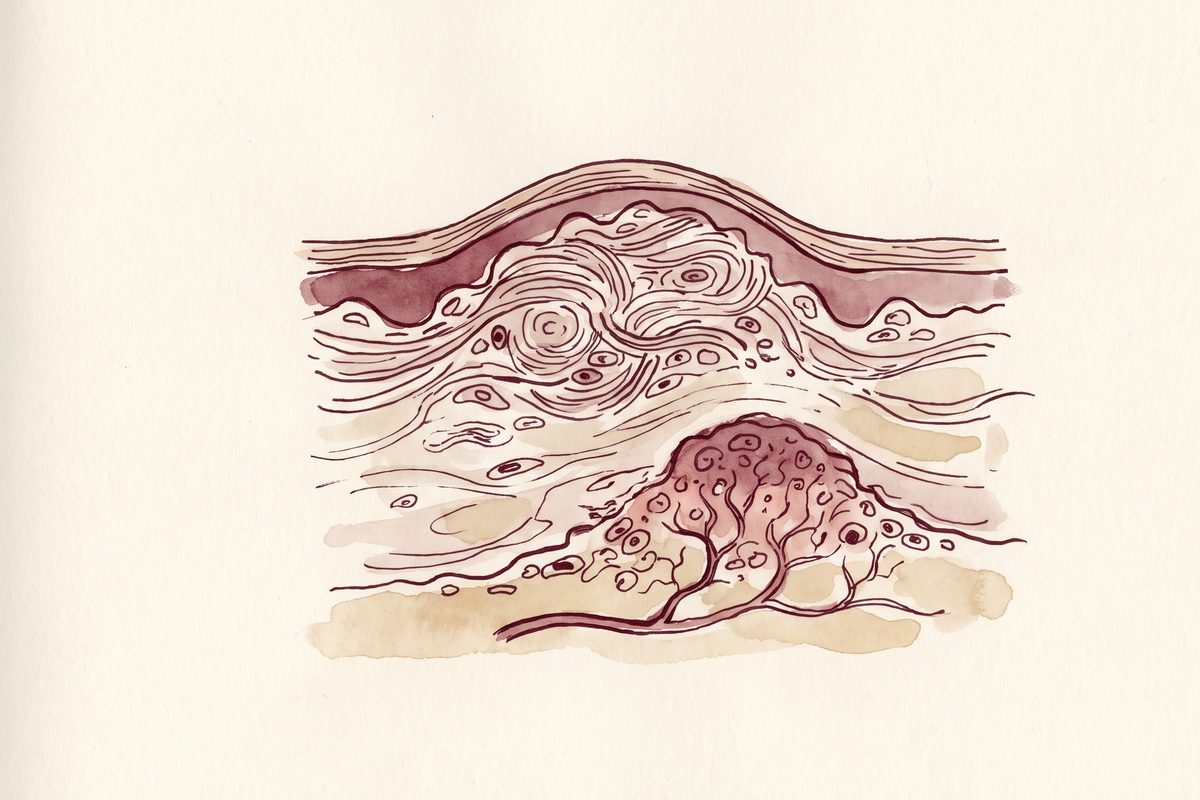
A scar that grows past its own wound
The usual story is an earlobe. A piercing years ago, a lump that has grown to the size of a pea, cut out once and back larger. The question that follows is always the same: why does it keep coming back?
The answer begins with what a keloid is. A scar normally stops growing when the wound is closed. A hypertrophic scar overdoes it but stays inside the wound edge, and often settles over time. A keloid grows beyond the border of the original wound and, in DermNet's words, is unlikely to regress. The American Academy of Dermatology adds that it does not fade with time.
In outline, the biology is this: fibroblasts, the cells that make collagen, carry on producing it after the wound should be finished. The signals that drive them, TGF-beta among them, stay switched on, and low-grade inflammation continues in the deeper skin. In plain terms, the repair crew never gets the message to go home.
Who gets keloids, and where
Skin type and family matter. DermNet says keloids are more frequent in Fitzpatrick skin types III to VI, which covers most of Malaysia. The Academy reports that 33% to 50% of people who develop a keloid have at least one blood relative who gets them. The Japan Scar Workshop consensus lists early age of onset, Asian and African ancestry, pregnancy, hypertension and local skin tension as risk factors.
The upper chest, shoulders, ears and neck are especially prone. Tension is the reason: skin that moves and stretches all day keeps pulling on the repair.
The trigger can be small. DermNet lists surgery, burns, insect bites, acne, infections and immunisation, and an ear piercing belongs on the same list. A keloid can appear months or even years after the injury, so the cause is not always obvious.
Why keloids come back
The wound is the trigger. Cutting out a keloid makes a new wound, in skin that already heals too much. DermNet warns that surgical excision may result in a new keloid even larger.
The numbers are stark. A 2024 meta-analysis in Plastic and Reconstructive Surgery Global Open states that surgical excision alone leads to recurrence rates ranging from 45% to 100%. The Japan Scar Workshop consensus gives 50% to 80% after surgery alone, and 10% or less when radiotherapy follows within the right window. The same meta-analysis found a pooled recurrence rate of 13% across 22 studies of a technique that leaves the keloid margin in place. That is a pooled figure from varied studies, and it describes a group of keloids, not any one person.
Other reasons for return are plainer. Treatment may stop early, the injected dose may be too low, the site may be under constant tension, or the original cause, such as acne or a new piercing, is still there.
Is there such a thing as an acute keloid?
Not as a diagnosis. Search the scar guidelines and no standard definition appears. None of the guidelines read for this article lists acute keloid as a condition with its own criteria.
What people mean is the active phase. A keloid that is red, tender, itchy and still growing is behaving differently from an old, pale, quiet one. The Japan Scar Workshop document describes strong inflammation at the leading edge of a keloid and lists pain and itch as the symptoms and redness as a sign. DermNet notes that these scars can be uncomfortable and itchy. So an active, inflamed keloid is a real clinical picture. It is simply not a separate named condition.
The distinction matters because an active keloid is the one most worth treating early, and treatment aimed at inflammation, such as an injected steroid, suits it best. A quiet mature keloid may need a different plan, or none if it does not bother the person.
One caution. A keloid that suddenly becomes hot, swollen, painful or starts to discharge may be infected, or may not be a keloid at all. That is a reason to be seen soon, not to wait for the next review.
What the evidence supports
No single treatment works best for all keloids, as the Academy puts it. The international scar guideline panel (Gold and colleagues, 2014) concluded that combining modalities offers the most potential for hypertrophic scars and keloids, and recommended earlier use of 5-fluorouracil.
Injection into the scar. Intralesional corticosteroid, such as triamcinolone, repeated every few weeks, is the usual first treatment for a thick keloid. 5-fluorouracil is injected the same way and is used alone or with the steroid.
Cryotherapy, silicone and pressure. Cryotherapy, which means freezing, is on DermNet's list. Silicone gel or sheets and pressure, such as earlobe clips or garments, are low-risk supports, mainly for prevention and for after treatment.
Pulsed dye laser. This laser targets blood vessels and is used for the redness of an active scar. It is an adjunct, not a cure. Fractional lasers are discussed in the guideline too, though fractional CO2 laser carries its own risks on Asian skin, and this clinic does not offer it.
Surgery. Excision alone has the poorest record. It makes sense only with an adjuvant, such as steroid injection around the wound or radiotherapy within a short window after the operation, and it belongs with a dermatologist or plastic surgeon.
Making a return less likely
Prevention is partly choosing to avoid the injury. A person with a keloid history can think twice about an elective piercing or a cosmetic procedure on a prone site.
Early treatment of acne helps, since acne can leave keloids on the chest and jaw. The acne scar article explains how raised scars differ from the dipped kind. After any injury or operation, silicone and pressure start early, and a person who has had one keloid is followed closely so the next sign of overgrowth is treated while it is small.
A keloid also needs finishing. Stopping injections at the first improvement is a common route back to the start.
The honest limit
No treatment cures a keloid tendency. Every option here is a management plan, and some keloids stay difficult despite good care. Some need a dermatologist or plastic surgeon from the start, and radiotherapy, where it is used, is arranged through them.
This clinic does not advertise keloid treatment. What the clinic does is ask. The clinic's scar and pigment care article covers what a skin clinic can do for a scar. On this point the acne scar article is explicit: a history of keloid or thick scars is a reason to say so at the start, because the skin that heals that way may do so after a peel, a laser or a filler as well, and it changes which procedures are advised. The history is part of what a first consultation decides, and the way we diagnose before we treat applies here as much as anywhere.
If you need more information, you can always contact us.