
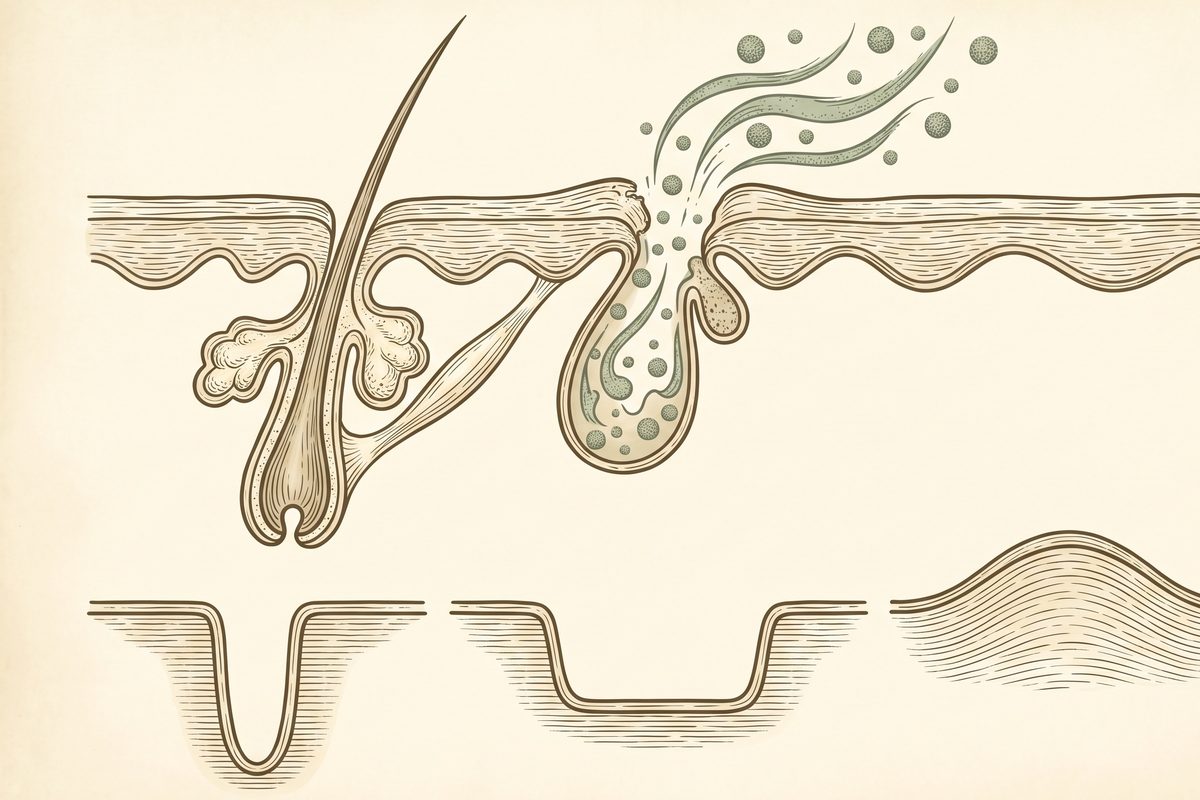
What are the three types of acne scar?
Most acne scars are dips in the skin. Acne inflames the dermis, the layer below the surface, and healing sometimes lays down too little collagen, leaving a depression. A 2010 review puts 80 to 90% of acne scars in this atrophic group. The remaining minority are raised scars, covered further down.
Dermatologists sort the dips into three types, a system proposed in 2001 that is still the working vocabulary. The shape and depth decide which treatments can reach them.
Icepick scars are narrow, under 2 mm across, and V-shaped. They are sharp-edged tracts that run down into the deep dermis or the fat beneath. The review of treatment options notes that their depth makes them resistant to conventional resurfacing. They are the most common type, at 60 to 70% of atrophic scars.
Boxcar scars are wider, 1.5 to 4 mm, round or oval, with sharply cut vertical edges, like a small steep-sided dish. They make up 20 to 30%. Depth matters here: shallow boxcar scars, 0.1 to 0.5 mm, respond to resurfacing, while deep ones, 0.5 mm and over, are resistant.
Rolling scars are the widest, up to about 5 mm, with soft, sloping edges that give the cheek an undulating look. They make up 15 to 25%. The skin surface can look near normal. The cause lies below it: fibrous bands anchor the dermis to the tissue underneath and pull the skin down, which the review says means treatment has to focus on that deeper tether.
One face usually carries a mix. The same review notes that different scar types are typically seen on the same person, which is why the first job is a map of what is there.
Are red or brown marks the same as scars?
No. A flat red or brown mark left after a spot is a change of colour, with no dip in the skin. Redness after acne is called post-inflammatory erythema, and brown marks are post-inflammatory hyperpigmentation. They fade with time and with the right care, and they are managed differently from a scar. The 2017 review advises treating persistent redness first: in lighter skin it can make scars look more obvious, and treating it is an early step toward improvement.
In richly pigmented skin, brown marks are common and slow to clear. Why acne dark marks linger longer in Malaysian skin covers them. A simple test separates the two: a mark is flat to the touch and a scar is not. Many faces carry both, and the marks are often what is noticed first, with the shadow of a dip underneath.
How does a doctor tell which type you have?
By looking, feeling and stretching. A practical guide for general dermatologists describes the routine: inspect the scars under direct overhead light, palpate them for firmness beneath, and stretch the skin to see whether the dip flattens. A scar that disappears on stretching and one that stays put are different problems. Feeling for fibrosis, a hard fibrous base, also matters, because deeply fibrotic scars often improve only with excisional procedures.
The history counts as much as the exam. The questions include whether the acne has cleared and how recently, whether oral isotretinoin was used and when it stopped, whether there is a past of dark marks after skin injury, and whether keloids or thick scars have run in the person or family. Skin type matters: the same guide notes that people with Fitzpatrick skin types III to VI, which covers many Malaysians, run a higher risk of dark marks after many resurfacing procedures. It also advises a test spot in a hidden area before treating a large one.
Where the scars are matters. The guide notes that scars on the chest, back and shoulders are much more resistant to treatment than facial scars.
What does an icepick scar need?
Something that reaches the bottom. A resurfacing pass works on the top layers, and an icepick scar reaches the deep dermis, so resurfacing alone tends to leave it behind. A 2017 review of treatment options names the CROSS technique as the method indicated for icepick and narrow boxcar scars: a high-strength trichloroacetic acid, 65 to 100%, applied to the base of each scar to remove its narrow wall and prompt the dermis to rebuild. The improvement grows with the number of courses.
A systematic review of non-energy treatments reports more than 70% improvement in 73.3% of patients treated with TCA CROSS. The studies are small, and the reviewers call for larger trials. The pigment cost matters in Malaysian skin: in one series of 53 people with skin types IV and V, treated with 70% TCA CROSS, 34.0% developed dark marks, more often in type V.
Punch techniques are the other classic option. The 2001 classification paper includes punch excision, where the scar is cut out and the edges are closed, and punch elevation, where the base is lifted, in its algorithm. Choosing between them depends on the scar and is a surgeon-level decision. Icepick scars also did least well with laser in one study: a fractional erbium laser in 35 Asian patients, described in the 2017 review, improved icepick scars by 25.9%, against 43.1% for rolling and 52.9% for boxcar.
What does a rolling scar need?
A release from below, since the pull comes from below. Subcision slides a needle under the scar to cut the fibrous bands that tether it. The 2017 review says it is best suited to rolling scars, with less effect on icepick and boxcar scars: once the tether is cut, the scar lifts, and the healing that follows lays down new collagen without recreating the dip.
How much it helps varies a great deal. A systematic review of ten subcision studies reports improvement anywhere from 10 to 100%, which says more about differences between studies than about any one person. The review concludes that the treatments it covered were generally safe, with few and transient side effects.
Filler placed under a soft scar is another route. A 2026 review of 24 studies found improvement with every type of filler tested, lasting from a few months to more than two years depending on the material, with swelling, redness and bruising common and lumps and dark marks less so. Why doctors still use dermal filler, and where it stops covers what filler is and the limits that come with it.
What does a boxcar scar need?
It depends on the depth. Shallow boxcar scars can be smoothed by resurfacing: lasers, chemical peels and similar work remove or remodel the surface layers so the edges soften. Deep ones resist it. The CROSS technique above is indicated for narrow boxcar scars as well as icepick scars, and wider or deeper ones can need more than one method.
Energy-based resurfacing means controlled heat to remodel the dermis. Fractional lasers, which treat a pattern of tiny spots and leave the skin between them, are widely used. The 2017 review notes that a fractional ablative CO2 laser works better than non-ablative lasers and also carries higher rates of dark marks and a longer recovery. Radiofrequency, with or without needles, delivers its energy into the dermis. Reviews of microneedling are mixed on what the radiofrequency adds: a 2022 meta-analysis of 12 trials and 414 people found an advantage in scar improvement for microneedling without radiofrequency, and none for the fractional radiofrequency version. Microneedling in Malaysia, and where the evidence stops goes through that evidence.
Chemical peels also work on shallow boxcar scars. Chemical peels in Malaysia, by depth explains what each depth does and why darker skin raises the stakes.
Why do plans so often combine treatments?
Because the face has more than one scar type, and no single tool covers all three. The practical guide gives the plain example: punch excision for icepick scars and filler under soft, rolling ones, in the same person.
The pooled trials point the same way. A 2026 network meta-analysis of 56 randomised trials and 1,488 patients with moderate to severe atrophic scars found that combinations generally outperformed single treatments, with fractional CO2 laser plus subcision, or plus platelet-rich plasma, the most consistent. A 2025 analysis of 68 trials and 4,480 patients ranked laser plus another treatment highest on scar scores and satisfaction. The same analysis found no strong evidence that any treatment lowered the risk of dark marks, which stays the main worry on Malaysian skin.
Three cautions come with these rankings. They compare treatments in trials, often with split-face designs, and a ranking is not a promise for one face. Much of the best-ranked work is laser based, and this clinic does not offer fractional CO2. And the order and spacing of treatments matter as much as the choice.
What about raised scars?
Raised acne scars, hypertrophic scars and keloids, are the opposite problem: too much collagen instead of too little. They are the minority, and their treatment is different. The 2010 review lists silicone gel, steroid injected into the scar, freezing and surgery. An international panel concluded in 2014 that combining modalities gives raised scars and keloids the most potential, with care tailored to the person.
The practical point is that a raised scar needs recognising before anything is done to it. A history of keloid, or of thick scars after earlier skin injury, is a reason to say so at the start.
How much improvement is realistic?
Improvement is realistic, and erasure is the exception. The 2017 review is blunt that complete resolution of acne scarring is the exception rather than the rule, and the systematic review of non-energy treatments concludes that there is no easy and definitive solution. The ranges in the papers are wide for a reason: scar type, depth, skin type, the number of sessions and how results were measured all differ.
Time is part of the answer. Collagen is rebuilt slowly, and a course usually means several sessions. The 2017 review says the full result of skin needling can take 8 to 12 months. The risks are real as well, and the 2017 review lists redness, infection, poor wound healing, dark marks and, paradoxically, new scarring. Those are the reasons for a test spot and for starting gently.
Why is active acne treated first?
Because acne that is still active keeps writing new scars. The 2017 review says early treatment of active acne remains the best way to prevent or limit scarring, and that it is imperative to ensure active acne has been treated before approaching scar treatment, so that new lesions do not scar the areas already done. The practical guide adds that active inflammatory acne may be a contraindication to scar treatment.
Oral isotretinoin sets a clock of its own: many procedures are held back for six months after it is stopped. What a doctor checks first in adult acne sets out the order for the acne, and isotretinoin (Roaccutane), and what a doctor checks covers the drug. Clearing acne also helps in itself: the practical guide notes that improving active acne may satisfy a patient even without any scar treatment.
What does this clinic do, and not do?
The clinic assesses scars by type, and treats them only once acne is under control. It does not treat scarring over active acne. For selected acne scarring and surface texture, it uses PicoSure in its focus mode, decided scar by scar over a planned course. Deep icepick scars are stubborn territory, and where a different tool would serve a scar better, the clinic says so and refers.
TCA CROSS, subcision and filler are part of the clinic's work on acne scars, each used when the scar type calls for it: a targeted acid for icepick scars, a release for tethered rolling scars, filler under soft rolling ones, often more than one in the same face. It does not offer fractional CO2 laser, microneedling or RF microneedling, and punch techniques are described here for completeness. The page on how acne scars, pores and texture are assessed sets out the clinic's own approach.
The short version
Acne scars come in three types, icepick, boxcar and rolling, and the type decides the work: a targeted acid or punch technique for icepick, resurfacing for shallow boxcar, a release or filler for rolling, and combinations for the mixed faces most people have. Marks are a different problem from scars, raised scars are a third, and active acne is controlled before anything else. Improvement is the realistic aim.
Naming the scar comes before choosing the treatment.