
What is isotretinoin, and who is it for?
Isotretinoin, also called 13-cis retinoic acid, is a retinoid, a relative of vitamin A, taken by mouth. In Malaysia its registered use is severe acne, meaning nodular or conglobate acne or acne at risk of scarring, and acne that has failed standard treatment with an oral antibiotic and topical therapy. The 2024 guideline of the American Academy of Dermatology strongly recommends it for acne that is severe, is causing psychosocial burden or scarring, or has failed standard oral or topical treatment. It is not for mild acne, and the UK measures of 2023, relayed by the Malaysian regulator, say it should not be used for prepubertal acne.
A search of the regulator's register on 30 September 2026 found eight registered products, all oral capsules, sold as Roaccutane, Oratane, Acnotin and Nimegen. Accutane is the name of a United States brand. Where isotretinoin sits in the wider ladder of acne treatment is set out in adult acne: what a doctor checks first.
How does isotretinoin work?
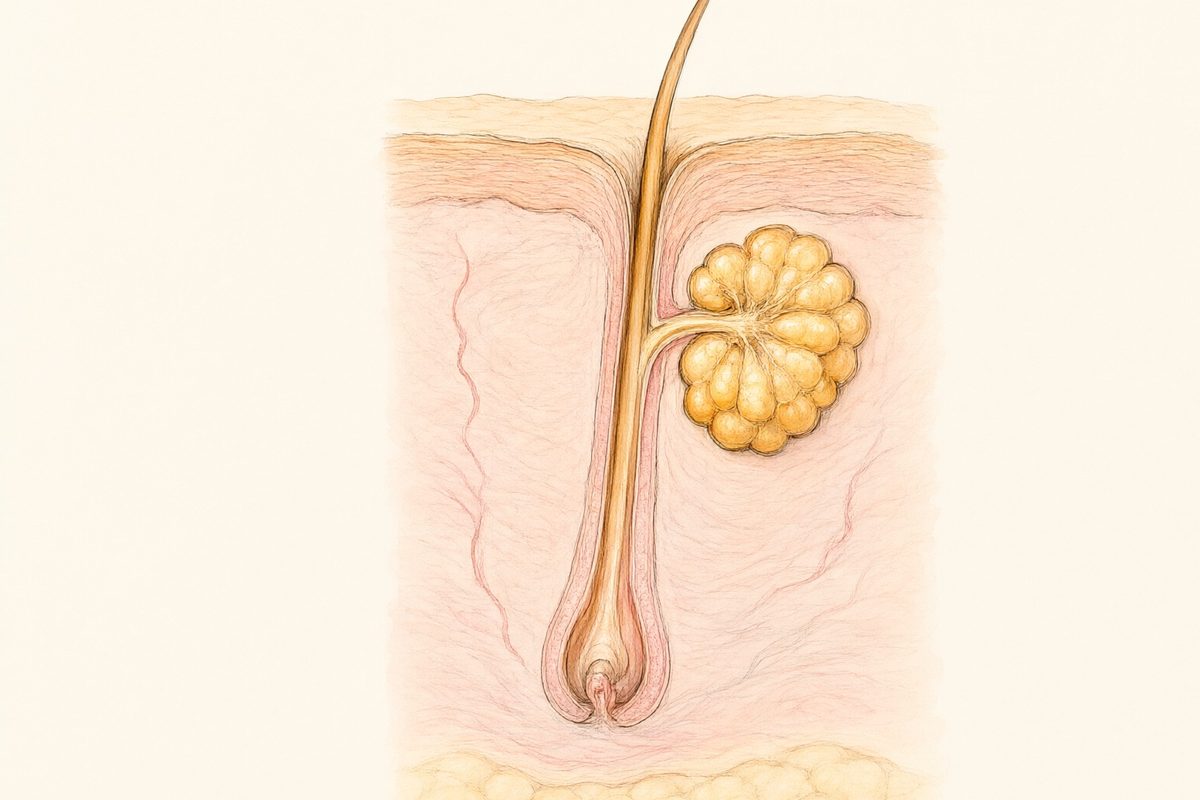
It acts on several causes of acne at once. It shrinks the sebaceous glands and cuts sebum production, normalises how the lining of the hair follicle sheds so pores block less, lowers the growth of the acne bacterium Cutibacterium acnes, largely because there is less sebum for it to feed on, and calms inflammation. At the usual dose it lowers sebum excretion by about 90% within six weeks, according to a 2009 review. Dryness of the skin and lips is the expected side effect, and the Malaysian Roaccutane insert says many of its side effects resemble those of an excess of vitamin A.
Who can prescribe it in Malaysia?
Isotretinoin is a Group B poison under the Poisons Act 1952, so it is prescription-only: it may be supplied by a registered medical practitioner, or by a pharmacist on a doctor's prescription, and there is no over-the-counter route. On top of that, in 2020 the National Pharmaceutical Regulatory Agency (NPRA) updated the conditions of registration for oral retinoids for skin disease, so that they may be sold or supplied to, and prescribed by, dermatologists registered in the National Specialist Register, or dermatologists serving in government health facilities. The Malaysian Roaccutane insert says it should be prescribed only by physicians experienced in systemic retinoids, and the patient leaflet says treatment must be supervised by a skin specialist.
How to check a dermatologist, or an aesthetic doctor, on their own public register is set out in skin specialist or aesthetic doctor: which to see, and why.
What does a doctor check before starting?
Pregnancy comes first. It applies to anyone who could become pregnant, including people who are not sexually active or who believe they cannot conceive, unless the prescriber sees compelling reasons. The Malaysian insert asks that the risk is understood and accepted, that effective contraception is in place from a month before treatment, either one highly effective method that does not depend on the user or two complementary methods, and that a medically supervised negative pregnancy test is done shortly before the first prescription. Some progesterone-only pills may not be enough. For men, the insert says the available data suggest the level in semen is too low to cause birth defects, and warns them not to share the medicine.
Then the blood. The insert lists liver insufficiency and markedly raised blood fats as reasons not to prescribe, and asks for liver enzymes to be checked before treatment and at one month, with fasting blood fats checked at one month. In people with diabetes, obesity, heavy alcohol use or a fat metabolism disorder, the insert says more frequent checks of blood fats and blood sugar may be needed. Then mood and history. The insert asks for particular care in anyone with a history of depression, and the regulator advises assessing mental health and sexual function before starting and telling family and friends what to watch for. The doctor also asks about medicines and supplements, because tetracycline antibiotics and vitamin A must be avoided, and about allergy, because the capsules contain soya.
What is checked during the course?
The insert starts at 0.5 mg per kg a day, usually 0.5 to 1.0 mg per kg, taken with food, and up to 2.0 mg per kg for very severe disease or for trunk acne. It says a total of 120 to 150 mg per kg has been documented to increase remission rates, and that complete remission is often reached in 16 to 24 weeks, and the patient leaflet says a course usually lasts four to six months. Whether a fixed total matters is debated, and a 2025 study found higher totals went with fewer relapses. Acne may flare at the start; the insert says this usually settles within 7 to 10 days, though it also lists a flare that lasts several weeks.
Follow-up visits are ideally monthly for anyone who could become pregnant, with a pregnancy test at each visit and prescriptions ideally limited to 30 days. The Malaysian insert repeats liver enzymes and fasting blood fats at about one month and then every three months. Practice varies: in a US study of 1,863 people, severe triglyceride and liver test abnormalities occurred in fewer than 1% and 0.5% of those screened, and the authors suggested testing less often. Mood is monitored throughout, and the leaflet tells patients to tell friends and family, who may notice changes first.
What are the side effects?
Dryness is the expected effect: dry lips, dry skin, a dry nose with nosebleeds, and dry or sore eyes, with intolerance of contact lenses. In one review, dry, cracked lips affected up to 98% of people and dry skin up to 50%. The skin becomes more sensitive to sun and more fragile, so the insert advises a moisturiser and lip balm from the start, sunscreen of at least SPF 15, no waxing, and no other exfoliating acne products. Muscle and joint aches and headache are also reported. Sunscreen in the tropics explains what the SPF number leaves out.
Less common effects are the reason for the checks: raised blood fats and liver enzymes and, when triglycerides pass about 9 mmol per litre, sometimes inflammation of the pancreas; inflammatory bowel disease; raised pressure inside the skull, with headache, vomiting and visual disturbance, in some reported cases together with tetracyclines; reduced night vision, which has rarely persisted; back pain from sacroiliitis; severe skin reactions reported after marketing; and persistent hair thinning.
Mood draws particular attention. The insert lists depression, anxiety, mood change and psychotic symptoms among reported effects and says a causal relationship has not been established. A 2024 meta-analysis of 25 studies and 1.6 million people found no increased risk of psychiatric disorders in users at population level, and a lower risk of suicide attempts two to four years after treatment. The regulators still ask for monitoring: a UK review could not definitively confirm a causal link, and its measures, relayed to Malaysian prescribers in 2023, include assessing mood and sexual function first. Sexual side effects, including reduced libido, have been reported, and some have persisted after stopping.
What happens after the course?
Further improvement can continue for up to eight weeks after the last capsule, so a second course, if one is needed, is not started before that. Contraception continues for a month, a final pregnancy test is done about a month after stopping, and blood should not be donated for a month. Acne returns in some people: in a 2025 US claims study of 19,907 people treated for four months or more, 22.5% had a relapse and 8.2% had a second course, and relapse was more common in women and after lower total doses.
Skin procedures during and after a course need separate care. The Malaysian insert advises avoiding aggressive chemical dermabrasion and laser treatment during treatment and for 5 to 6 months after, because of scarring and pigment change, and avoiding waxing for at least six months. A 2017 systematic review with expert-panel consensus found that the older delay of 6 to 12 months rests on three small case series from the 1980s, saw insufficient evidence to delay superficial peels, laser hair removal or fractional lasers, and advised against mechanical dermabrasion and fully ablative laser during treatment. Which advice applies is a decision for the treating doctors, and every clinic should be told that a course has been taken.
The marks and scars acne leaves behind are a separate question, covered in why acne dark marks linger longer in Malaysian skin and on the acne scar and pore page. Whether isotretinoin suits a particular person is decided by the prescribing doctor after a full assessment.