
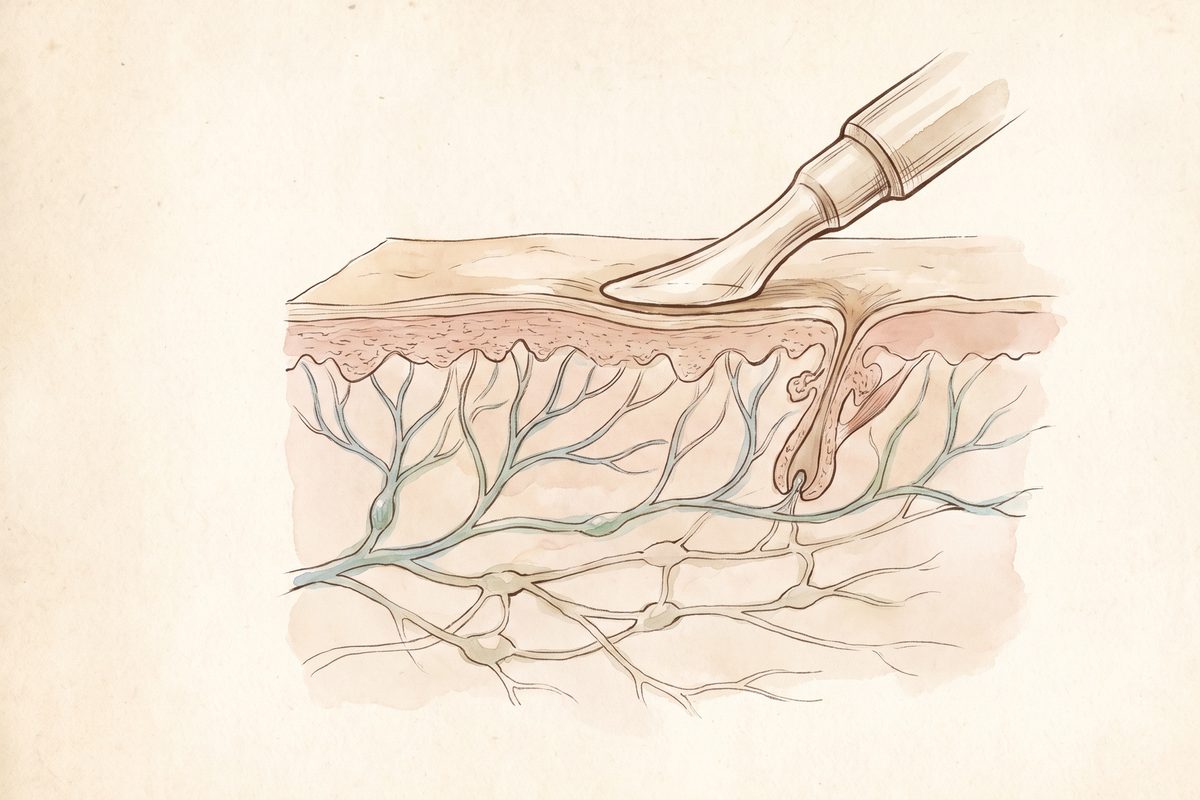
What is microneedling, and what does it do?
Microneedling uses fine needles to puncture the top layer of skin, and the small wounds prompt the skin to repair itself. A 2017 review in Dermatologic Surgery describes it as minimally invasive: the microwounds release growth factors and induce collagen production, and because the epidermis stays relatively intact, adverse events are limited. Collagen is the protein that gives skin its firmness.
On its own, the needling adds nothing to the skin. The skin's response to the small injury is the treatment.
Are microneedling, RF microneedling, derma pens and rollers the same thing?
No. One name covers four different things, and evidence for one does not carry over to another.
Clinic microneedling uses an automated pen holding a cartridge of fine needles, or a manual roller, in a clinical setting. Pens are sold under brand names, and Dermapen is one name people search for.
RF microneedling adds radiofrequency energy, which is heat, delivered through the needles. It has its own literature and its own trade-offs, which ultrasound, radiofrequency, RF microneedling and threads compared sets out.
Home rollers and pens are sold to the public. A 2014 report on complications noted that microneedle systems are accessible for home use.
Needling with products means a serum or other substance is applied before or during the needling, which places some of it into the skin.
The Medical Device (Designated Medical Device) Order 2026 lists lasers, HIFU and liposuction devices in its Schedule, and no microneedling devices appear among them. That leaves the question of any particular pen or roller open, so ask the provider. The Order, explained covers the public register.
Does microneedling work for acne scars?
Reviews say it can help, with limits. A 2022 meta-analysis pooled 12 randomised trials and 414 participants, comparing microneedling with other treatments. Microneedling without radiofrequency showed a significant advantage in objective scar improvement. The fractional RF microneedling group did not. Satisfaction was mostly no different between treatments, and the trials reported no secondary scarring or infection.
A 2026 review of 11 studies and 713 participants set microneedling against chemical peels for atrophic scars, the shallow, sunken kind. It found no significant difference in the proportion reaching 50% improvement or more, and microneedling was more likely to give some improvement. The authors call the two broadly comparable with no clear evidence of superiority, and microneedling caused more pain during the procedure. A 2025 network meta-analysis of 68 trials found combinations with laser ranked highest for scar scores, microneedling ranked most tolerable for pain, and no strong evidence that any treatment lowered the risk of pigment change.
Scar type, depth and skin all shape the choice, and how texture, pores and acne scars are assessed starts there.
Does microneedling work for wrinkles and skin quality?
Many people treated report being satisfied, and the measurement is weaker than that sounds. A 2025 systematic review pooled 21 articles and 723 patients and found 83% satisfied. The main aims were wrinkles and skin texture, most trials gave several sessions, and the number and timing of sessions varied. The authors conclude that satisfaction and low adverse events support it as a viable option, and that the lack of standardised measures for aesthetic outcomes calls for more research.
Satisfaction is what the person feels. It does not measure the wrinkle. That is the gap in this literature, and it is why a claim of a percentage improvement for wrinkles deserves a question about how it was measured.
RF microneedling has its own review. Its authors examined 42 higher-quality studies and describe it as effective, with collagen change that is slow and progressive and still improving at 6 months.
What are the side effects and risks?
Most are temporary. The 2017 review says permanent adverse events are uncommon, and that transient redness and post-inflammatory hyperpigmentation, darker marks after the skin heals, are the more commonly reported. In the 2025 rejuvenation review the most common effects were transient redness (6.8%), scaling (1.7%), burning (1.5%) and itching (0.4%).
Products change the picture. A 2014 report describes three women who developed facial granulomas, lumps of immune cells around a foreign material, after microneedling with a topical product. Two tested positive on patch testing to the product used. The authors write that applying products before needling can introduce particles into the dermis. Three cases give no rate. They explain why what is applied matters as much as the needling, and why the same rule applies at home.
The trials above were supervised studies. They say little about a roller used at home.
Is microneedling suitable for darker skin?
The evidence points in two directions, and it is short. The 2017 review lists post-inflammatory hyperpigmentation among the more commonly reported effects and calls for larger trials in different skin types. The 2022 meta-analysis found no pigment change from microneedling, with the pooled result favouring it, while the 2025 network meta-analysis found no strong evidence that any acne scar treatment lowered the risk. The RF review concludes that RF microneedling can be used in darker skin phototypes.
For Malaysian skin, where pigment change is the common worry, that is a reason to ask about the plan for it before treatment. Pigment laser side effects on Asian skin describes how that risk behaves with lasers.
Where does the evidence stop?
At five places. Trials compare microneedling with different treatments, so a pooled result depends on the comparator. Outcome measures are not standardised. Schedules vary in number and timing of sessions. Skin types are under-studied. And a review that finds two treatments broadly comparable has not shown either to be better.
None of this says microneedling does nothing. It says the improvement the reviews describe is gradual and modest, that results vary, and that no review supports a promise about your face. A doctor should be able to tell you what was measured, in whom and against what.
Does this clinic offer microneedling?
No. For clarity, this clinic does not offer microneedling, plain or with radiofrequency. Why this clinic does not offer RF microneedling gives Dr Ong's reason for the RF version. For acne, what a doctor checks first comes before any scar treatment.
The tool is simple. The claims around it need checking one at a time.