
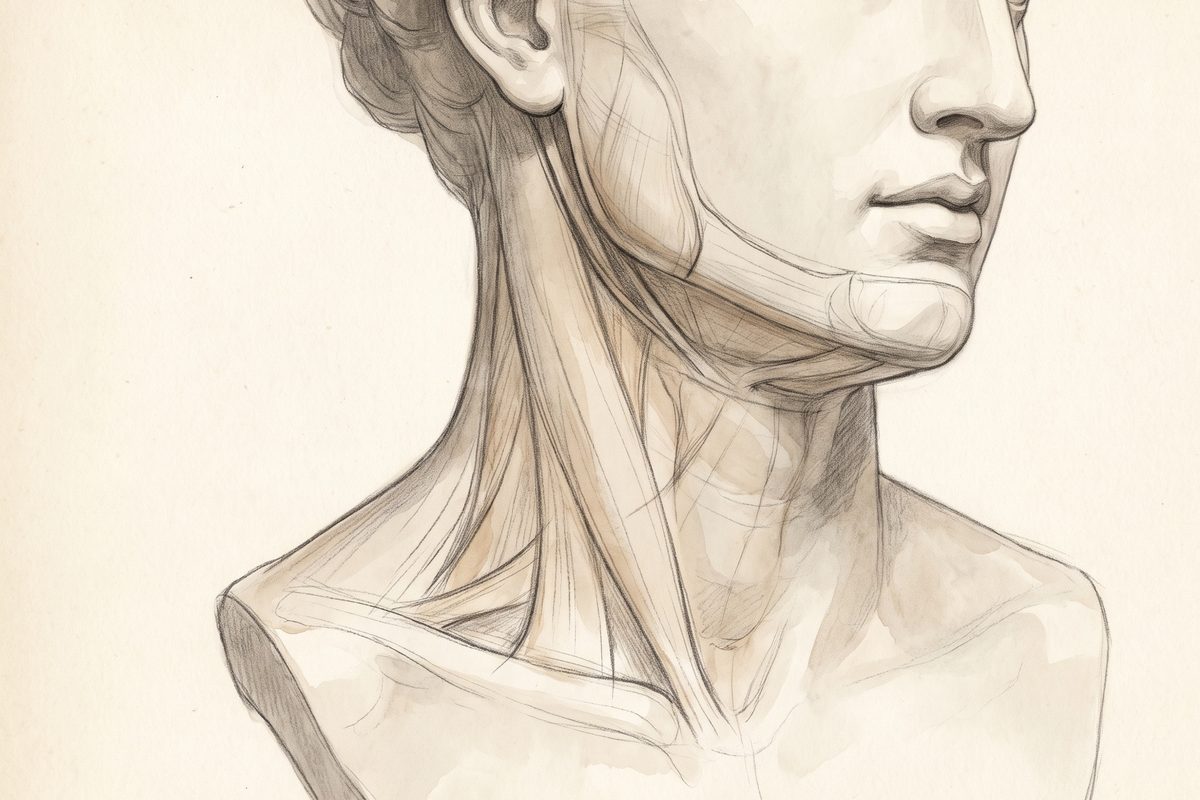
Why do three different neck problems look the same?
A sagging neck is a description. Behind it sit at least three different problems. The skin can lose its recoil and turn crepey. The platysma, the thin sheet of muscle across the front of the neck, can stand out as vertical cords. And fat can collect under the chin. Surgical reviews describe the neck as layers: skin, subcutaneous fat, the platysma, and the glands beneath it, with fat lying both above and below the muscle.
Because the layers sit on top of each other, a change in any one of them alters the outline. That is why the treatment that helped a friend may do nothing for you. This page is the triage. It sorts the three problems, says what each treatment class can do, and sends you to the longer pages on each.
What three mirror checks tell them apart?
Stand in daylight and do three things. First, tense the neck: clench your teeth and pull the corners of your mouth down. Cords that stand out from the collarbone to the jaw are platysma bands. Second, pinch the skin under the chin. Fat feels thick and mobile. Loose skin feels thin and folds easily. Third, look down and then back up. Skin that pools, folds or looks crepey when the muscles are relaxed points to laxity.
Most necks give a mixed answer. A mirror suggests and an examination decides, which is the same logic as in why a double chin is not always fat. Horizontal lines across the neck are a fourth thing, and they have their own page: what treats neck lines.
What can treat loose, crepey neck skin?
Energy devices heat tissue and the body answers by remodelling collagen over the following months. XERF (monopolar radiofrequency) and Ultherapy (micro-focused ultrasound) are both used on the neck at this clinic for early to moderate laxity. Micro-focused ultrasound is cleared by the US Food and Drug Administration to lift submental and neck tissue.
The trials show a real and modest effect. In a randomised trial of 20 people with moderate neck laxity, one treatment of monopolar radiofrequency or micro-focused ultrasound lowered investigator-rated laxity grades by day 90 and the change persisted to day 180, with no significant difference between the two. Ultrasound caused more pain. A study of 25 Asian patients measured a submental lift of 26.44 mm at 90 days, but the 13.76 mm at 180 days was not statistically significant. A 103-person trial of the lower face and neck found that blinded reviewers saw improvement in 58.1% at three months, and that no change was measured in 54.5% of people with a BMI over 30 against 12.2% of those at or under 30.
For radiofrequency as a class, a review of 121 articles found improved laxity and elasticity, and one serious neck complication, a fistula. There is no neck trial of XERF itself in what I read, so for XERF the evidence is the class evidence. Both devices tighten gradually, over months, and neither removes excess skin. Results vary, and the trials follow people for months.
What can treat neck bands?
Bands are a muscle, so the treatment is a muscle relaxant. Botulinum toxin (sold as Botox, Dysport, Xeomin and others) injected into the platysma lets the cords soften. At this clinic, botulinum toxin is used for neck bands when the assessment shows the muscle is the cause.
An early case series reported good to excellent results in the majority of 1,500 patients, rated by doctor and patient. Better evidence came in 2025, from two placebo-controlled phase 3 trials of onabotulinumtoxinA. In the first, among people affected by the look of their bands, 76.7% against 21.2% on placebo improved by at least one grade at day 14, and 41.0% against 2.2% by at least two grades. In the second, 32.3% against 1.9% reached a minimal or mild rating with at least a two-grade gain. Adverse events were similar to placebo in the second trial, with no dysphagia or muscle weakness reported. The manufacturer funded the first and employed authors on the second.
Both trials gave one treatment and followed people for 120 days. Responder rates stayed above placebo to day 120 and declined gradually, so the effect fades as the toxin wears off, and repeat treatment is how it is kept. The trials do not give a date when bands return. Toxin does not tighten skin and does not move fat.
What about fat under the chin?
Fat needs a fat-reduction tool, and tightening devices do not substitute. OndaPro (a microwave-based device) has a face handpiece that treats the fullness under the chin at this clinic. A study of a microwave system under the chin in 48 people, with six 10-minute sessions two weeks apart, recorded fat scores falling from 3.4 to 1.7 and laxity scores from 3.7 to 2.4 at 12 weeks, with no side effects observed. It followed people for 12 weeks after the last session, and it was a single-centre study with no control group.
Surgical papers describe fat on both sides of the platysma, and a surgeon can remove both. A pocket that is mostly muscle or mostly skin will not shrink with a fat-reduction device, which is why the pinch test comes first.
When is surgery the honest answer?
When laxity is marked, with excess skin that folds and hangs, or when the bands and the skin have both gone far. Surgical papers describe neck lift, platysma tightening and skin excision for this, and the best candidates for skin excision are described as having laxity limited above the thyroid cartilage with minimal jowling. A neck lift is a surgeon's operation. At that stage the honest step is a referral to a surgeon, because an energy device does not remove hanging skin.
The same logic applies one level up, where a sagging jawline has its own causes, set out in the jowls article.
How do the options combine, and what are the limits?
Many necks carry two or three of these problems, so plans often combine tools: toxin for the bands, an energy device for the skin, and a fat-reduction step where fat is present. The sequence follows what the examination finds. The trials above tested each option alone, so the size of a combined effect has not been measured.
Everything here is modest. The device trials are small, graded by raters the investigators chose, and followed for months. The toxin trials were funded by the manufacturer. No study compared these routes on the same neck. A plan is a reasoned estimate, and it changes as the neck responds.

