
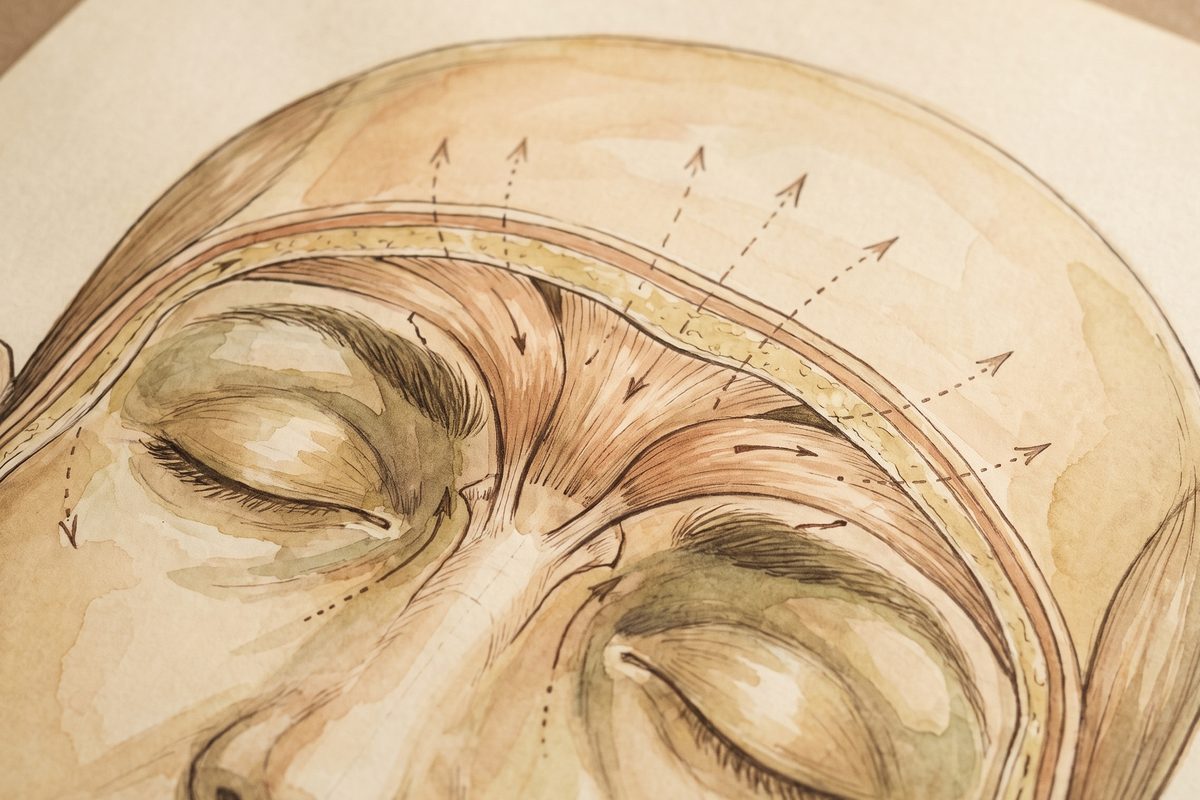
Can Botox treat depression or make you happier?
Botulinum toxin (Botox) is not an approved treatment for depression, and this page does not suggest anyone use it for mood. What exists is a small group of randomised trials in which people already diagnosed with major depression had botulinum toxin or saline injected between the eyebrows, and those given the toxin scored lower on depression scales a few weeks later. The question people type, "can Botox make you happier", is a different one: none of these trials tested people who were well.
The ideas behind the trials are old. Frown lines come from the corrugator and procerus muscles, which pull the brows together in worry, anger and sadness. If the face sends information back to the brain, softening those muscles might change how a low mood is held. That is the facial feedback hypothesis, and the sections below set out how far the evidence for it goes.
What is the facial feedback hypothesis?
The facial feedback hypothesis says that the expression on your face does not only show an emotion but also helps to produce it. Smile and you may feel a little warmer; scowl and you may feel a little more irritated. Psychologists have argued about it for decades, and results have been mixed.
The largest test so far, the Many Smiles Collaboration of 2022, recruited 3,878 participants in 19 countries. Asking people to mimic a smile or hold a deliberate expression could amplify and start feelings of happiness. A quieter method, holding a pen in the mouth so the face moved without the person noticing, gave a less conclusive answer. So the idea has support in a deliberate, effortful expression task, and weaker support when the signal is subtle. How much it matters to a clinical illness such as depression is a separate question that a laboratory task cannot settle.
What did the randomised trials find?
Three small trials from 2012 to 2014 gave the first signal. In the trial of Wollmer and colleagues, 30 adults with major depression who had not improved enough on medication received onabotulinumtoxinA or saline in the glabellar region. Six weeks after one treatment, depression scores had fallen by 47.1% in the toxin group and 9.2% in the saline group. The injections were an add-on to existing care, not a replacement.
Finzi and Rosenthal then randomised 85 people (74 analysed) to the toxin or saline in the corrugator and procerus muscles, at 29 units for women and 40 units for men. At six weeks 52% of the toxin group had responded, meaning a fall of 50% or more on the MADRS scale, against 15% with saline, and 27% against 7% were in remission. Magid and colleagues followed 30 participants for 24 weeks and crossed the groups over at week 12. Response on the 21-item Hamilton scale was 55% (6 of 11) in the group treated first, 24% (4 of 17) in the group treated second and 0% (0 of 19) with placebo. The remission difference was not statistically significant. The authors report that improvement went on after the cosmetic effect had faded at 12 to 16 weeks.
All three used a single treatment of a dose chosen for frown lines. Nothing in them is a recommendation about dose, timing or who should be injected.
What do the meta-analysis and the FDA reports add?
A 2026 systematic review by Gao and colleagues pooled eight randomised trials and 636 people. Facial botulinum toxin was associated with lower depression scores overall (standardised mean difference -0.81, 95% CI -1.23 to -0.38), a larger gap against placebo (-1.04) and an effect comparable to the antidepressant sertraline in the trials that compared them (-0.23). A subgroup that injected high doses across the whole face showed no significant difference from controls, so more injection did not mean more benefit in that group. Adverse events were similar to controls (relative risk 1.04). The authors declared no competing interests.
Makunts and colleagues took a different route. They analysed reports in the US FDA Adverse Event Reporting System, comparing depression reports among people given botulinum toxin for wrinkles, migraine, sweating, spasticity and other reasons with reports among people treated for the same conditions in other ways. For cosmetic use in the face the reporting odds ratio was 0.46 (95% CI 0.27 to 0.78), meaning depression was reported less often. Lower ratios appeared for other injection sites too, which the authors read as a sign that the effect may not depend on the frown muscles.
Why are these results hard to trust yet?
The first problem is blinding. When a toxin smooths the frown, the person can see and feel it, and so can the rater. A person who knows they were treated may expect to feel better, and expectation alone can move a depression score. Makunts and colleagues say so plainly in their own paper: the trials were flawed by the impossibility of reliably blinding the treatment. Saline cannot imitate a face that no longer frowns.
The second is size. The core trials enrolled 30, 30 and 85 people. The third is authorship: several of the same researchers appear on the trials, the pooled analyses and the FDA-report study, and one author of that study has consulted for a toxin maker. The 2026 meta-analysis is by an independent group, which is welcome, but it can only combine what the small trials measured. The fourth is the report study itself. Voluntary safety reports cannot show cause, differ in how they are made and are not a trial.
None of this says the finding is wrong. It says the signal is interesting and unproven, which is why botulinum toxin has not become a standard depression treatment.
Is Botox approved for depression in Malaysia, and does this clinic offer it for mood?
No approval for depression is named on this page. The US prescribing information for Botox, read for this article, lists bladder, chronic migraine, spasticity, cervical dystonia, severe underarm sweating, eyelid spasm and squint, and does not list depression. A registered use is one printed on the product registration, and the NPRA register is where it can be checked; how to check whether your Botox or skinbooster is KKM approved shows the search.
At The Retreat Clinic in Setia Alam, anti-wrinkle injections are done for expression lines, jaw, neck bands and a gummy smile, after the doctor has examined the face. They are not offered or advertised for mood, and nothing here is a reason to book one. The page on anti-wrinkle injections describes what the treatment is for, the brands article explains Botox and its generic name, and the side effects article covers what to expect. Another page looks at the separate question of how a relaxed or frowning face is read by other people: why do I look angry or tired when my face is relaxed.
What should I do if I am struggling with my mood?
Please see a doctor. Low mood that lasts more than a couple of weeks, loss of interest in things you normally enjoy, sleep or appetite changes, or thoughts of harming yourself are medical matters, and there are proven treatments, including talking therapies and medicines. An aesthetic injection is not a substitute for that conversation.
If you want to talk to someone now, Befrienders KL answers on +603-7627 2929, 24 hours a day, free and confidential. Talian Kasih, from the Social Welfare Department (Jabatan Kebajikan Masyarakat), is 15999. If you think you may act on thoughts of harming yourself, or someone is in immediate danger, call emergency services. You do not have to carry it alone.
The honest complication
Two things can be true together. The facial feedback idea is plausible, and a group of small trials found something that deserves a larger, better-blinded study. Yet a lower score on a rating scale in a trial that cannot hide who was treated is not the same as a treatment that works for you, and a smoother frown is not a mood treatment. If a clinic or an advertisement suggests otherwise, treat it with caution.

