
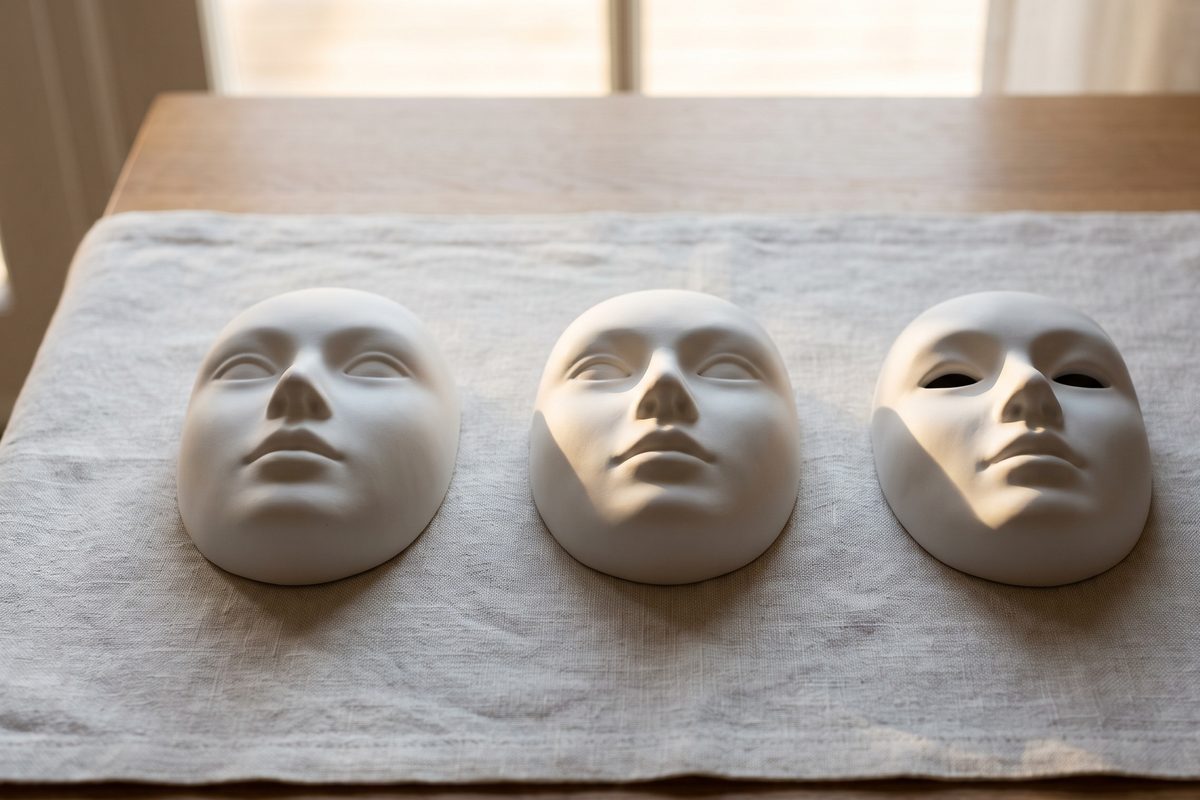
Why do I look angry or tired when my face is relaxed?
Because strangers read emotion from where the brow, the lids and the mouth sit, and a relaxed face can sit in a position that resembles an expression. Researchers call it a neutral face, and people search for it as a resting face. In experiments with edited faces, moving the eyes and the mouth a little closer together made a blank face look angrier, and moving them a little further apart made it look sadder, with no muscle moving at all.
A second study came at it from the other side. Neutral faces that observers judged threatening were found, by a classifier trained on expressions, to bear a measurable resemblance to anger. The authors describe the judgement as an overgeneralisation of a system that normally reads real emotion well.
So the question that follows is which feature is being read, because the answer decides who treats it. The sections below take the frown area, the brow and lids, and the mouth corners in turn.
What do observers read in the brow and the frown area?
In a 2008 experiment, one photograph of a youthful upper face was edited to change one feature at a time, and 20 people scored 16 images for seven emotions. Depressing the inner brow and adding lines between the brows were read as anger and disgust. Lowering the upper lid, changing the crease of the lid and depressing the outer brow raised the score for tiredness. Brow shape counted for more than its height alone, and raising the outer brow was read as surprise.
The lines between the brows are made by the corrugator and procerus muscles, which draw the brows down and together. Anger, fear and sadness are all associated with corrugator activity. The experiment edited one face and was scored by 20 people, so it shows which features can matter and says little about how often they do.
Does relaxing the frown muscle change how anger is read?
In small studies, it did. In one, 40 viewers who did not know about the treatment rated photographs taken before and after botulinum toxin (sold as Botox) in the frown muscles. The treated faces were rated as showing 40% less anger, 49% less fear and 10% less sadness, and 71% more happiness. In another, 52 women were recorded while watching emotion-inducing clips, before and a month after treatment of the glabella, and 31 observers rated the clips. The perceived intensity of anger fell by 50.4%, surprise fell by 20.6%, and disgust rose by 39.0%. Observers could still tell which emotion was being shown.
A 2026 study asked 118 raters to judge posed anger, joy, surprise and neutral expressions before treatment, at two weeks and at 16 weeks. Anger and surprise were attributed less at peak effect, while joy and neutral expressions stayed stable, and the authors saw no frozen-face appearance. Movement had partly recovered by 16 weeks.
These studies rated photographs and expressions that were provoked or posed, so they say little about a face at rest over years. They are also short and small. The clinic's page on anti-wrinkle injections names the frown line between the brows as one of the lines botulinum toxin treats, says a first treatment is often smaller than expected, and says the frozen look comes from too much product or the wrong site.
What about the lids, the lower brow and the tired look?
The same 2008 experiment found that tiredness was driven mostly by the lids. Lowering the upper lid, changing the crease and depressing the outer brow raised the tiredness score, and the authors concluded that tiredness is most affected by the pretarsal height of the lid, as in ptosis. Simulating the skin removal of an upper-lid operation paradoxically raised the tiredness score too, which shows how easily a well-meant change can move the reading the wrong way.
A hooded look has three different causes, a low brow, extra lid skin or a lid that sits low, and hooded eyes without surgery sets out which can be nudged without surgery and by how little. At this clinic a low brow can also be treated with radiofrequency (XERF), by assessment. The eye side is an oculoplastic surgeon's to assess, and Dr Catherine Chow explains what makes eyes look tired, from an eye surgeon's point of view, including the changes under the eye.
Shadows and hollows below the eye are the other half of the tired look, and dark circles are not one problem. How tired-looking eyes feed into the reading of age is a separate subject, covered in why people look older than their age.
Why can a relaxed mouth look sad or stern?
Two things are at work. The first is proportion. In the study of neutral faces, an eyes-to-mouth distance shorter than average read as angrier and a longer one as sadder, and the effect grew with the amount of change. That is a matter of how the features are laid out and no muscle is involved.
The second is the muscles that pull the mouth corners down. A 2026 narrative review places the depressor anguli oris and the platysma among the lower-face muscles linked to cues of sadness and contempt, and to dominance and approachability. In a prospective study of 51 people with drooping mouth corners, toxin injected on each side improved the corners at four weeks, and the improvement was gone by 12 weeks. The most severe cases still did not reach a satisfactory result at the highest dose tested. Corners that sit low can also reflect lost volume or sagging in the lower face, which the sagging skin page sets out.
Which of these are skin-clinic questions, and which are not?
The frown muscle, the balance of the forehead and brow, the muscles around the mouth and the volume and quality of the skin are skin-clinic questions. A lid edge that sits low, extra skin on the upper lid, fat under the lower lid and changes linked to the thyroid belong to an eye specialist, and the skin clinic refers.
A new or one-sided change is a medical matter. A sudden drooping lid, double vision, headache or a change in vision needs urgent review. A face or mouth that droops on one side, or a smile that has become hard, can be a sign of a stroke, and that is a reason to call emergency services (999 in Malaysia) and not to book an appointment.
The honest complication
The research on how faces are read is made mostly of edited photographs, small groups of raters and short follow-ups. The studies cited here do not measure what a stranger makes of one real person's face at rest over a day, and the treatment studies rate expressions that were provoked or posed. The size of any change is an average from small groups and cannot be promised to one face. Some faces look serious at rest because of the way they are built, and need nothing. Whether a feature is worth changing is a decision made after looking at the face in front of the doctor.

