Quick answer
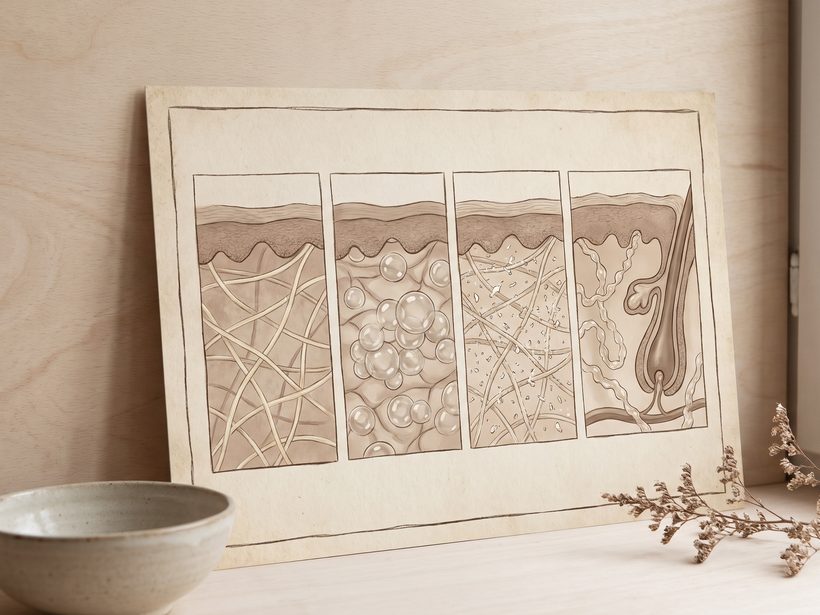
An hADM skin booster is an injectable made from human acellular dermal matrix. The dermis is the layer of skin under the surface. "Acellular" means the cells have been removed, leaving the collagen-rich framework. The framework is dried and milled into a fine powder, and a clinic mixes the powder with liquid hyaluronic acid before injecting it. The two names people search most are Elravie Re2O (also written RE20) and CellREDM. Nine named boosters are in the table below. A member of Korea's National Assembly said on 13 Oct 2026 that about 100 products from about 20 companies were on the market.
The order of the table is not a ranking. Company statements are labelled as the company's, and "none found" means no published human trial turned up in our searches on 2 Nov 2026.
| Brand | Maker (and distributor) | What the maker says it is made from | Published human trials |
|---|---|---|---|
| Elravie Re2O (RE20, 리투오) | L&C Bio (distributed in Korea by Humedix; L&C Bio also sells direct) | Donated human dermis processed to fine particles. Versions: Re2O, Re2O Fine, Re2O V | One trial, 20 adults, 20 weeks. One case report of a blood-supply complication |
| CellREDM (셀르디엠) | Hans Biomed (Hugel from 1 July 2026; Hans Biomed also sells direct) | Human dermis taken through a process that lowers cell material and nucleic acid while keeping collagen, elastin and sugar-protein chains. Versions: CellREDM, CellREDM V | None found |
| GCELLE RIBONNE (지셀르 리본느) | MS Bio processes it; GC Wellbeing sells it | MS Bio applies its own process to remove cells and the factors that trigger immune reactions | None found |
| Rhealo Inject Fine (리알로 인젝트 파인) | CGBio group (sold by group company DN Company) | Donated human tissue with the cells removed and the dermal structure kept | None found |
| CELIVION and CELIVION LINJAY (셀리비온) | Orthotech (BioBijou holds the Korean rights) | A low-temperature process meant to keep the structure and key proteins of the matrix | None found |
| Juveacell (쥬브아셀). Thinly documented | DOF (sold by Bim) | A 2026 review, quoting the product leaflet, calls it an injectable hydrated acellular dermal matrix made with a carbon dioxide process. The review's only tissue image is from rats | None found |
| ADITE (아디떼). Thinly documented | MedPark (no distributor listed) | No product-specific statement found. In Oct 2025 MedPark said it would launch a booster built on its controlled-rate-freezing technology, without naming the product | None found |
| Hucellin (휴셀린). Thinly documented | Maker not shown (sold by DM Bio) | Nothing found | None found |
| VELUCELL (벨루셀). Thinly documented | Maker not found (Dongbang Medical holds the importer licence) | Nothing found. Not yet launched on 29 Oct 2026 | None found |
One more product is sometimes mixed up with these. FreedomInject Refill is a dermis injection for ligament, tendon and muscle repair, and it is not marketed as a skin booster.
What does "human-derived acellular allogeneic dermis" mean?
It is the technical name for the material, and it can be read word by word. "Human-derived" means it comes from a person. "Acellular" means the cells have been taken out. "Allogeneic" means it comes from a different person from the one receiving it. "Dermis" is the layer of skin under the surface. In short, it is skin from another person with the cells removed.
L&C Bio, the maker of Re2O, uses these words. At a press briefing on 29 April 2026 the company said Re2O is not a "cadaver skin injection" but human-derived acellular allogeneic dermis. Its chairman said that dermis with the cells and DNA removed is a fundamentally different scientific idea from raw cadaver skin. That is the company's argument. It draws a line between the processed product and raw skin, and it does not say whether the donors were alive.
Where does the skin come from?
The makers say: donated skin, from donors in the United States, supplied through tissue banks accredited by the American Association of Tissue Banks (AATB), with the donor's prior consent to cosmetic use. L&C Bio said this about Re2O in April 2026. Hans Biomed said in October 2025 that it receives tissue from AATB-accredited US tissue banks, keeps tissue consented for medical use only separate from tissue consented for cosmetic use, and that CellREDM material comes from donors who gave prior written consent to cosmetic use. For GC Wellbeing, CGBio, Orthotech, DOF, Bim and MedPark we found no statement on the donor's country or consent beyond "donated human tissue" or "lawfully managed raw material".
The Re2O trial paper uses careful words. It says the product was made from "donor-derived human dermal tissue obtained with informed consent for cosmetic use", handled to AATB guidelines. It does not say where the donors lived, and it does not say whether they were living or had died.
Independent reports are plainer. Korean outlets (including MTN, Newsis and Bizwatch), the Korea Herald, the Korea JoongAng Daily and Hong Kong and mainland Chinese outlets describe the donors as people who had died. Korea's Ministry of Health and Welfare says the materials are imported and that bodies donated in Korea are not used for these products.
Two claims have no source behind them. No maker says its skin comes from living donors, and no maker says it comes from surgical leftovers. We searched in Korean and English and found no such statement. Equally, no maker uses the word "deceased" about its own raw material in the pages we read. We cannot say more than that.
How are they made?
There is no single recipe, and each maker's method differs. A Korean business paper describes the general steps, from industry accounts rather than any regulator's standard. A tissue bank collects the skin after checking consent, medical history and infection risk. The surface layer and fat are removed. The cells are removed with detergents, ultrasound or special solutions, depending on the company. The tissue is freeze-dried and milled into fine particles, and the leftover DNA is tested. The clinic then mixes the powder with liquid hyaluronic acid.
Some doctors worry about chemical leftovers. A National Assembly member raised possible traces of a detergent called SDS and of DNA. A pharmacy professor at Chung-Ang University listed leftover DNA, SDS and a chemical linker called EDC as possible causes of delayed allergic reactions or lumps. These are worries, not measured findings, and we found no independent test of any product. The makers' own figures are company claims: for example, a plastic surgeon described company data showing leftover DNA of 4 ng/mg or lower for Rhealo Inject Fine, and the Re2O trial paper describes the product as under 50 ng/mg.
How does Korea regulate them?
In Korea these products are supplied as human tissue under the Human Tissue Safety and Management Act, overseen by the Ministry of Food and Drug Safety through tissue-bank licences. They are not licensed as medicines or medical devices. Figures from a National Assembly member's office show about 100 of these boosters distributed, all classed as human tissue with no drug or device licence. A licence to import tissue is enough to sell one.
The government says this framework has gaps. On 7 Oct 2026 the health minister said the Act has limits and a different management system is needed. On 13 Oct the head of the Ministry of Food and Drug Safety said the ministry will study whether powder should stay classed as human tissue, and on 22 Sep the ministry said it is considering classing these products as medical devices. We found no recall, ban or licence suspension.
Being classed as human tissue is not an approval. We have not written "approved" for any of these products in Korea, and we found no statement from the US Food and Drug Administration about any of them.
What happened in Hong Kong?
Hong Kong's Department of Health says Re2O contains human dermis, so it is a "regulated product" under the Human Organ Transplantation Ordinance and a pharmaceutical product under the Pharmacy and Poisons Ordinance. Selling it needs an exemption from the Director of Health, and none has been granted. On 21 Oct 2026 officers raided four beauty premises, seized 20 vials of Elravie Re2O in Korean packaging, and arrested a 38-year-old woman on suspicion of unlawful dealing. A local distributor told the press it had applied for the exemption in February 2026. The action we found concerned Re2O. We found no regulator action against the other brands in China, Singapore or Japan.
Re2O's maker says it has approvals in Thailand, Peru and the United Arab Emirates. Those are the company's and press reports' statements, and we did not check them on the regulators' own sites.
What does the evidence show?
Re2O has one published trial. It was a randomised, split-face trial in 20 adults aged 30 to 65, run by a Yonsei University group over 20 weeks. One side of each face got particulated hADM mixed with hyaluronic acid and the other side got hyaluronic acid alone. The hADM side did better on several instrument readings, including skin density, hydration and elasticity, and there were no serious adverse events, only mild, short-lived redness and swelling. The authors list their own limits: a small group, 20 weeks that cannot show long-term or delayed effects, and a test product that was a mixture. The product was supplied by L&C Bio and one author advised on its development. The registry entry for the trial was made after it ended.
There is also one published case report. A 44-year-old woman injected at an outside clinic had pain, redness and pustules two days later, with suspected blood-supply trouble in the forehead. An enzyme that dissolves hyaluronic acid did not help, and the authors note that it would not dissolve hADM. She was treated with oxygen therapy and medicines, and at nine weeks a photo she supplied showed the pustules gone with some scarring. One patient is a signal, not a rate.
For CellREDM, Juveacell, GCELLE RIBONNE, Rhealo Inject Fine, CELIVION, ADITE, Hucellin and VELUCELL, we searched PubMed and ClinicalTrials.gov and found no published human trial. No trial compares Re2O with another booster. Companies have quoted large numbers of procedures. L&C Bio said about 300,000, and a physician at a company event said more than 400,000, but those are company claims and not safety studies.
Doctors in Korea hold different views on what that means. Dr Lee Jong-hee of Samsung Medical Center said hADM has long been used in reconstructive surgery but that safety record cannot simply be carried over to injection. Dr Lee said no serious adverse events have been reported in clinical studies so far, but the studies are small and short and do not reflect repeat use. Professor Lee Won-jae of Severance Hospital said ethically donated, strictly processed injectable tissue has good immune compatibility and few serious reactions. Dr Ong Jin Khang said on 26 October 2026: "I'm really not sure of the results and I for one feel it's very icky to inject cadaver tissue."
Are they in Malaysia?
We searched the Medical Device Authority register on 2 Nov 2026 (data last updated 1 Nov 2026) for Re2O, RE20, Elravie, CellREDM, GCELLE, RIBONNE, Rhealo, CELIVION, Linjay, Juveacell, ADITE, Hucellin, VELUCELL and the makers and distributors named in the table. None matched. Searches for Juvederm, Profhilo and Rejuran did work, so the search itself works. The register says that anything not shown is unregistered, expired, suspended or cancelled, and we could not search expired entries.
We could not reach the pharmaceutical regulator's product search on 2 Nov, so it was not checked that day. On 26 Oct it showed no result for "Elravie" or "L&C BIO". We also do not know whether Malaysia would class a human-tissue injectable as a device, a medicine or a tissue product. No Malaysian ruling on these products was found. So the accurate sentence is that we did not find them on the register, not that they are illegal. A box with a registration number can be checked in the article on checking a product.