
How long do biostimulators last?
Roughly one to two years in the studies, and the figure depends on the material. A 2026 systematic review of 14 studies reported that poly-L-lactic acid maintained its effects for up to 25 months and calcium hydroxylapatite for 12 to 18 months. Those are the longest published ends of the range, not what every person will see.
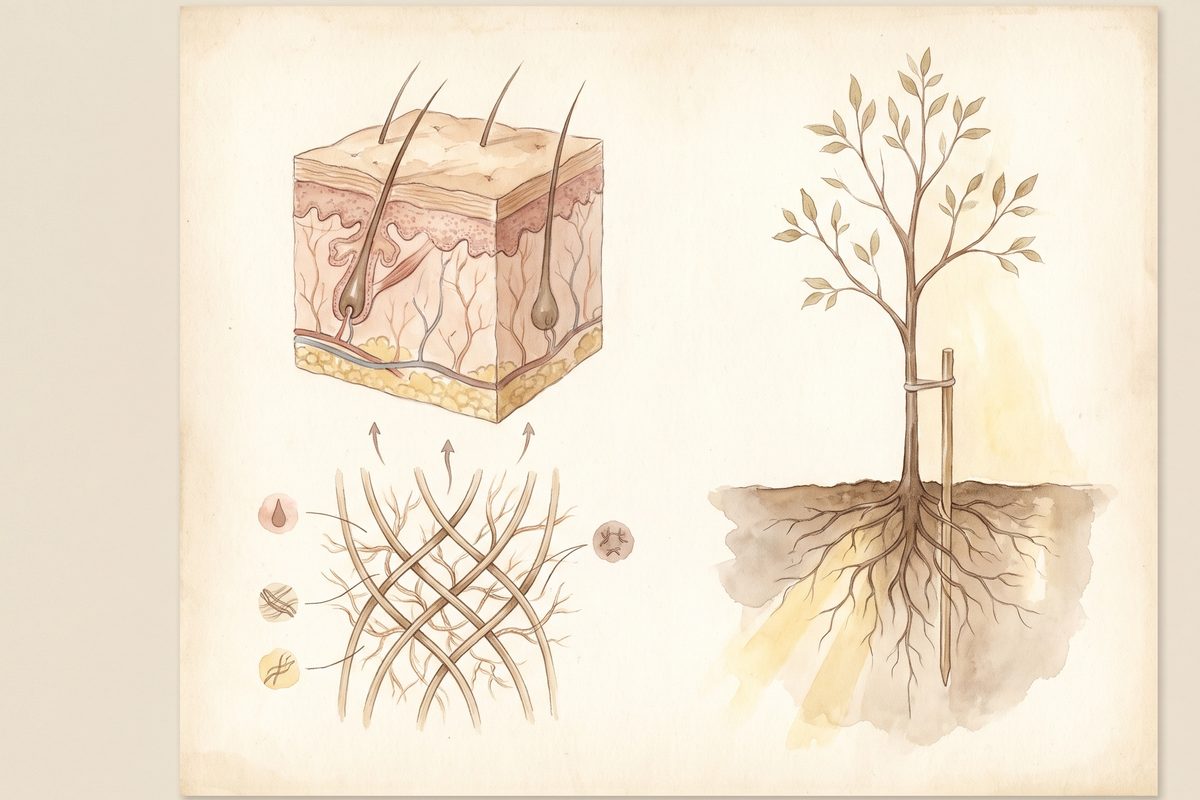
Biostimulators work differently from a hyaluronic acid filler: the particles ask the skin to build its own collagen, so the effect arrives over weeks to months and fades slowly rather than stopping. The article on the biostimulator types matches the brand names people search to the material in each, and three roads to collagen explains where biostimulators sit beside energy devices and skin boosters.
How long does poly-L-lactic acid last?
The longest follow-up data are for this class. A 2026 French split-face trial followed 55 adults with moderate to severe nasolabial folds for 24 months and compared two poly-L-lactic acid products. At 24 months the newer product had improved the wrinkle severity score by a mean of 0.21 points, and the established product by 0.12, which did not reach statistical significance. So "up to 25 months" means some effect was still measurable in the best case, and in that comparison one side was no longer clearly better than baseline.
A multicentre Chinese randomised trial followed people for 120 weeks, a little over two years, comparing poly-L-lactic acid with a hyaluronic acid filler. Both worked similarly at 4 and 12 weeks. At 120 weeks, 55.56 percent (35 of 63) of the poly-L-lactic acid group still had effective correction, against 25.00 percent (18 of 72) with hyaluronic acid. Of 208 people randomised, 135 were analysed at that point, and the authors say this loss of participants has to be kept in mind.
How long does calcium hydroxylapatite last?
The reviewed range is 12 to 18 months. A 2026 network meta-analysis of 20 randomised trials found calcium hydroxylapatite better than hyaluronic acid for nasolabial folds at 6 to 9 months, with no significant difference from poly-D,L-lactic acid. That comparison stops at 9 months, so it supports the early part of the curve and not how long it lasts.
The same systematic review reported mostly mild adverse effects, and one serious case of compression necrosis with calcium hydroxylapatite. That is one report in 14 studies, and it is the reason the doctor's technique and the product choice are part of the assessment. The article on nodules and delayed lumps covers the other risks.
How long do polycaprolactone and poly-D,L-lactic acid last?
For polycaprolactone, a randomised trial of 160 Chinese adults reported an effectiveness rate of 88.8 percent at 12 months against 23.8 percent for hyaluronic acid gel, with the hyaluronic acid result fading from about 3 months. That study followed people for one year, so it cannot say what happens in year two. Longer longevity figures for this class are not measured in the trial read for this page.
For poly-D,L-lactic acid, there are fewer trials. A Brazilian expert consensus advises maintenance about every two years, or sooner for those whose collagen breaks down faster, and notes that clinical trials of this material for aesthetic use remain limited. A consensus is expert opinion and not a measurement, and its authors speak for a distributor.
What is the initial course before any top-up?
It depends on the material and the plan, and the long-follow-up papers describe it differently. The polycaprolactone trial gave one treatment, started at a lower dose, with a touch-up allowed at one month. Poly-L-lactic acid is commonly described as a series of injections over several months, with the effect building over weeks, and the exact number of visits in the two poly-L-lactic acid trials above sits in their full methods and not in their abstracts.
So the length of the first course is part of what a long-term number is measured from. A result that "lasts 25 months" begins counting from the end of a course whose length differs between studies. The biostimulator cost article covers how many sessions a course may need and what a quote should state.
When should you top up a biostimulator?
The word has two meanings, and the evidence differs. An early touch-up finishes a correction that was deliberately started under-dosed. In the polycaprolactone trial, people were first given a lower dose and the investigators could add more at the 1-month visit. That is a plan agreed at the start.
Maintenance comes later, when the face has changed back toward where it began. The only published interval in what was read is the poly-D,L-lactic acid consensus of about two years, and nothing else fixes a number for poly-L-lactic acid, calcium hydroxylapatite or polycaprolactone. So treat anyone who quotes a single date as giving an average, not a rule. The review visit is where the decision is made, and the biostimulator cost article explains why a quote should say whether that review is included.
What shortens how long a biostimulator lasts?
The honest answer is that the studies read for this page do not isolate the reasons. The one source that speaks to individual differences is the poly-D,L-lactic acid consensus, which advises shorter intervals for patients who show accelerated collagen degradation, without saying why. Age, weight change and the area treated are plausible factors, but none has been shown to set a number of months, so this page does not name one.
What can be said is how the numbers are measured. The trials score a nasolabial fold on a wrinkle scale, and the folds of one person's face may not behave like the cheeks or the jawline of another. A figure of "25 months" does not describe a particular face. For the comparison with hyaluronic acid, see how long filler lasts and what makes it fade.
Is the biostimulator gone when the result fades?
Not necessarily. The visible effect and the material are different things. The material is broken down by the body over time, and what you see also depends on the tissue response it prompts, so a result can fade while some particles remain. That is also why a lump can appear late, and why a biostimulator cannot be dissolved in the way a hyaluronic acid filler can.
A top-up is therefore judged by how your face looks and by an assessment of what is already there, not by assuming the product has disappeared.
Who funded these numbers?
Some of the data come from the makers or the people who sell the product, and that affects how far the figures can be trusted. The poly-D,L-lactic acid consensus authors speak for a distributor. The polycaprolactone paper declares no funding or conflicts, although two of its authors are affiliated with a medical company, the 120-week poly-L-lactic acid paper reports no conflicts, and in the 24-month trial one author reports funding for trial work. Each studied a particular product.
Every source here also says something is missing. The systematic review calls for standardised techniques and long-term safety data, the network meta-analysis calls for more rigorous trials, and the 120-week authors flag loss of participants. Read the figures above as the best published range, not a guarantee for your face.
The honest complication
None of this tells you when your own biostimulator will fade, and this page does not try to. The figures come from nasolabial fold studies with different products, different follow-up and different ways of scoring. A longer number can reflect a better product, a better-suited face or a study that lost the people whose results had faded. The reliable step is a review with the doctor who treated you, comparing how you look now against how you looked at the start. Dr Ong performs injectables at this clinic, and the biostimulators page describes the treatment itself.

