

Foundations

Emsella side effects: who should not sit on the chair, and what the first session is like

Dr Ong Jin Khang · MMC 45245 · LCP holder · The Retreat Clinic, Setia Alam

Studies of the Emsella chair, which stimulates the pelvic floor with focused electromagnetic energy (HIFEM), report few side effects, but pacemakers, metal implants and pregnancy are reasons not to sit on it. A first session is seated, fully clothed and about 28 to 30 minutes. The trials are mostly small, and the sham-controlled pilot read for this article found no significant difference from sham stimulation.

A painted plate of an empty cream armchair beside a potted fern in a terracotta pot, with a small round wooden side table holding a glass of water, in a bright daylit room. Illustration, not a photograph.

A chair, a screen, then a plan.

On this page
  1. What does the Emsella chair do?
  2. What do the trials show, and what are their limits?
  3. What are the side effects of Emsella?
  4. Who should not have Emsella?
  5. What is the first session like?
  6. How many sessions do studies use?
  7. When should I see a urogynaecologist or physiotherapist first?

What does the Emsella chair do?

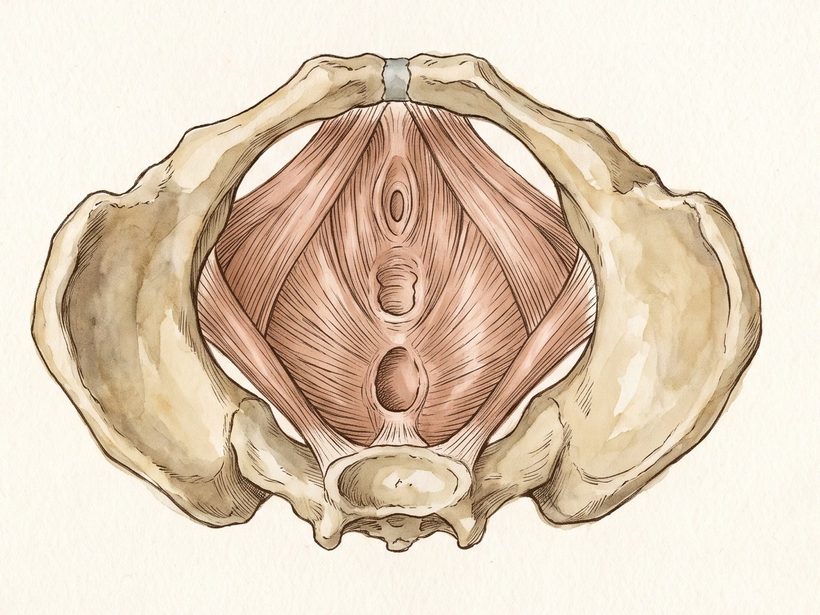
It is a chair with a coil in the seat that delivers high-intensity focused electromagnetic energy (HIFEM) to the pelvic floor muscles. The field makes the muscles contract without you tightening them. In one trial protocol that came to about 11,000 contractions in a 28-minute session, which is why the treatment is described as muscle training done for you. How Emsella works, and which leakage it can help covers the mechanism and the types of leakage; this page is about risk and the first visit.

What do the trials show, and what are their limits?

The early evidence is encouraging and uncontrolled. In a 2019 study of 75 women, Samuels and colleagues gave six 28-minute sessions over three weeks. Afterwards 61 of 75 reported a significant reduction in symptoms, the ICIQ-SF incontinence score improved by about 50%, rising to about 64% at three months, and pad use fell by about 44% and then 54%. There was no control group, so some of that improvement may come from expectation and the natural course of symptoms.

Controlled evidence is smaller and more cautious. A 2026 pilot of 40 women compared HIFEM plus pelvic floor training with sham HIFEM plus training, weekly for six weeks. It found no significant difference between the groups on any outcome; pad-test leakage improved within the HIFEM group (p = 0.049), while symptom scores improved in both. It was a feasibility pilot, and its authors ask for a larger trial. A 2026 randomised trial of 44 women gave everyone supervised pelvic floor training, with HIFEM added in one arm. After correcting for multiple comparisons, the HIFEM arm improved more on peak muscle activity, maximum voluntary contraction and one symptom score; the other measures did not hold up, and there was no HIFEM-only arm.

In men, a 27-man retrospective study after prostate surgery reported the incontinence score falling from 10.58 to 5.43 after six sessions and 4.16 a month later, with no control group. Taken together, the fair summary is that the chair is promising as an addition to exercise, that benefit as a stand-alone treatment is not settled, and that long-term follow-up is thin.

What are the side effects of Emsella?

Few have been reported. The 75-woman study recorded no pain, downtime or adverse events. The 27-man study reported only mild, transient muscle discomfort and no major adverse effects. The 99-woman comparison reported no treatment-related adverse events, and the 44-woman trial had the intensity raised to the maximum each person tolerated.

Read those results with their limits in mind. The studies are small, last weeks to months, and enrolled people after screening out the groups described below, so they describe screened people and do not prove that no one is affected. Muscle soreness or fatigue after a session is a reasonable thing to ask about, and any sharp pain, new bleeding or a change in urinary pattern is a reason to stop and be assessed.

Who should not have Emsella?

The trials give a consistent list of exclusions. A cardiac pacemaker or implanted defibrillator, a metal implant such as spinal cord hardware, and other implants contraindicated for magnetic fields. An untreated cardiac arrhythmia. Vaginal or pelvic surgery in the last six months, childbirth in the last 12 weeks or a miscarriage in the last six, and any recent surgery. An active urinary or genital infection, blood in the urine of unknown cause, or an untreated blockage to bladder outflow. Pelvic cancer or pelvic radiotherapy in the last six months. Neurological or neuromuscular disease, or kidney or liver failure. Prolapse of stage II or above, and fever.

Two cautions on that list. These are exclusion criteria from published trials, not the manufacturer's own contraindications, although one trial also excluded anything the device manual lists. The manual governs, and a clinic should be able to show it. And this clinic's screening also excludes pregnancy, even though the trials above, which enrolled women who were not pregnant, do not discuss it.

What is the first session like?

It starts with an assessment of the type of leakage, because the chair suits some patterns and not others. At the session you sit upright on the chair fully clothed, with staff positioning you so the field lines up with the pelvic floor. There is no probe and no preparation, and the session lasts about 28 to 30 minutes with no recovery time.

The sensation is the muscle contracting in rhythm. In the trial protocols the intensity was raised gradually to the maximum the person tolerated, so you are part of setting the level and can say when it is too strong. Mention any implant, device or recent surgery before the chair is switched on.

How many sessions do studies use?

Most used six sessions of 28 minutes, twice a week over three weeks. The 44-woman trial used twelve sessions, twice weekly for six weeks, and the sham-controlled pilot used six weekly sessions. At this clinic a course is usually six sessions over about three weeks, confirmed at assessment and reviewed against how symptoms respond. No study read shows how long the effect lasts beyond a few months, so no duration is promised.

When should I see a urogynaecologist or physiotherapist first?

See a doctor first for leakage with pain, blood, fever or a sudden change in pattern, and for a bulge or heaviness that suggests prolapse. In a comparison of 133 menopausal women with grade 2 prolapse and leakage, surgery corrected the prolapse more often than the chair (88% against 64% reaching stage 0) and recurred less at one year (14% against 31%), while the chair allowed a faster recovery, with 91% back to daily activities within a week. Prolapse beyond a mild degree belongs with a urogynaecologist first.

Supervised pelvic floor muscle training, usually led by a physiotherapist, is the usual first-line treatment for stress incontinence, and the chair can sit beside it. In the 99-woman study, adding a structured Kegel programme to Emsella gave better scores than Emsella alone. Leaking urine after childbirth sets out the exercises and when each route is right, and the bladder leakage page maps the types. Emsella is offered at this clinic, and Dr Ong sees the patients; the Emsella page explains the treatment and the assessment that comes first.

Common questions

What are the side effects of Emsella?

Published studies report few. A 75-woman study reported no pain, downtime or adverse events, a 27-man study reported only mild, transient muscle discomfort, and a 99-woman study reported no treatment-related adverse events. These are small, short studies of people who were screened first, so they cannot rule out rarer effects.

Who should not have Emsella?

Trials excluded people with a pacemaker, implanted defibrillator or other metal or electronic implant, cardiac arrhythmia, recent pelvic surgery or childbirth, active urinary or genital infection, pelvic cancer or radiotherapy and neurological disease, and those with prolapse beyond a mild degree. This clinic also screens out pregnancy. The device manual governs, so ask for the contraindication list before booking.

Is Emsella painful, and what happens in the first session?

The trials report no pain from the treatment itself. You sit upright and fully clothed on the chair for about 28 to 30 minutes, and the pelvic floor muscles contract repeatedly while the intensity is raised in steps to a level you tolerate. There is no probe and no recovery time. An assessment comes before the chair.

How many Emsella sessions do studies use?

Most of the trials read used six sessions of 28 minutes, twice a week over three weeks. One used twelve (twice weekly for six weeks) and one used six weekly sessions. The number for any individual is set at assessment and reviewed against symptoms.

Does Emsella work, and is it better than Kegel exercises?

Results are mixed and the evidence is early. Uncontrolled studies report large symptom gains, but a sham-controlled pilot of 40 women found no significant difference between real and sham stimulation. In a 44-woman trial, adding Emsella to supervised pelvic floor training improved some measures more than training alone. Supervised pelvic floor muscle training remains the usual first-line treatment.

Can I have Emsella in Setia Alam?

Yes. Emsella is offered at The Retreat Clinic in Setia Alam, and Dr Ong sees the patients. The Emsella page sets out the treatment, and the first step is an assessment of the type of leakage.

Sources

  1. Samuels JB, Pezzella A, Berenholz J, Alinsod R. Safety and efficacy of a non-invasive high-intensity focused electromagnetic field (HIFEM) device for treatment of urinary incontinence and enhancement of quality of life. Lasers in Surgery and Medicine, 2019;51(9):760-766 Seventy-five women with stress, urge or mixed incontinence, no control group, six 28-minute sessions twice a week. After the sixth session 61 of 75 (81.33%) reported significant symptom reduction; ICIQ-SF improved by 49.93% after the sixth session and 64.42% at three months, and pad use fell by 43.80% and 53.68%. Patients reported no pain, downtime or adverse events.
  2. Kilicoz Bakar M, Ozkocak G, Algun ZC. Comparison of high-intensity electromagnetic therapy and pelvic floor muscle exercises in women with urinary incontinence: a randomized controlled trial. International Journal of Women's Health, 2026;18:612726 Forty-four women with stress incontinence, 22 per group. Both groups did supervised pelvic floor muscle training three times a week for 8 weeks; one also had HIFEM twice a week for 6 weeks in 28-minute seated, clothed sessions, with intensity raised to the maximum tolerated. After correction for multiple comparisons the HIFEM group improved more on peak EMG activity, maximum voluntary contraction and UDI-6 (effect sizes 1.41, 1.26 and -1.22); other outcomes did not remain significant. There was no HIFEM-only group, and the trial was small and single-centre. Exclusions included cardiac implants, any metal implant, recent pelvic surgery and recent childbirth.
  3. Chan et al. Effects of high-intensity focused electromagnetic therapy (HIFEM) with pelvic floor muscle training in mothers living with incontinence: a pilot for a randomized controlled trial. Women's Health Issues, 2026;36(2):173-180 A single-blinded pilot with 40 women (20 per group), weekly for 6 weeks, HIFEM plus pelvic floor training against sham HIFEM plus training. There were no significant time-by-group interaction effects for any outcome. Within the HIFEM group the 1-hour pad test improved (p = 0.049), and ICIQ-UI SF scores improved in both groups. The authors call for a larger, longer definitive trial.
  4. Tosun et al. Evaluating the efficacy of high-intensity focused electromagnetic (HIFEM) therapy for postprostatectomy incontinence in men. Therapeutics and Clinical Risk Management, 2025;21:1309-1315 Twenty-seven men at least 6 months after radical prostatectomy had six 28-minute sessions twice weekly on the BTL Emsella chair. ICIQ-SF fell from 10.58 to 5.43 after treatment and 4.16 at one month; daily pad use fell to 1.45 and 1.13. No major adverse effects; only mild, transient muscle discomfort. Exclusions listed pacemakers, implanted defibrillators, spinal cord metal implants, active urinary infection, haematuria of unknown origin, pelvic radiotherapy within 6 months, pelvic malignancy and neurological conditions. Retrospective and uncontrolled.
  5. Serbanescu et al. Efficacy of combining Kegel exercises with EMS-based pelvic floor muscle electrostimulation in postmenopausal women with involuntary urinary leakage. Clinics and Practice, 2026;16(5):85 A prospective comparison of 99 postmenopausal women over three months: Emsella alone (49) against Emsella plus a Kegel programme (50). Protocol: six 28-minute sessions, two a week, intensity raised to the maximum tolerated, about 11,000 contractions per session. Both groups improved on ICIQ-UI SF and the combined group improved more. No treatment-related adverse events. Exclusions included pacemakers, metallic implants, active urinary or genital infection, pelvic malignancy, prior pelvic floor surgery and prolapse stage II or above.
  6. Sacarin et al. Prospective comparative study of EMSella therapy and surgical anterior colporrhaphy for urinary incontinence: outcomes and efficacy. Healthcare, 2025;13(8):864 In 133 menopausal women with grade 2 cystocele and incontinence (78 surgery, 55 Emsella), surgery gave more anatomical correction (88% against 64% reaching stage 0 prolapse), more bladder-function normalisation (72% against 55%) and lower one-year recurrence (14% against 31%). Emsella allowed faster recovery, with 91% resuming daily activities within a week.

Disclosure: In November 2018 BTL Aesthetics, which makes Emsella, Emsculpt and Vanquish, named the clinic a HIFEM Centre of Excellence, and in April 2019 Dr Ong spoke at the Malaysian launch of BTL Unison. How he thinks about ties like these: The quiet we kept: what shapes what your doctor recommends.

If you need more information, you can always contact us.