
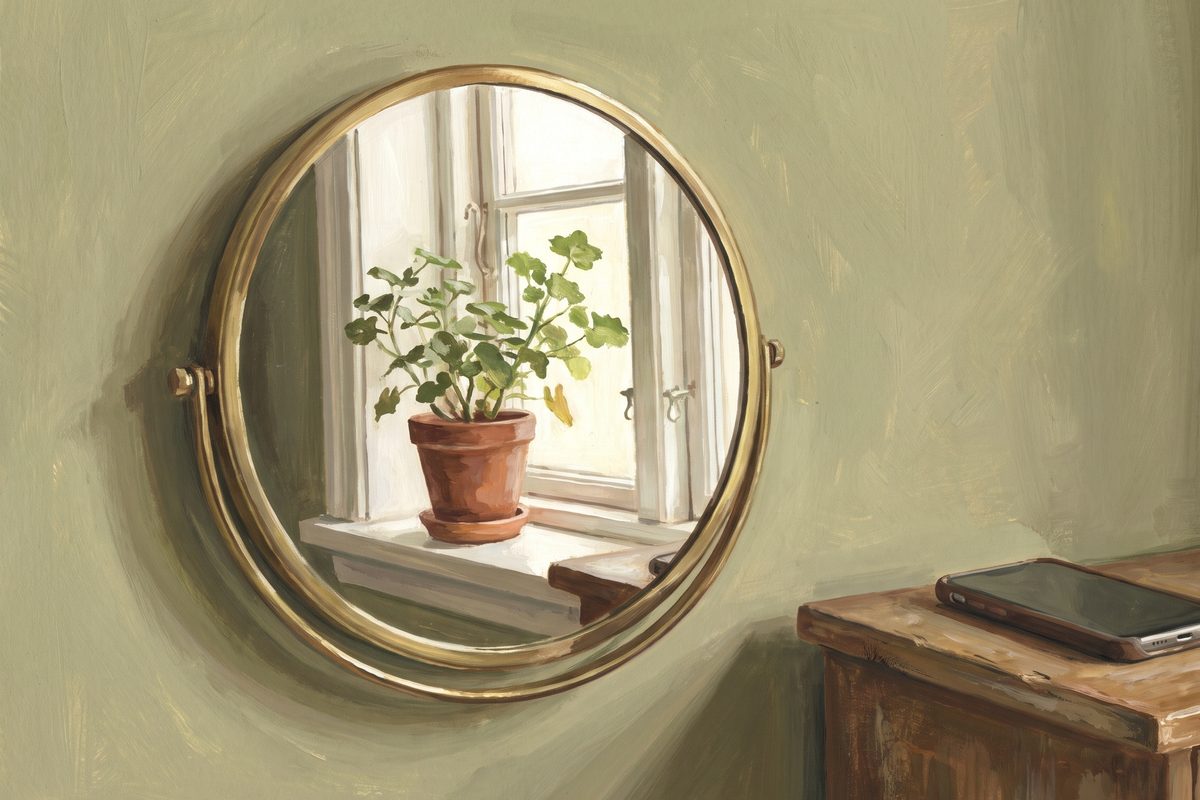
Why do I look better in the mirror than in photos?
Because the mirror shows the face you know. A mirror reverses you, left for right, and you have looked at that reversed face every day for years. Everyone else sees the other version, the one the camera records.
Psychologists call the pull of the familiar the mere-exposure effect: repeated exposure to something tends to make us like it more. In 1977, Mita, Dermer and Knight tested it on faces. Their participants showed a significant preference for the mirror image of their own face. Their friends, who had seen the true face, preferred the unreflected print. Same two prints, opposite choices.
So the "wrong" feeling in a photo is partly unfamiliarity. The photo is accurate about which side is which. It simply is not the arrangement you are used to.
Does the phone camera change my face too?
It can, when it is held close. A 2018 model by Ward and colleagues in JAMA Facial Plastic Surgery found that at 12 inches a selfie makes the nose look 30% larger in males and 29% in females than a distortion-free projection, and that at 5 feet there is essentially no difference. The authors point out that this does not reflect the real three-dimensional shape of the nose.
That is a model, and the detail of how big the effect is in real faces is covered in why a selfie is not your face. The point here is simpler: a photo can differ from the mirror for two separate reasons, familiarity and lens distance, and neither says anything is wrong with your face.
Is my face asymmetrical?
Almost certainly a little, and that is normal. A 2018 study in Plastic and Reconstructive Surgery used 3D imaging on 533 healthy children aged 0 to 18. The mean facial asymmetry was 1.2 mm, with a range from 0.4 to 5.4 mm, and it did not differ significantly by age, sex or race. The authors concluded that normal form is asymmetric. These were children, so the figures are a guide to the idea and not a measure for an adult face.
You can see this in your own photos. Eyebrows sit at slightly different heights, one eye looks a little larger, the smile lifts more on one side. Each looks sharper once you know to look for it, which is also why a mirror, a photo and a close-up each seem to show a different face.
Would a more symmetrical face look better?
Not necessarily. In a 1995 experiment, Swaddle and Cuthill altered faces to be more symmetrical and asked people to rate them. The more symmetrical faces were rated as less attractive. The authors suggested that natural directional differences between the two sides had been removed, which may make a face look less expressive.
It is one experiment, and the wider literature on symmetry and attractiveness is mixed, so it does not prove that unevenness is attractive. It does show that the idea of a perfect, even face is not a target the evidence supports.
When is asymmetry worth a doctor's look?
The useful question is whether something has changed. A difference you have always had, visible in old photographs, is usually part of normal variation. A change that is new, sudden or getting steadily more marked is worth having looked at.
One-sided weakness is the one to act on quickly. The NHS describes Bell's palsy as weakness on one side of the face, or being unable to move one side, sometimes with a drooping eyelid or mouth, and advises seeking urgent medical advice because treatment started early works best (NHS on Bell's palsy). If a droop comes with weakness in an arm or slurred speech, it may be a stroke, and the NHS advice is to call emergency services at once (NHS stroke symptoms). In Malaysia that number is 999. This is a medical matter, not a cosmetic one.
What can I do with this?
Look at your face from more than one source before deciding anything. Compare the mirror with a photo taken from a normal distance, in the same light, and expect them to differ. If a feature keeps bothering you, what a useful goal sounds like is a gentler place to start than a filter, and a face that others read as tired or older may be responding to other things, set out in what people actually read as age.
If you would like a doctor to look at something specific, a first consultation is the place to ask.