
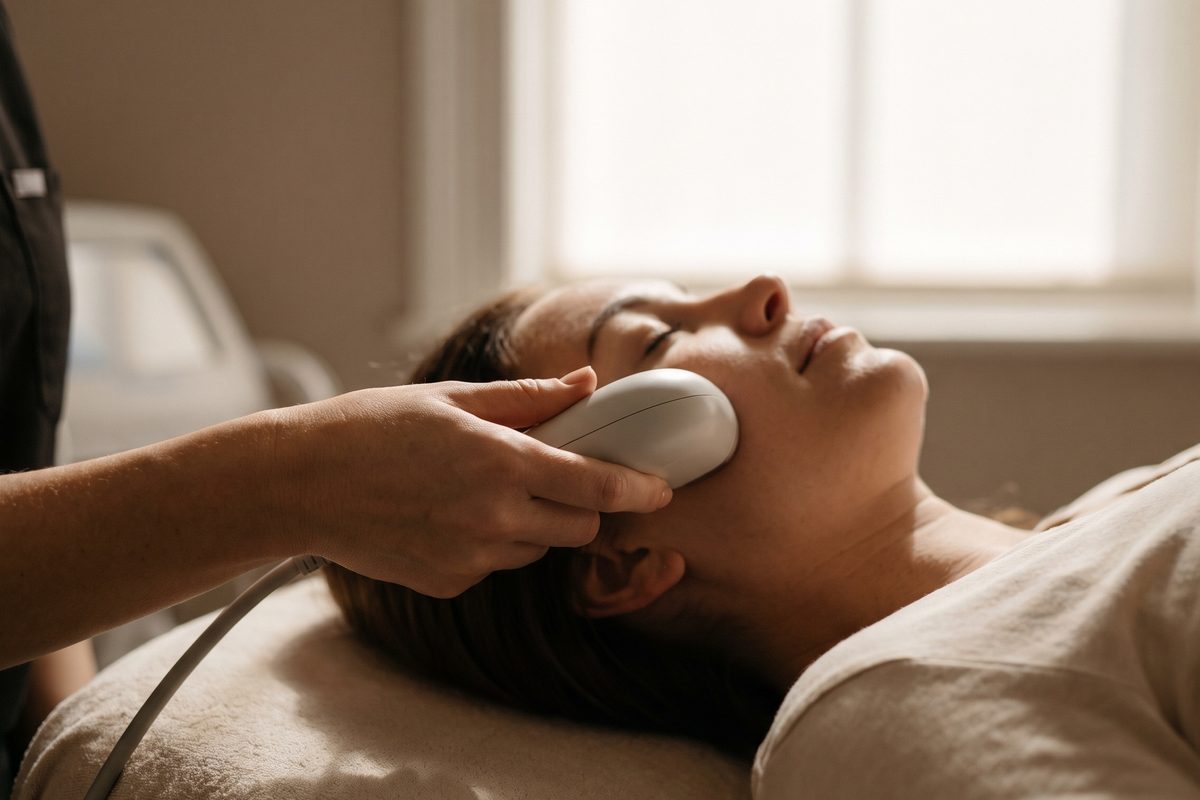
Two different facts, one word confuses them
People hear "no downtime" and reasonably assume it means the treatment works fast. It does not. Downtime describes what happens to your day after the appointment: whether you look treated, whether you need to hide anything, whether you can go straight back to work. Results timeline describes something else entirely: how long the treatment takes to actually do what it is for. These are separate facts about a treatment, and a device can score well on one and poorly on the other with no contradiction at all.
XERF, Ultherapy and OndaPro all score well on downtime. None of them score well on speed. That combination is worth understanding on its own terms rather than assuming the first fact settles the second, because it is exactly where planning around an event date most often goes wrong.
XERF: little to show that day, more to show months later
XERF is a radiofrequency treatment that heats the deeper layers of skin to prompt new collagen. The clinic's own account of the week after treatment is specific: redness is the common finding, sometimes lasting into the evening, with mild tenderness and slight swelling possible, and most people are back to their day the same afternoon. Less common effects, redness that outlasts the day, a tender or swollen patch, rarely a small blister, are also named plainly rather than glossed over.
None of that is the result. The clinic states it directly: "expect subtle tightening early, with the meaningful change developing as new collagen forms over the following months." A course is typically two sessions, four to six weeks apart, and the treatment's own page is candid about what that means for anyone working to a deadline: "a patient who needs a result by a fixed date is better told that plainly than sold a course that cannot meet it." A week before an event, a XERF session is honest about producing very little visible change. The little after-effect it does leave settles within a day or so; the meaningful change was never going to arrive that quickly in the first place.
Ultherapy: the least visible aftermath of the three, and the slowest lift
Ultherapy uses focused ultrasound to reach the same deep layer of tissue a surgeon would tighten in a facelift, without cutting anything. Its own page states there is no downtime, beyond the skin possibly being slightly flushed or tender for a short while. Of the three treatments in this piece, it is the gentlest immediate aftermath.
It is also the slowest to show a result. The lift develops slowly over two to three months and typically lasts up to a year, and it is usually planned as a single session rather than a repeated course. That timeline is not a caution added for effect. It is the treatment doing what it is designed to do: prompting the body to lay down new collagen at depth, a process that has its own biological pace regardless of the calendar. Someone who books Ultherapy a fortnight before an event will have no downtime to manage and, honestly, nothing much to show for it on the day either.
OndaPro: comfortable that afternoon, months to finish the job
OndaPro is a different category of treatment, aimed at localised fat and skin tightening through microwave energy rather than surface heat. Its own page states plainly that a session, thirty to ninety minutes depending on the area, leaves no downtime afterwards.
The result is where the patience is required. Most areas benefit from a course of three to five sessions spaced about a month apart, and the change typically builds over four to eight weeks and continues through the months that follow. The treatment's own page is direct about who it is not for: "not for the patient chasing a visible change by a fixed date, because the biology takes weeks." Counting the course itself and the weeks the result takes to build afterwards, OndaPro needs roughly four to six months booked ahead of a date, and that cannot be compressed into the weeks before an event, no matter how comfortable each individual session is.
The honest answer for a date close at hand
None of this means a session done close to an event is wasted, only that it should be understood for what it actually is: a session that, on this clinic's own stated timelines, will not have produced the meaningful change the treatment exists to deliver. Little downtime and a small visible change are both true at once, and it is more useful to a patient to hear both than to hear only the reassuring half.
The pattern across all three devices is the same. The comfortable part happens on the day. The real work happens on a biological clock measured in weeks and months, not hours, and no amount of "no downtime" reassurance changes that clock. Across the three, that means booking roughly three to six months ahead: about three months for Ultherapy, three to four for XERF, and four to six for OndaPro's longer course. Starting early is the only lever that actually moves the outcome, which is why each of these belongs on the longer end of the countdown in the planner rather than the final week.
If the goal is collagen that builds rather than tightening that develops
XERF, Ultherapy and OndaPro all work on tissue that already exists, tightening or reducing it. A separate group of treatments, skinboosters, ProNuLook, ReGlow and biostimulators, works by building new collagen through a spaced course rather than a single session, and those follow their own timeline again. What that group's own published timelines say, and how far ahead a course needs to start, is covered in part three of this series.