What are NAD+, NMN and an NAD+ drip?
NAD+ is a molecule found in every cell. It helps cells turn food into energy and takes part in repair work. Levels in some tissues appear to fall with age, and that observation is the reason for the interest. NMN is one of the raw materials the body uses to build NAD+. So the two names refer to different things. NAD+ is the finished molecule, usually given by drip or injection, and NMN is the precursor, usually sold as a capsule or powder.
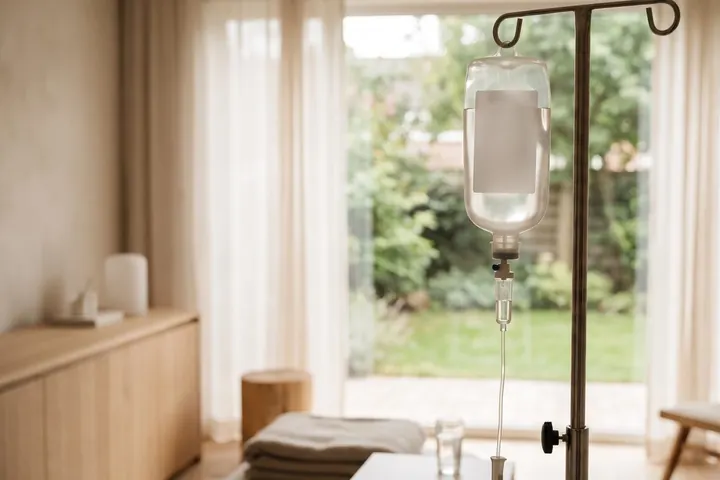
A drip delivers the product straight into a vein, over a period measured in hours. An injection under the skin or into muscle is also sold under the name. All of these are sold for energy, focus or "anti-ageing". None is a treatment for a diagnosed condition.
What does the evidence show for NAD+ drips?
Very little, and what exists describes how the drips were tolerated, with no measure of benefit. The most recent report, published in Frontiers in Aging in February 2026, looked back at the records of one commercial wellness clinic: 14 clients, of whom 6 had an NAD+ infusion. There was no comparison group, and the authors worked for the clinic. It tells you what was noticed during the drips, not whether they did anyone good.
No trial that I could find shows that an NAD+ drip slows ageing, restores energy or improves a disease. Those claims rest on the idea that a falling molecule should be topped up. That is a reasonable thing to study. It has not been shown to change how a person feels or how long they stay well.
What side effects have been reported with IV NAD+?
In that report, all 6 people given NAD+ described moderate to severe symptoms during the drip: stomach cramps, diarrhoea, nausea and vomiting, a faster heart rate, throat pain, congestion and chest pressure. They eased when the infusion stopped, and the authors did not record them as formal adverse events. The NAD+ infusions took about 97 minutes on average, against about 37 for a related compound, which is consistent with staff slowing the drip when symptoms came on.
Flushing, light-headedness and chest tightness with a fast infusion are also described on clinic information pages. Those pages are not trial findings. The practical point holds either way: symptoms during a drip are a reason to say so at once, and the drip can be slowed or stopped.
A drip carries risks that belong to any drip. The needle site can become infected or inflamed, the vein can be hurt, fluid can leak into the tissue, and a reaction to the product can be sudden. That is why the person giving it must be able to deal with those events.
What does the evidence show for NMN supplements?
More studies exist, because a capsule is easier to test than a drip. A pooled analysis in Current Diabetes Reports (2024) gathered 8 small double-blind trials in 342 adults, mostly middle-aged and relatively healthy, lasting between 14 days and 12 weeks. It found no significant benefit for fasting blood sugar, insulin, HbA1c or cholesterol. No trial reported safety concerns, with a tendency to more side effects at the highest doses, and the authors say long-term safety is not known.
Single trials have looked at other outcomes, such as muscle function. They are small and short, and one trial does not settle a question. The honest summary is that NMN has been tested for weeks, in small groups, and the headline claims about ageing have not been tested at all.
Who may give an IV drip in Malaysia?
A registered medical practitioner, in a clinic or hospital registered or licensed under the Private Healthcare Facilities and Services Act 1998 (Act 586). The Ministry of Health said on 3 June 2026 that providing healthcare at premises that are not registered or licensed is an offence, with a fine of up to RM500,000, up to six years in prison, or both.
The March 2026 guideline for private clinics goes further. It says a drip is allowed for emergency care, or for a recognised medical indication after assessment, under the direct supervision of a registered practitioner who stays in the clinic. It lists drips for aesthetic or wellness purposes as not allowed: vitamin, beauty, whitening, detox and anti-ageing drips or the like. On the wording, an NAD+ drip sold for energy or youth belongs in that last group. The guideline also says clinic assistants may not insert the cannula, assess the patient, start the drip or manage complications. Whitening drips and glutathione injections covers the same rule for a widely advertised drip in this country, and who can perform aesthetic procedures in Malaysia sets out the wider picture.
How do you check an NAD+ injection or an NMN product?
An injectable is a medicine, and a medicine sold in Malaysia must be registered with the NPRA and carry a MAL number. Advertisements for medicines also need approval from the Medicine Advertisements Board, so a post that names an injection and invites you to book is one more thing to question. Ask the provider for the product name, the manufacturer and the registration number, and look the number up yourself. The check for a KKM-approved product shows each step. A name on a menu, an overseas box or a certificate on a wall is not a registration.
A supplement carries its own MAL number, which you can search on the NPRA Product Search page in the same way. Registration means the product was assessed for quality, safety and the claims allowed on the label. It does not mean those claims were shown to work, which is the same limit as for collagen drinks and supplements. A product with no number, a number that does not match the name, or a seller who cannot give one should be left alone.
When should you stop, and when is it urgent?
If you are on a drip and feel chest tightness, a racing heart, light-headedness, cramps, nausea or a flushed face, say so straight away and ask for the drip to be slowed or stopped. Do not wait to see if it settles.
Go to an emergency department for chest pain that does not ease, trouble breathing, swelling of the lips, face or throat, fainting, or a rash spreading across the body. See a doctor the same day for fever or chills after a drip, or for redness, heat, pain or swelling at the needle site or along the arm. Bring the bag, the packaging and any receipt, so the doctor can see what was given. A product that caused a reaction can be reported through the NPRA route for side effects.
Does The Retreat Clinic offer NAD+?
No. The clinic does not offer NAD+ infusions or injections, and it does not give IV drips for wellness or beauty, in line with the Ministry guideline above. This article is general information, not advice about any product, and a doctor who knows your history and medicines is the right person to ask about one.
Common questions
Is an NAD+ injection or drip legal in Malaysia?
An injection or drip is a medicine given by a registered medical practitioner. The Ministry of Health guideline of March 2026 does not allow a private clinic to give a drip for wellness, beauty, detox or anti-ageing purposes outside an emergency or a recognised medical need, and a salon or spa is not a licensed healthcare facility at all. Any injectable product must also be registered with the NPRA. Ask the provider for the registration number and check it yourself.
Does an NAD+ drip slow ageing?
No human study has shown that. The published human data are small and short, and the recent tolerability report had 6 people on NAD+ and no comparison group. Whether raising a molecule in the blood changes how a person ages has not been tested in a way that answers the question.
Does NMN work as a supplement?
A 2024 pooled analysis of 8 trials in 342 adults found no clear benefit for blood sugar or cholesterol over 14 days to 12 weeks. Other outcomes have been tested in single small trials. The evidence is thin, and long-term safety is not known.
How do I check an NMN product in Malaysia?
Find the MAL number on the pack and search it on the NPRA Product Search page, then match the product name and the company. A registered supplement has been checked for quality, safety and the claims allowed on the label. That does not mean the claim has been shown to work.
Sources
- Reyna K, Heinzen G, Patel N, et al. Intravenous infusion of nicotinamide adenine dinucleotide (NAD+) versus nicotinamide riboside (NR): a retrospective tolerability pilot study in a real-world setting. Frontiers in Aging, February 2026 A retrospective review of records from one commercial wellness clinic: 14 clients, 6 given IV NAD+ and 8 given IV nicotinamide riboside, followed for 30 days. All 6 on NAD+ reported moderate to severe stomach symptoms (cramping, diarrhoea, nausea, vomiting), a faster heart rate, throat pain, congestion and chest pressure during the infusion, which resolved when it ended. NAD+ infusions averaged about 97 minutes against about 37 for the other compound. No control group, small numbers, and the authors worked for the clinic.
- Chen F, Zhou D, Kong AP-S, et al. Effects of Nicotinamide Mononucleotide on Glucose and Lipid Metabolism in Adults: A Systematic Review and Meta-analysis of Randomised Controlled Trials. Current Diabetes Reports, published online November 2024 Eight small double-blind trials, 342 adults, mostly middle-aged and relatively healthy, lasting 14 days to 12 weeks. No significant benefit for fasting glucose, insulin, HbA1c or blood fats. No trial reported safety concerns, with a tendency to more adverse events at the higher doses; the authors call long-term safety uncertain and ask for longer, larger trials.
- Ministry of Health Malaysia, Private Medical Practice Control Section (CKAPS). Garis Panduan Pemberian Intravenous (IV) Drip di Klinik Perubatan Swasta, March 2026 (in Malay) Under Act 586, an IV drip in a private clinic is allowed for emergency pre-referral care, or for a recognised medical indication after clinical assessment, and only under the prescription and direct supervision of a registered medical practitioner who stays on the premises. Section 6.1: drips for aesthetic or wellness purposes are not allowed, including vitamin, beauty, whitening, detox and anti-ageing drips or the like. Clinic assistants may not insert the cannula, assess the patient, start the drip or manage complications.
- The Star. Only premises registered or licensed under Act 586 may provide healthcare services, says Health Ministry (3 June 2026) The Ministry said healthcare services may be given only at premises registered or licensed under the Private Healthcare Facilities and Services Act 1998. Offering them elsewhere is an offence, with a fine of up to RM500,000, imprisonment of up to six years, or both. Reports can be sent to ckaps@moh.gov.my. The report does not mention drips, spas or salons by name.