
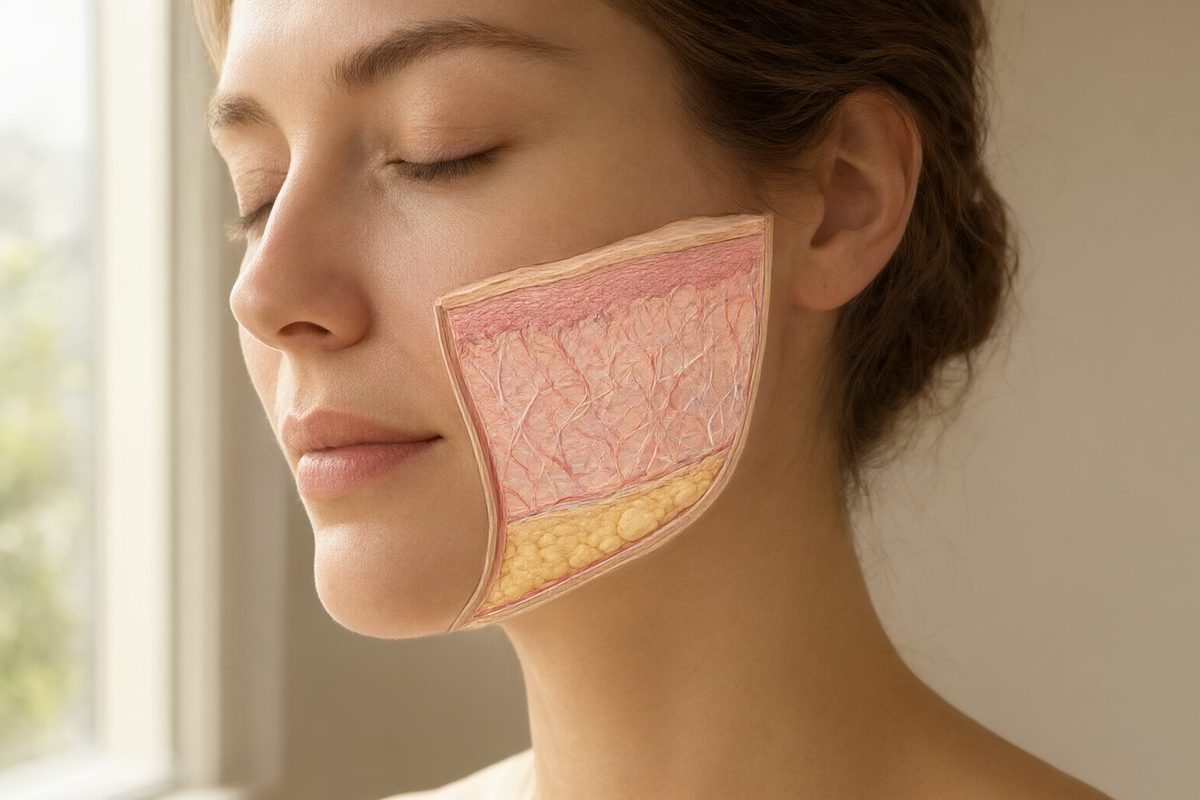
What changes in the skin around menopause?
Skin gets drier, thinner and less elastic. A 2025 review explains that the fall in oestrogen at menopause contributes to lower collagen production, less elasticity and less moisture, and that shows as dryness and wrinkling. The years around menopause, called perimenopause, are described as a time of accelerated decline in skin quality.
Some numbers exist, from older observational studies quoted in that review. Skin collagen was found to fall with the years since menopause rather than with age itself, at an average of about 2.1% a year over 15 years, and oil production falls too. These are averages, and they do not forecast what will happen to one person's face. Sun exposure, smoking and genetics also shape ageing skin, and the review lists them beside hormones. The tropical sun question is covered in sunscreen in a tropical climate.
The review makes one more point worth repeating. Many women are unaware that menopause affects the skin, and these changes are often dismissed as purely cosmetic even though they can affect quality of life. If the changes bother you, that is a reasonable thing to raise with a doctor.
Does menopause change hair as well?
Yes. The hair follicle is sensitive to oestrogen. A 2025 review in Maturitas describes hormonal changes that can start up to ten years before menopause: a relative rise in androgens, then the end of ovarian oestrogen. The result can be lower hair density, thinner strands and a change in texture. Female-pattern hair loss, telogen effluvium (a temporary heavy shed) and frontal fibrosing alopecia (a scarring hair loss at the hairline) are noted more often in women after menopause.
A 2022 review agrees that menopause affects the hair cycle, and adds that more research is needed on what to target and on the role of hormonal treatment. Those conditions are treated in different ways, so the first step is to know which one is present, as set out in hair loss is several diseases. Hair loss can also affect mood and self-esteem, and that deserves to be taken seriously.
Is perimenopause behind adult acne, itching or a rash?
It may be one cause among several. Acne can appear or persist in the forties, and a doctor works out whether hormones, products, stress or something else is behind it, as described in adult acne: what a doctor checks first. I found no menopause-specific trial for acne or itching in the sources I read, so I will not put figures on them.
A new rash or lasting itch is worth a doctor's look before anyone assumes it is menopause, because many skin conditions cause both.
Does hormone therapy improve skin?
The evidence is mixed, and the decision belongs with your GP or gynaecologist. In the 2025 review, most studies found positive associations between hormone therapy and better skin, though the findings were sometimes inconsistent. It also states that clinical guidelines do not support hormone therapy solely for skin, because robust trials with skin as the main outcome are lacking.
The trials it lists show why. A 12-month placebo-controlled trial in 60 postmenopausal women found thicker skin on systemic oestrogen. A 48-week trial of low-dose hormone therapy did not significantly change mild to moderate facial skin changes. A 4-year trial in 116 early postmenopausal women found no significant change in wrinkle score or skin rigidity. The review notes that the 4-year study may have been underpowered and used relatively low doses, so the results do not settle the question in either direction. Its own call is for future trials to record menopausal status and hormone therapy use, which most aesthetic studies do not. This review was supported by Merz Aesthetics, a maker of aesthetic products, though its authors declare no conflicts of interest.
Hormone therapy is a prescription decision with effects far beyond the skin. I do not recommend it or advise against it here. Ask your own doctor.
What actually helps skin at this stage?
Start with the ordinary things. The review names sun exposure and smoking among the influences on ageing skin, so sun protection and not smoking are the plain place to begin, with a simple moisturiser for dryness. After that, the honest position is that menopause-specific evidence for aesthetic treatments is thin. The same review notes that only one study looked at menopausal status in minimally invasive aesthetic treatment: temple volume filler with hyaluronic acid, which showed good longevity and satisfaction in both pre and postmenopausal women. Treatments that rely on skin cells making new collagen, such as energy devices and biostimulators, have not been studied by menopausal or hormone therapy status, to the authors' knowledge.
So a treatment for menopausal skin is chosen the way any treatment is: by what the skin shows. Dryness, laxity, volume loss and pigment are different findings with different tools, and that logic runs through there is no anti-ageing treatment, just specific findings. How the collagen-building options differ is set out in three roads to collagen. Melasma can also flare around this age, as described in melasma in Malaysia.
Bladder leakage is a separate concern that many women meet at this stage, and the Emsella page covers the pelvic floor.
What can an aesthetic doctor offer, and what falls outside?
An aesthetic doctor can examine your skin and hair, name what has changed, explain which changes have evidence behind them, and set honest expectations for a treatment. An aesthetic doctor does not decide about hormone therapy, and no cream or injection replaces oestrogen.
Come with your questions. What is dry, thin or thinning, and what is a shadow, a volume change or pigment? Which of those needs a treatment, and which needs only patience and sun protection? Some pieces will not need treatment at all, and a good assessment will say so.
When should I see a doctor first?
See a GP or your gynaecologist first if the skin or hair change comes with hot flushes, heavy or irregular bleeding, tiredness or mood change, because those belong to a wider conversation. See a doctor promptly for a new or changing mole, a sore that does not heal, patchy or scarring hair loss at the hairline, or hair falling out in clumps. Menopause is a life stage, and there is no need to treat every change as a problem.