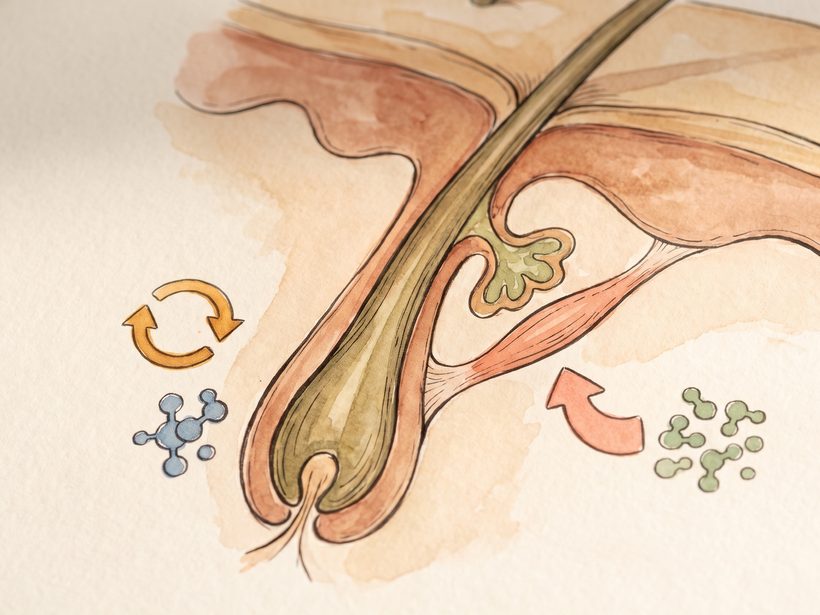
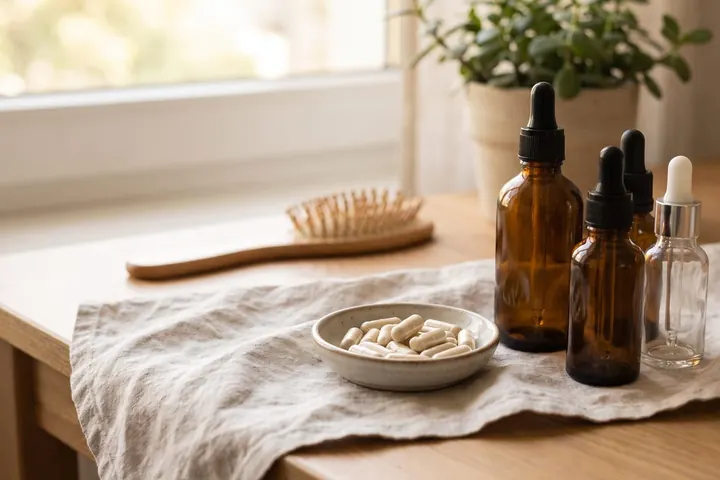
What are hair growth supplements, serums and tonics?
They are a shelf of very different things sold under one promise. The hair growth supplement Malaysian shoppers search for is usually a capsule, tablet or powder, and the serum or tonic is something you apply to the scalp. They differ in what they contain and in how the law treats them.
- Biotin and multivitamin capsules, often with zinc, iron or vitamin D added.
- Marine collagen drinks and powders. The skin evidence is covered in collagen drinks and supplements: what the trials show, and none of it was about hair.
- Saw palmetto, a plant extract with an anti-androgen action in the lab, sold as a pill or added to shampoos.
- Scalp serums with caffeine, peptides or plant extracts, left on after washing.
- Rosemary oil and herbal hair tonics, including home-made ones.
A different group, minoxidil lotion and finasteride, are medicines, and are covered in their own article. They are mentioned here only to show where the line sits.
What does the evidence show for each?
Biotin has the strongest reputation and the weakest evidence. A 2017 review found 18 reported cases of biotin used for hair or nail problems, all in people with a cause such as an inherited enzyme deficiency, and no evidence of benefit outside a true deficiency. A deficiency is rare in people who eat normally. A 2019 review of vitamins and minerals reached a similar view, and supports iron or vitamin D only where a test shows a low level. The same review notes that too much vitamin A or selenium can itself contribute to hair loss, so more is not safer.
Saw palmetto has more to show. A 2020 systematic review found five randomised trials and two cohort studies of products containing it, with positive effects reported and no serious side effects. The authors also say high-quality data are lacking, and many of the products held other ingredients, so the effect of saw palmetto alone is not known.
Caffeine in a leave-on product is the best studied of the serum ingredients. A 2025 systematic review of nine trials in 684 people favoured it, but rated the evidence low or very low in most of them, with missing control groups and unstated doses. Peptide serums and plant-extract tonics have less. Rosemary oil was compared with 2% minoxidil in a six-month trial of 100 people. The abstract reports no change in hair count in either group at three months, a similar rise in both by six months, and scalp itching more often with minoxidil. That is one small trial, not a verdict.
The honest summary is that some of these may help a little, none has been shown to replace a medicine, and the studies that exist are small. Hair also changes by itself. Shedding after an illness or a baby often recovers without anything, so a product started at that point can seem to work when time did it.
Can a supplement cause harm or confuse a test?
Yes, in two ways. Biotin at high doses can interfere with laboratory tests. The US FDA warned in 2017, and again in 2019, that it can give falsely low or falsely high results, and it was most concerned about troponin, the test for a heart attack, where a falsely low result could mean a missed diagnosis. If you take biotin, a multivitamin or a hair, skin and nails capsule, tell the doctor and the laboratory, and ask whether to stop it before a blood test.
The second is taking more than the body needs. Iron taken without a low level can do harm, and excess vitamin A or selenium can thin hair. A product that names no amounts, or a stack of three capsules that overlap, is a reason to ask a pharmacist first.
What does a notification or MAL number actually mean?
A serum, tonic or shampoo is normally a cosmetic. In Malaysia cosmetics are notified to NPRA, not approved by it. NPRA states that a claimed benefit must be backed by evidence or by the formulation, that the company holding the notification is responsible for it, and that names and claims that are medicinal in nature are not acceptable. A claim to regrow hair or treat hair loss is a treatment claim, so a cosmetic carrying it deserves a second look. A notification confirms the product was declared and its ingredients checked against the rules. It does not confirm that it grows hair.
A pill may be a registered health supplement, with a MAL number ending in N, or a natural product with a number ending in T. Registration checks safety, quality and the claim type. Samples of natural products are tested before registration, but the register does not test whether the product works. A prescription or controlled medicine carries a number ending in A. You can look up a MAL number on the NPRA product search, as set out in how to check if a product is KKM approved.
Minoxidil is the example of a different category. The lotion is a registered medicine, in Malaysia a pharmacist can supply it, and its effects, side effects and the early shedding it can cause are set out in minoxidil: how long before it works. It is a medicine because it has been tested as one, and that is the real difference from a tonic.
When does hair loss need a doctor before any product?
See a doctor first, and do not wait to finish a product, if you have:
- sudden or heavy shedding, or a large amount of hair on the pillow and in the drain over a few weeks
- round or irregular bald patches
- a scalp that is painful, burning, red, scaly or shows shiny scarred areas
- hair loss with tiredness, feeling cold, weight change, heavy periods or a lump in the neck, which can point to iron or thyroid causes
- hair loss that began after a new medicine, a crash diet, a fever or childbirth
- loss of eyebrows or body hair as well
A doctor asks when it started and what came two to three months before, examines the scalp and, where it fits, orders blood tests. Hair loss: causes, blood tests and when to see a doctor sets out which tests help. Iron or thyroid causes are found this way and corrected, and scarring conditions need a dermatologist soon, because the follicle that is destroyed does not come back. A serum applied for six months over the wrong diagnosis costs time that cannot be recovered.
What The Retreat Clinic does and does not offer
The clinic does not sell hair growth supplements, serums or tonics, and does not recommend one brand over another. It does not offer PRP or any injection for hair loss, and does not perform hair transplants.
What it does offer is a doctor-led assessment, as the hair thinning page sets out: a history, a scalp examination and, where appropriate, blood tests, with treatment matched to the cause. Where the cause is a deficiency, the answer may be a corrected diet and a supplement at the right dose. Where it is pattern loss, a prescription medicine may be discussed. Scarring or patchy loss is referred to a dermatologist. A label is a category, and a diagnosis is what decides what is worth trying.
Common questions
Do hair growth supplements work?
For most people, the trial evidence is thin. Iron or vitamin D help where a blood test shows a deficiency. Biotin has not been shown to help hair in people who are not deficient. Saw palmetto has small, mostly low-quality studies. None has been shown to match a regulated medicine.
Is a hair serum or tonic with a notification number approved by NPRA?
No. A cosmetic is notified to NPRA, which is not the same as being approved for the claim on the bottle. Medicinal claims such as regrowing hair are not acceptable for a cosmetic. A registered medicine or supplement carries a MAL number you can look up.
Can biotin affect blood tests?
Yes. The US FDA warned that high-dose biotin can give falsely low or falsely high results on some tests, including troponin used to diagnose a heart attack. Tell the doctor and the laboratory about any biotin or multivitamin you take.
When should hair loss be seen by a doctor before trying a product?
Sudden heavy shedding, round bald patches, a scalp that is painful, red, scaly or scarred, hair loss with tiredness, weight change or heavy periods, or loss that follows a new medicine. Some causes, such as iron or thyroid problems, are found by blood tests and corrected, and scarring loss is time-sensitive.
Sources
- Patel DP, Swink SM, Castelo-Soccio L. A review of the use of biotin for hair loss. Skin Appendage Disorders 2017. Read 28 November 2026 The authors found 18 reported cases of biotin used for hair or nail changes, all in people with an underlying cause such as an inherited enzyme deficiency or brittle nails. They found no evidence of benefit from biotin supplements outside known deficiencies.
- US Food and Drug Administration. The FDA warns that biotin may interfere with lab tests (safety communication of 28 November 2017, updated 5 November 2019). Read 28 November 2026 High-dose biotin can cause falsely low results in some laboratory tests, and the FDA was particularly concerned about falsely low troponin, which could lead to a missed heart attack. It advises telling the doctor and the laboratory about any biotin or multivitamin supplement.
- Almohanna HM, et al. The role of vitamins and minerals in hair loss: a review. Dermatology and Therapy 2019. Read 28 November 2026 A narrative review. Supplementing iron or vitamin D is supported where a deficiency is found. Biotin and vitamin E supplements are not supported for pattern loss or shedding, and too much vitamin A or selenium can itself contribute to hair loss.
- Evron E, et al. Natural hair supplement: friend or foe? Saw palmetto, a systematic review in alopecia. Skin Appendage Disorders 2020. Read 28 November 2026 The review found five randomised trials and two cohort studies of products containing saw palmetto, with positive effects reported, and no serious adverse events. The authors state that robust high-quality data are lacking and that large trials on saw palmetto alone are needed.
- Panahi Y, et al. Rosemary oil vs minoxidil 2% for the treatment of androgenetic alopecia: a randomized comparative trial. Skinmed 2015. Read 28 November 2026 One hundred people were randomised to rosemary oil or 2% minoxidil for six months. The abstract reports no significant change in mean hair count at three months in either group, a significant rise in both groups at six months with no difference between them, and scalp itching more often in the minoxidil group.
- Szendzielorz E, Spiewak R. Caffeine as an active ingredient in cosmetic preparations against hair loss: a systematic review of available clinical evidence. Healthcare 2025. Read 28 November 2026 Nine trials in 684 people favoured topical caffeine, but the evidence was rated medium in three studies and low or very low in the rest, with missing placebo or control groups and unstated caffeine concentrations in many.
- NPRA. Regulatory requirements for cosmetics, and cosmetic main page. Read 28 November 2026 Cosmetics in Malaysia are controlled by a notification procedure, in place since 1 January 2008. A claimed benefit must be backed by evidence or the formulation, the notification holder is responsible for it, and names and claims that are medicinal in nature are not acceptable for a cosmetic.
- Pharmacy Board Malaysia. Registration number (MAL), and NPRA. Health supplements. Read 26 November 2026 A registered product carries a MAL number whose final letter shows the category (N for a health supplement, T for a natural or traditional product, X over the counter, A controlled medicine). Status is checked on the NPRA product search.