
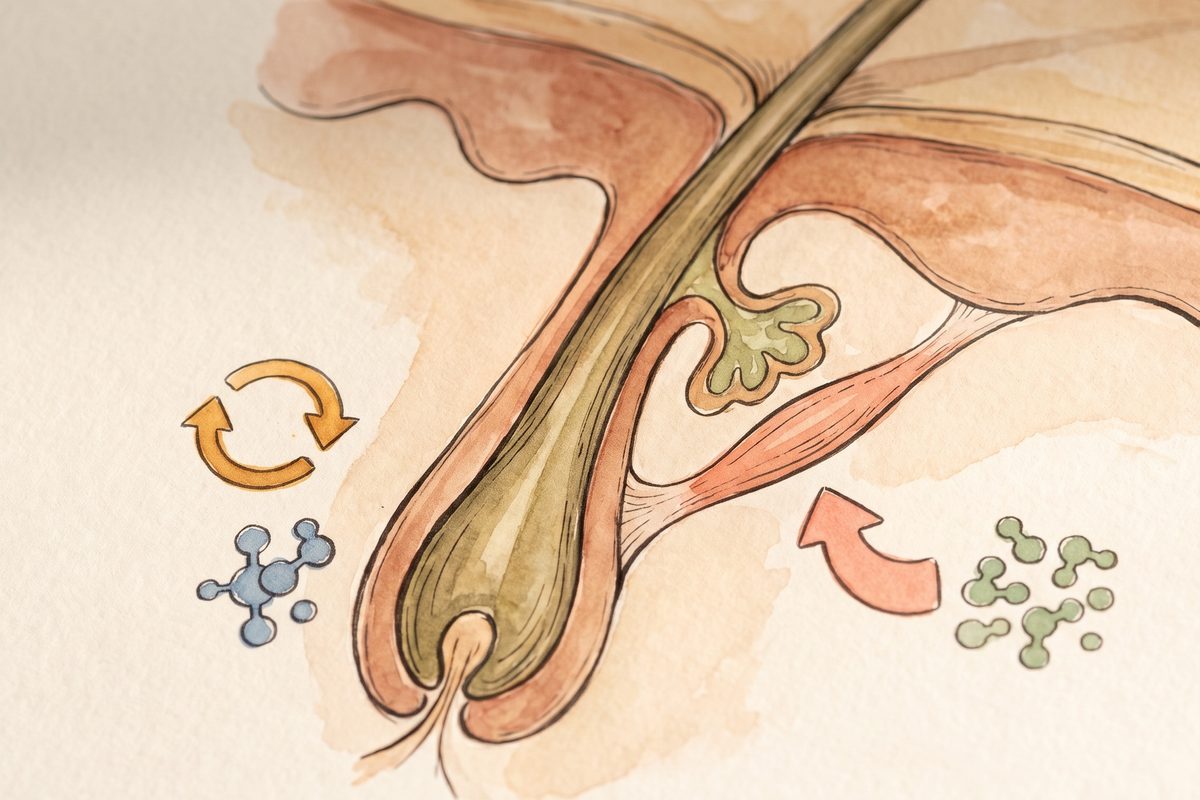
Which kind of hair loss do these medicines treat?
Pattern hair loss, also called androgenetic alopecia. Over years, a hormone called dihydrotestosterone (DHT) makes susceptible follicles shrink, and they grow finer, shorter hairs until some stop altogether. Minoxidil and finasteride are used for that. Shedding after illness or childbirth, low iron or thyroid trouble, and scarring conditions each need something else first, and the article on why hair loss is several diseases explains how they are told apart.
What does minoxidil lotion do?
It slows pattern hair loss in some people and thickens some of the hairs that remain. How it works is not fully understood, and the consumer leaflet on the register of the National Pharmaceutical Regulatory Agency (NPRA) describes it as prolonging the growth phase of the hair cycle. Registered minoxidil lotions come in 2%, 3% and 5% strengths, applied to the scalp, usually twice a day. In a 48-week trial of 393 men, 5% minoxidil produced more regrowth than both 2% and placebo, with more itching and irritation than the 2% lotion.
In Malaysia, topical minoxidil at up to 5% is a Group C poison, the category a licensed pharmacist can supply without a prescription. Rogaine is the US brand name for minoxidil lotion. The topical products on NPRA's register carry other names, so the ingredient, the strength and the MAL number are what to look for.
Side effects are mostly local: dryness, redness, scaling and itching of the scalp, and extra hair on the forehead or cheeks if the lotion runs. If minoxidil reaches the bloodstream it can cause chest pain, a fast heartbeat, dizziness, swollen hands or feet, or sudden weight gain, and the leaflets say to stop using it and tell a doctor if any appear. Several Malaysian leaflets say it is for adults aged 18 to 65. The leaflets advise against use in pregnancy or breastfeeding, and people with heart problems are told to ask a doctor first.
What does a minoxidil tablet do, and what does off-label mean?
Off-label means a doctor prescribes a medicine for a use that is not on its registration, and low-dose minoxidil tablets are used that way for hair loss. The minoxidil tablet on Malaysia's register is a 5 mg product registered as a blood pressure medicine, and hair loss is not among its registered uses. No minoxidil tablet is approved for hair loss in the United States either, where a slow-release tablet made for the purpose was still in phase 2/3 trials in 2026. In Malaysia it is a Group B poison, supplied only by a doctor or by a pharmacist on a doctor's prescription, and a full evaluation should come first.
The evidence is smaller and newer than for the lotion. In one randomised trial of 90 men, 5 mg of minoxidil a day for 24 weeks did not show superiority over 5% lotion twice a day, and 49% of the men randomised to the tablet developed extra body or facial hair. A retrospective study of 1,404 people on low doses, with no control group, found extra hair growth in 15.1%, lightheadedness in 1.7%, fluid retention in 1.3% and a fast heartbeat in 0.9%, and 1.7% stopped because of side effects. A 2026 review calls serious complications, including fluid around the heart, rare at these doses.
Because the tablet is a blood pressure medicine, blood pressure and heart history should be checked before it is started, and an international panel involving hair transplant surgeons agreed in a 2026 consensus that body weight and blood pressure should be checked first. The Malaysian product information does not recommend it in pregnancy and says minoxidil has been reported to pass into breast milk. Fluid retention, a fast heartbeat, dizziness and swelling around the eyes or in the legs are the signs to report to the prescriber.
What does finasteride do, and who is it for?
Finasteride blocks the enzyme that turns testosterone into DHT, so DHT falls in the scalp and the blood and the shrinking of follicles slows. The 1 mg tablet, taken daily, is sold as Propecia and as generic tablets. It is registered in Malaysia for men with pattern hair loss, and the trials enrolled men aged 18 to 41 with mild to moderate loss at the crown and mid-scalp. The product information says efficacy at the receding temples has not been established. The 5 mg tablets are a different strength for a different purpose. Finasteride is a Group B poison, supplied only by a doctor or by a pharmacist on a doctor's prescription, and a full evaluation of the hair loss should come first.
In two one-year trials of 1,553 men, those taking finasteride 1 mg had 107 more hairs than those on placebo at one year, and 138 more after a second year, in a 5.1 square centimetre patch of the crown. A hair count describes a group. It says little about any one head.
In the 12-month trials, men on finasteride reported reduced sex drive (1.8%, against 1.3% on placebo) and erectile dysfunction (1.3%, against 0.7%), and 1.7% stopped for any side effect, against 2.1% on placebo. The label says these effects resolved in men who stopped and in many who carried on. Reports from general use also include depression and suicidal thoughts, breast tenderness and enlargement, male breast cancer, and sexual problems that continued after stopping. Those are voluntary reports, and the label says it is not always possible to estimate how often they occur or to establish that the medicine caused them. Low mood, or a lump, pain or other change in the breast, is a reason to speak to a doctor promptly. Finasteride also lowers PSA, the prostate blood test, so any doctor reading one needs to know it is being taken.
Finasteride is not used in women who are or may become pregnant, because it can cause abnormalities in the genitals of a male baby, and a woman who is or may be pregnant should not handle crushed or broken tablets, although intact coated tablets protect against contact. The Malaysian product information covers men only and says the tablet is not effective in postmenopausal women with pattern hair loss. A finasteride scalp spray for men is also registered, and women who are or may become pregnant must avoid contact with the treated scalp.
Why does hair shed at first, and how long is the wait?
Minoxidil can make hair shed in the first weeks. The British Association of Dermatologists puts the extra fall at the first four to six weeks and explains it as hairs already at the end of their life cycle being replaced by newly growing ones. A 2026 review of the tablet puts transient shedding at 16 to 22%. The Malaysian product information for finasteride describes no shedding phase.
The wait is long because scalp hair grows only about a centimetre a month. Most Malaysian leaflets for minoxidil lotion say four or more months may be needed before growth is noticeable, and two say two months or more. The dermatologists' association says at least six months, possibly twelve. For finasteride, the Malaysian product information says three months or more of daily use, and the association says up to fourteen months may pass before a benefit is usually seen. A month or two says little either way.
What happens when you stop?
The gain fades. Malaysian leaflets for minoxidil lotion say the balding process starts again after stopping, and several say the gain may be lost within three to four months. The finasteride leaflet says the hair gained will likely be lost within twelve months of stopping. The dermatologists' association says the same of topical and oral treatments alike: they work only for as long as they are continued.
That makes starting a decision about years. Pattern loss is progressive, so a medicine that holds it has to be kept up, and knowing which loss is present comes before beginning. How the cause of hair thinning is found and how a hair loss plan is built around it cover that ground. The choice between a lotion and a tablet, if either is needed, follows the diagnosis.