
Not fat, not weight, not a disease
The instinct, when someone notices cellulite for the first time, is to reach for the nearest explanation: too much fat, not enough exercise, needs to lose weight. None of those explanations survive contact with the anatomy. Cellulite is graded by dimpling and texture, and it correlates poorly with body weight. It shows up in lean, athletic women as readily as in heavier ones, and it is present to some degree in the large majority of adult women at some point, which is a strange thing to call a disease.
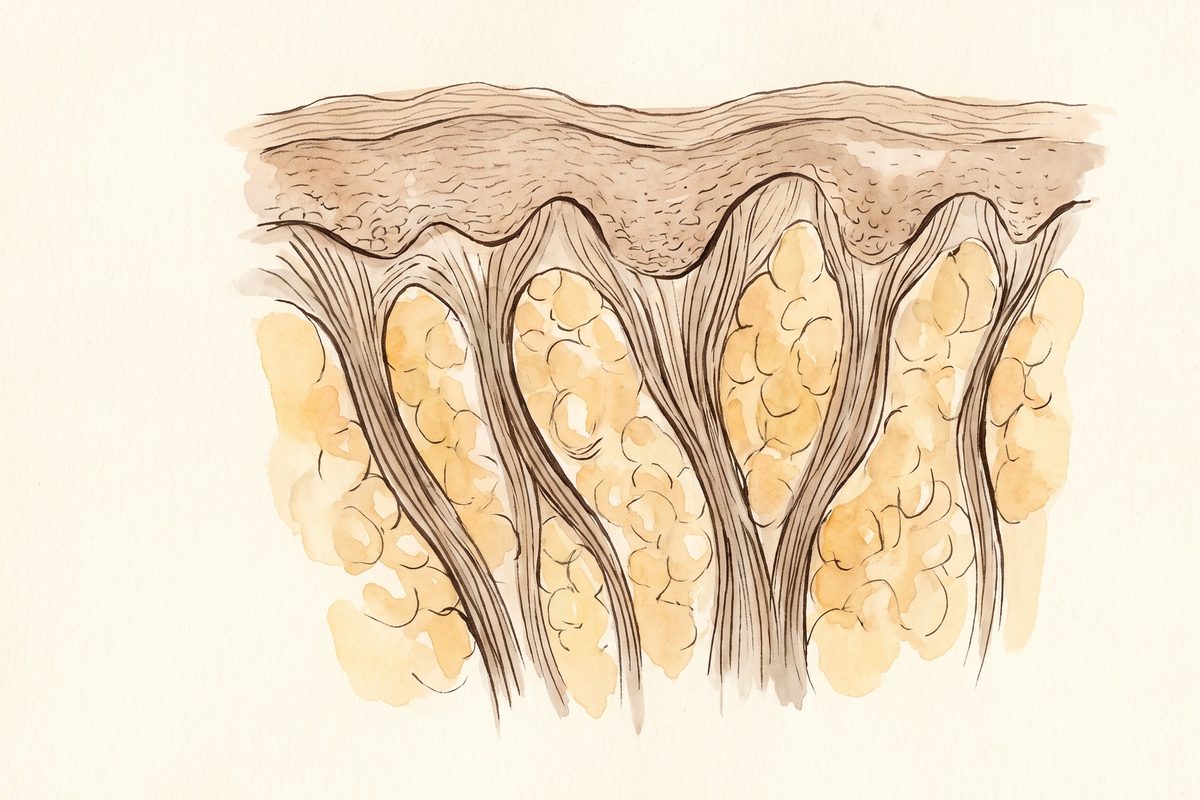
What actually varies between a smooth thigh and a dimpled one is the structure underneath the skin. A published review of the pathophysiology puts it plainly: fibrous septae, thin bands of connective tissue running from the underside of the skin down into deeper tissue, are the feature most consistently linked to cellulite's appearance, more so than the fat itself. Where those bands pull the skin down at fixed points while lobules of fat push up around them, the surface dimples. Where they do not, it stays smooth.
Why this is mostly a female pattern
The sex difference is not incidental, and it is not about who carries more fat. The same review reports that women's septae are typically oriented close to perpendicular against the skin, while men's run at roughly a 45-degree angle and cross each other in a supportive lattice. Women's fat lobules also tend to be larger, in both height and width, than men's. One cited study measured this directly at a mechanical level: the force needed to break the septae in men was significantly greater than in women.
Put together, that is a structural explanation for something that gets treated as a personal failing. A perpendicular band pulling on the skin, over a larger fat lobule, with less structural resistance holding the surface flat, produces dimpling far more readily than a criss-crossed lattice does. None of this is about how much a person weighs, how often she exercises, or how disciplined her diet is. It is about the direction fibres happen to run.
What has weak evidence: creams and massage
The two most heavily marketed categories, topical creams and massage or mechanical devices, are also the two with the weakest and least durable evidence. Small trials of topical caffeine and retinol creams, generally applied daily over several weeks, do show a measurable improvement in cellulite severity while in use. The same review that reports this also reports the honest complication: the one study that checked what happens after stopping found the improvement was short term, fading within two weeks.
Mechanical massage systems show the same shape of result. Two studies of an FDA-cleared massage device recorded a real, statistically significant improvement on a standard cellulite grading scale. What the published data cannot answer is how long that improvement holds once sessions stop, and the review treats its durability as unproven. Both categories can produce a visible, temporary change. Neither is shown to change the underlying structure.
What has more evidence: energy devices, subcision and the collagenase class
Treatments that reach or affect the septae themselves have more consistent published support. A 2024 systematic review pooling 24 randomised trials and over 2,000 patients found radiofrequency therapy produced a measurable reduction in thigh circumference and subcutaneous tissue thickness, and shockwave therapy produced a consistent improvement in cellulite severity scoring across several studies. These are real, measured effects, though the same review grades the overall evidence base as moderate quality, with most trials following patients for only a few weeks, which limits how confidently anyone can speak about long-term durability.
The strongest mechanistic case belongs to two categories that act on the septae directly rather than around them. Subcision is a minor surgical technique that physically releases the fibrous bands pulling the skin down. The collagenase drug class works similarly but enzymatically: it is injected into the septae and breaks down the collagen holding them taut. Two large phase 3 trials of this drug class found a significantly greater share of treated women showed meaningful improvement compared with placebo. That evidence base won it US approval in 2020, specifically for moderate to severe cellulite of the buttocks in adult women. The only approved product was then taken off the market by its maker in December 2022, not for safety reasons but because of how often treatment caused bruising and prolonged skin discolouration: good trial numbers and a treatment people tolerate well are not the same thing.
None of that is a claim this clinic makes about its own treatment list. The collagenase class is a prescription injectable named here for the reader's own reference, by its generic class, because an honest explainer on cellulite cannot leave out the one drug category with the clearest trial evidence behind it. It is not a treatment offered at this clinic, and its formal registration and availability in Malaysia is a separate question from what a published US trial shows.
What this clinic actually offers, stated plainly
The device most often asked about in this context is OndaPro, a microwave platform (the Coolwaves system built by DEKA in Italy, 2.45 GHz) that this clinic uses both for localised fat contouring and for cellulite. The two uses rest on different parts of the same mechanism, described in the published literature on this device class. For fat, the microwaves stress adipocytes until they release lipid content that the body clears over following weeks. For cellulite, the microwave energy is described as being absorbed by the fibrous septae themselves, loosening the dense collagen that pulls the skin down and prompting fibroblasts to lay down new, more elastic collagen, which is the mechanism this piece opened with as the actual cause of the dimpled surface.
The published evidence for the cellulite use is modest. A small, uncontrolled study of 26 women given four monthly microwave sessions on the buttocks and posterior thighs found the Cellulite Severity Scale fall from a mean of 10.7 to 4.5 out of 15, measured three months after the last session, with a matching improvement on the Nurnberger-Muller grading scale, a modest circumference reduction, and no serious side effects beyond temporary redness. An international advisory board of specialists who work with this same microwave platform has since published consensus recommendations describing the same septal mechanism, candidacy criteria (cellulite that is already moderate to severe tends to respond better than very mild cases, and a BMI generally under 30), a stated safety ceiling of 40 to 41 degrees Celsius at the skin surface, and side effects such as small nodules that were reported to resolve over roughly 78 days on average. Both sources are small and short-follow-up by the standard of a drug trial, and the advisory board is exactly what its name says, a panel of expert users of the platform rather than an independent controlled trial, which is worth knowing rather than glossing over.
None of this makes stubborn fat and cellulite the same problem. They remain different presentations, a volume of fat sitting where it should not versus a dimpled surface caused by septae pulling unevenly on the skin, and stubborn fat and body shape is the honest place to read about the first of those on its own terms. What the evidence above shows is that the same device can address both, through two separate effects of the same microwave energy, in a patient for whom either or both are the actual concern. Whether OndaPro is the right tool for a specific case, for fat, for cellulite, for both, or for neither, is decided at an in-person assessment, not from a search result.
The part that does not need treating
It is worth saying once, without a caveat attached: cellulite affecting most adult women to some degree is not evidence of anything gone wrong. It is not a marker of poor health, poor fitness or excess weight, and a body that has it is not a body that needs fixing. Someone who wants to reduce its visible appearance is entitled to weigh the evidence above and decide what, if anything, is worth pursuing. Someone who would rather leave it alone is not missing a step. Both are reasonable answers to a cosmetic question.