
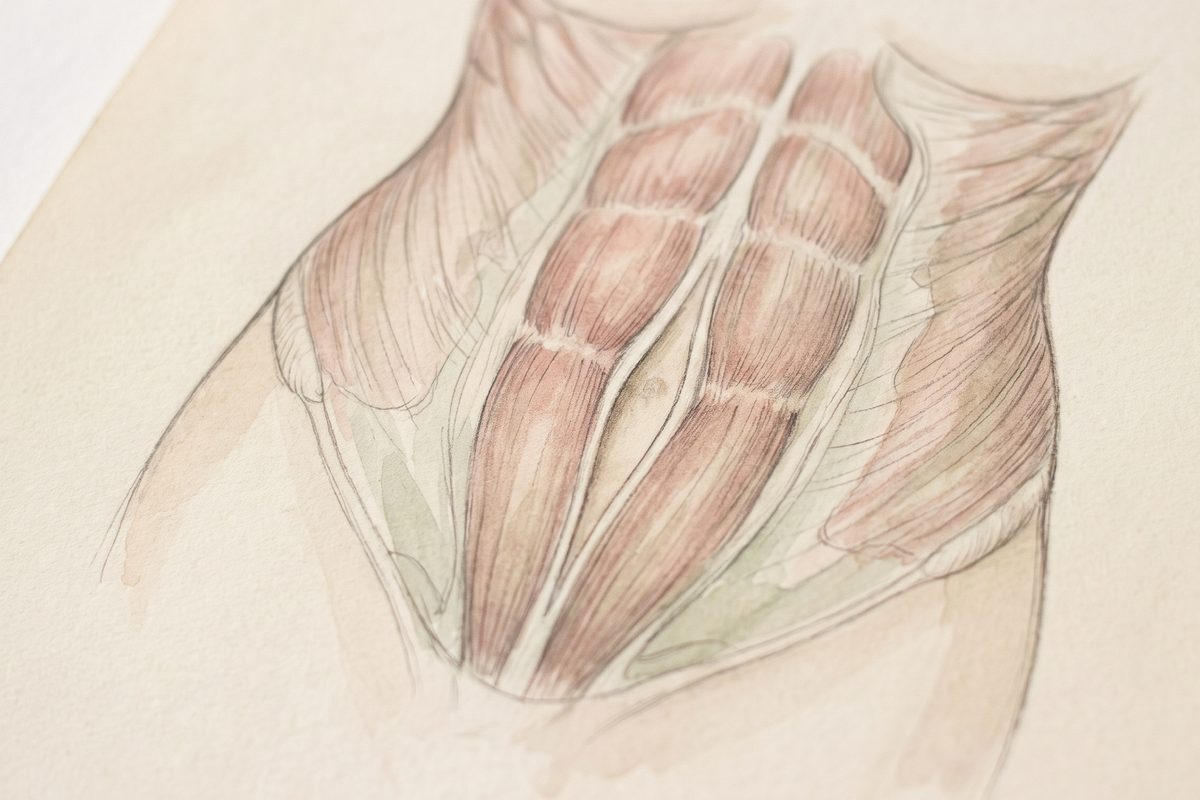
Why is my belly still soft after a baby? Three different causes
It is usually one of three things, and often more than one. The first is the muscles: the two vertical muscles of the abdomen, the rectus muscles, can separate along the midline during pregnancy, which is called diastasis recti. The second is the skin, which has been stretched and may not return fully. The third is fat, which can settle in a pocket over the lower belly.
The three look alike in a mirror and need different answers. A muscle gap is for exercise, physiotherapy and sometimes surgery. Loose skin is a tightening or surgical question. A fat pocket is where a device can play a part. Naming the cause comes before choosing anything.
How common is a muscle gap after pregnancy?
Common, and it settles in many women over time. A cohort study followed 300 first-time mothers and defined a gap as two or more finger widths felt above, at or below the navel. Such a gap was present in 33.1% at week 21 of pregnancy, 60.0% at 6 weeks after birth, 45.4% at 6 months and 32.6% at 12 months.
The same study found no difference in lower back or pelvic pain at 12 months between women with a gap and women without one. So a gap is not always painful, and a lack of pain does not rule it out. It is also a reminder that the first weeks are the wrong time to judge the final shape of the belly.
What is the simple self-check?
Lie on your back with your knees bent and feet flat. Lift your shoulders slightly off the floor, as if starting a sit-up, and place your fingertips along the midline just above the navel, then just below it. Feel for a gap between the two muscle edges. A gap wider than about two finger widths, which is roughly 2 cm, counts as diastasis recti. You may also see a ridge or a soft dome running down the middle as you lift.
This is a screen and does not replace an examination. A physiotherapist or doctor can measure the gap, judge how firm the tissue is at the base of it, and check for a hernia. Seek advice if the gap is wider than two fingers, if it hurts, or if you notice a bulge that is firm, painful or cannot be pressed flat.
What do exercise and time actually do?
Time does a good deal, as the numbers above show. Exercise adds a smaller amount. A network analysis of 21 randomised trials in 1,195 postpartum women found that exercise alone narrowed the gap by 0.48 cm on average compared with no treatment. A wider 2025 review found low-certainty evidence that abdominal training reduced the gap more than no exercise, and said evidence on some outcomes is limited.
The way you exercise matters. Cleveland Clinic advises avoiding crunches, sit-ups and planks while there is a gap, and a physiotherapist can show which movements load the midline safely. The pelvic floor belongs in the same plan: the 2025 review found pelvic floor muscle training lowered the odds of urinary leaking by 37%, and leaking after childbirth goes through what is worth doing. Hair, too, follows its own clock, covered in postpartum hair loss.
When does it need a physiotherapist or a surgeon?
A physiotherapist, ideally one with postpartum experience, is the first step for a gap wider than two fingers, pain, back or pelvic floor symptoms, or a belly that bulges or domes when you sit up. Cleveland Clinic describes physical therapy as a way to treat the condition without surgery.
A surgeon is for a hernia, for a gap that persists and limits what you can do after a period of proper rehabilitation, or for loose skin and a gap together that a person wants corrected. A 2026 review notes that postpartum women often present with core instability, back pain, pelvic floor symptoms and skin excess together, and that the evidence for surgical techniques is limited by short follow-up. It is a decision to take with a surgeon, not from a device brochure.
What can an aesthetic device do, and what can it not do?
A device cannot close a muscle gap. It cannot remove a large amount of loose skin either. At this clinic, OndaPro is used for a localised pocket of fat in someone near a stable healthy weight, and a lower belly that hangs on after pregnancy is one of the examples the clinic names. It is not for a belly that is mostly skin laxity, and it is not a weight loss treatment. Stubborn fat and body shape sets out how the diagnosis decides the tool.
At The Retreat Clinic the belly is assessed first, and OndaPro is used for the part that is fat. There is a timing question as well. The clinic defers OndaPro in pregnancy. An international advisory board paper lists breastfeeding until 10 months after delivery among its contraindications; that is a precaution from expert consensus, because no study has tested OndaPro during breastfeeding, so it is discussed with Dr Ong at assessment. The article on side effects and exclusions gives the full list. A gap in the muscles may also sit under what looks like a fat pocket, which is a reason to have it checked before paying for any fat treatment.
When to wait
Wait while the body is still changing. The cohort data show the gap narrowing through the first year, and the belly in the first weeks is not its final shape. Wait too while your weight is still settling, because contouring suits a stable weight.
Waiting is not the same as doing nothing. A physiotherapy check and gentle strengthening can start without any device, and the answers they give make later decisions simpler.
The honest complication
Many women ask for a treatment for the shape of the belly when the real issue is a separated muscle or loose skin, neither of which a fat device touches. The most useful first step is to work out which of the three you have. Sometimes the answer is exercise and more time, sometimes a referral, and sometimes a pocket of fat that a device can reshape.

