
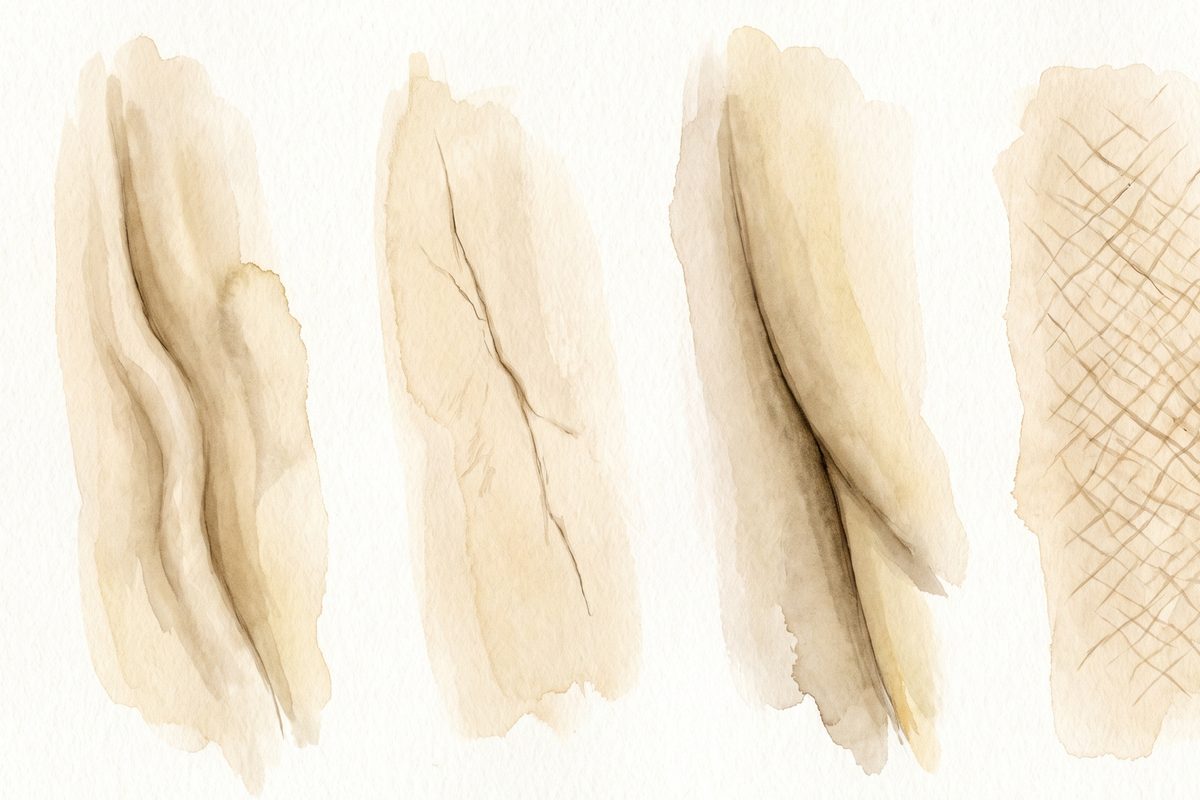
One word, four problems
Type "wrinkle treatment" into a search bar and the results assume a single answer. In practice, a line and a crease and a fold and rough texture are four separate mechanisms, sitting sometimes within a centimetre of each other on the same face, and each one answers to something different. A reader who only ever sees the injection page is being handed a quarter of the picture.
This piece maps the other three quarters. What line type responds to what class of treatment, why the class matters more than the specific product inside it, and where the honest answer is that nothing needs doing yet. Four different things people call wrinkles goes deeper on how the four types are told apart at consultation; this piece stays with the treatment side of the question.
The line that moves: botulinum toxin
A frown line, a forehead line, the crease at the outer corner of the eye when you smile, these are folded into the skin by a muscle doing its job, and they soften when the muscle rests. Anti-wrinkle injections, meaning botulinum toxin, are built for exactly this category. As the mechanism piece on this journal puts it, the toxin "acts at the neuromuscular junction... it blocks the release of acetylcholine... the muscle rests. The repeated folding stops." How anti-wrinkle injections actually work covers the mechanism in full, and the treatment itself is dosed by muscle group, mapped to how a face actually moves rather than applied from a menu.
The same principle slims the masseter along the jaw, a different muscle answering to the same class of tool. What botulinum toxin will not do is erase a line that has already stopped moving with expression. That is a different category, covered next.
The line that has stopped moving: skin quality and collagen support
Years of the same fold, over collagen that has thinned, and a crease prints into the surface and sits there even when the face is at complete rest. Relaxing the muscle underneath still helps, because it removes the repetition that keeps writing the line deeper, but the part already pressed into the skin needs the skin itself treated.
Two different tools answer to that, depending on how thin the collagen has become. Skinboosters improve hydration and texture across an area, which is the more direct answer where the surface itself has lost its bounce. Where the deficit is a broader loss of collagen support, biostimulators work more slowly, asking the skin to lay down its own collagen over the months that follow, described on the clinic's own treatment page as "long-term collagen support" rather than a quick fix, and not the right tool once laxity is advanced enough that surgery is the honest conversation.
General dermatology also has a prescription option in this category worth naming plainly: topical retinoids, prescribed and supervised by a doctor, are a well-established class for fine lines and sun damage, working by increasing skin cell turnover and stimulating collagen in the dermis over months. Like any prescription medicine, they need proper medical supervision because of irritation, sun sensitivity and caution in pregnancy, and they are not a treatment to start from a shelf.
The fold: a support problem, not a line problem
The nasolabial crease beside the nose and the marionette line beside the mouth are not lines in the folded sense at all. They are the edge of a shadow, formed where the deeper support beneath the skin has softened or descended. Easing a muscle there changes little, because there is no muscle doing the folding in the first place.
Two different classes of tool answer to this, depending on what has actually happened underneath. Dermal fillers restore volume directly where it has been lost. Where the issue is the deeper support layer losing its lift rather than volume itself, energy devices such as Ultherapy, which reaches that layer with focused ultrasound, or XERF, which works by radiofrequency, are the tools built for it. Which of the two fits, filling or lifting, is a question the assessment answers, not a preference stated in advance.
Texture: the category people forget to name
Fine, shallow lines across the cheeks, under the eyes and on the neck, the kind that show up in hard light or after a dry, air-conditioned week, usually are not folds or creases at all. They are a surface problem: dehydration, a worn skin barrier, years of cumulative sun exposure. They do not sit over a muscle, and no amount of muscle relaxation will touch them.
Skinboosters, again, are the direct answer here, placing hydration and collagen support into the skin itself. Where the concern includes visible surface texture rather than dehydration alone, PicoSure's focus mode is a narrower option: concentrating energy into microscopic zones beneath the surface to prompt the skin to remodel, a use the clinic's own treatment page describes for "selected acne scarring and surface texture", assessed case by case rather than offered as a general wrinkle treatment.
When the honest answer is nothing
A face with no visible lines does not need preventive treatment, and a line so faint it only shows under raking light in a bathroom mirror is not a reason to book anything. Waiting costs nothing. Treating a line that was never going to bother anyone, or treating the wrong category because it happened to be the page that ranked, spends money and skin tolerance on a problem that was not actually there.
The reason this piece maps categories instead of naming one winning treatment is that the category is the diagnosis. Once the type of line is identified, the treatment mostly chooses itself. What a consultation looks like is where that identification happens, before anything is booked rather than after it has failed to work.