
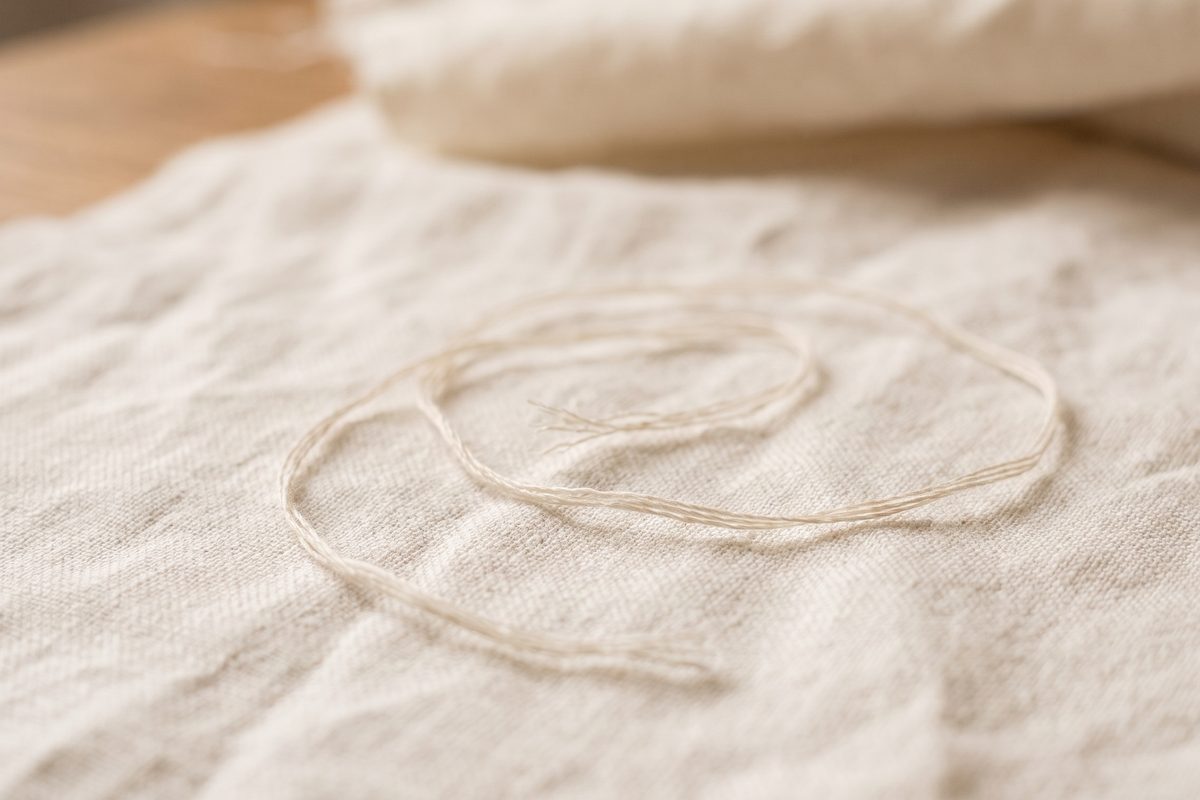
What a thread lift actually does
A thread lift is a mechanical treatment before it is anything else. A barbed suture made of an absorbable polymer, most often polydioxanone, is placed under the skin with a needle or cannula and pulled to reposition tissue that has begun to sag, most often along the jowl, cheek or brow.
Two things happen at once, on two different timescales. The tissue moves the moment the thread is placed and anchored, which is why the effect is described as immediate. Underneath that, the thread provokes what one 2024 paper on the technique calls "a selective inflammatory response that encourages collagen production and tissue contraction", a slower biological response that continues while the suture itself is being absorbed.
Both effects are temporary by design, because the thread is designed to dissolve. The mechanical hold softens as that happens, over a stated window of months to a year on the clinic's own comparison guide.
What the published evidence says about how long it lasts
The literature does not converge on a single number, and it is more honest to say so than to round it to one. A 2025 review of thread lifting technique and thread types describes "lifting effects that can last up to 18 to 24 months". A separate 2024 study of mid-face lifting using polydioxanone threads puts the figure differently: "the direct lasting effect of mid-face lifting with PDO threads is generally understood to be around two years, though there is ongoing debate about this duration."
Read together, the two figures agree on the order of magnitude, roughly one to two years, and disagree on the specifics, which is a reasonably common state for a treatment whose thread designs, anchoring techniques and patient selection vary considerably between studies. Neither figure is a promise for any individual face, and no honest reading of either paper treats it as one.
What the published evidence says about complications
The comparison guide already sets out the downtime a patient should expect if she has one placed anywhere: "days to two weeks: bruising, swelling, dimpling or puckering, a pulling sensation," with "some restrictions on wide mouth opening early on."
The 2025 review breaks the complication picture down further by thread shape, and the range is wide enough to matter. U-shaped threads, anchored in the temporal area, achieve strong visible lift, with success rates reported at 85 to 90%, but the same threads carry meaningfully higher complication rates: bleeding in 15 to 20% of cases, dimpling in 12 to 18%, and tissue damage at the exit point in 5 to 10%. I-shaped threads sit at the other end, described as minimising tissue trauma and patient discomfort, with complication rates below 5%. Sensory changes such as tingling are reported for up to a month in some patients, and bruising and swelling for two to four weeks.
None of that makes threads an unreasonable choice for the right face in the right hands. It does mean the decision carries a real range of outcomes that a patient deserves to see stated in numbers, not softened into a single word like "minor".
Why this clinic does not offer them
The clinic's comparison guide marks the row for absorbable threads "Not offered at this clinic," alongside its rows for the ultrasound lifting and radiofrequency devices the clinic does run. That is the fact. No clinical reasoning beyond that line is stated on the guide, and none is invented here to fill the gap. A clinic that will not offer a treatment should not need to manufacture a story for why, and a reader is better served by the honest limit than by a rationalised one.
That is not a comment on the doctors who do offer thread lifts, in Malaysia or anywhere else. The published evidence above describes a real, registered, implantable medical device with a genuine effect and a genuine, quantified set of risks, and a practitioner who assesses properly and places one well is doing legitimate work.
What this means for a reader considering one
Anyone weighing a thread lift is better placed reading the numbers above than a marketing description of "a lunchtime lift". The lift is immediate and mechanical. It fades on the timeline the thread takes to dissolve, somewhere between one and two years depending on which study is read. The complication range depends heavily on thread type and technique, and it is wide enough to ask about directly before agreeing to anything.
Where thread lifting sits against the two tightening devices this clinic does run, ultrasound and radiofrequency (RF microneedling is also not offered here), each with its own mechanism and its own honest limits, is set out in full on the comparison guide the quotes above are drawn from.