
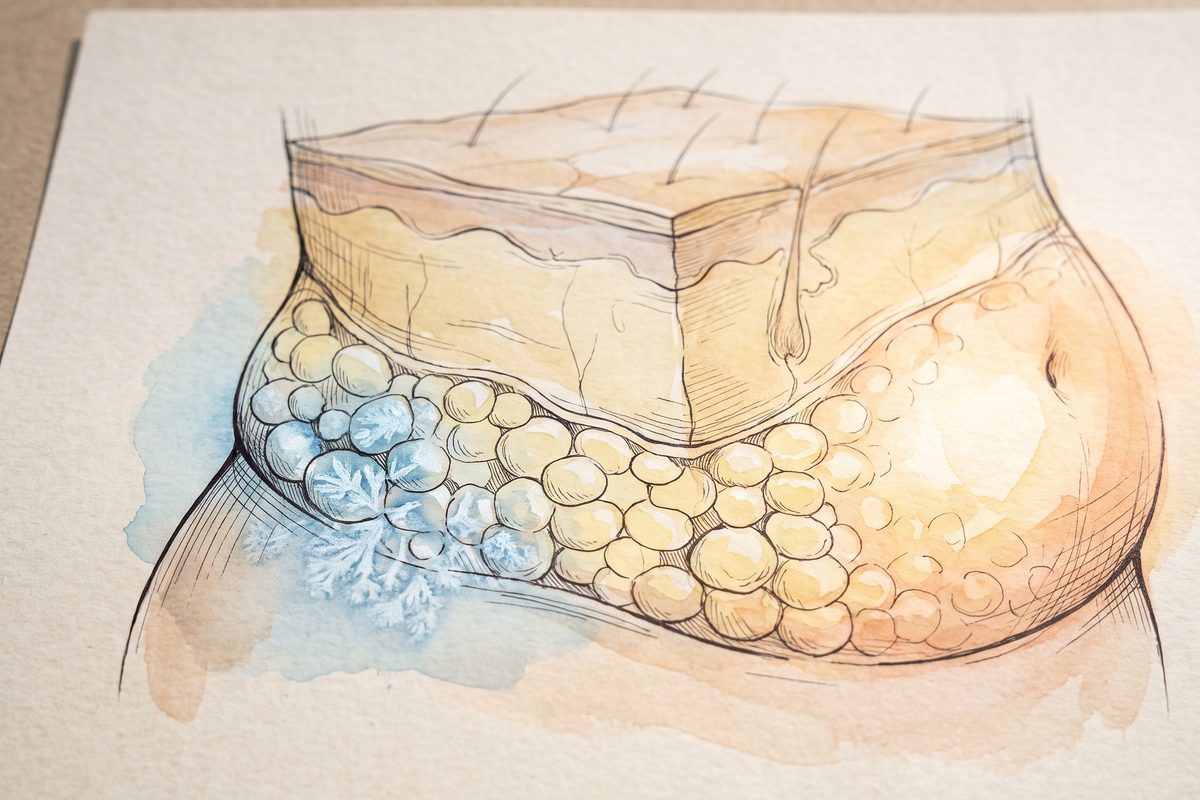
What is fat freezing, and how does it work?
Fat freezing is a device treatment that cools a defined pocket of fat for a set time. Its medical name is cryolipolysis, and CoolSculpting is the brand most people type into a search box. The idea comes from animal work published in 2008: in pigs, controlled cooling inflamed the fat lobules, the fat cells were lost, and several millimetres of fat disappeared gradually over 3.5 months, with no injury to the skin above.
The body does the clearing. One paper describes immune cells called macrophages peaking about four weeks after treatment and gone by around three months. The treatment session starts the process, and nothing about it removes fat on the day.
Who does it suit, and what is a session like?
The studies enrol adults close to a typical weight. In two recent trials the average body mass index was 24.9 and 25.1, and the aim was a localised pocket, so the target is shape and not weight. People who want to be smaller overall are in a different category, which slimming, weight loss and contouring separates.
A session means an applicator on the area and sustained cooling. One small trial used 45 minutes at minus 8 degrees Celsius for each abdominal session, three sessions in all. Cold, pulling and numbness are the usual sensations. In a trial of 35 adults the average highest pain score was 2.6 and 4.1 out of 10 across two sessions. Comfort differs from person to person.
How do the results arrive, and what does the evidence show?
Slowly. Studies usually measure at about 12 weeks. A 2025 meta-analysis of 30 studies and 3,158 participants found that, at 12 weeks, average abdominal circumference was 3.56 cm lower and suprailiac fat thickness 5.22 mm lower. A second 2025 analysis agreed on a fall in circumference and fat thickness, found no significant change in weight, and noted that benefits were more pronounced at short follow-up.
Those are averages across studies that differed a great deal from each other, and the second analysis reported high heterogeneity. A 2020 review of 32 reports also raised a caution: most lacked rigorous design, with concerns about photographs, conflicts of interest and commercial bias. So the effect is real on average, the size for one person is not predictable, and the long-term picture is less well documented than the first three months.
What are the side effects of fat freezing?
Most are short and local. The 2025 meta-analysis recorded numbness in 49.5% of people, redness in 44.5%, swelling in 30.5%, pain in 28.8%, sensitivity in 25.4%, tingling in 15.2% and hyperpigmentation in 2%. A Japanese prospective study of outpatients found adverse events in 71.6% straight after treatment, falling to 1.3% at three months, with pain gone within a month and numbness lasting about three.
Those are the common effects. A rarer one needs its own section, because it changes what the treated area looks like.
What is paradoxical adipose hyperplasia, and how often does it happen?
Paradoxical adipose hyperplasia, or PAH, is an enlargement of the treated area. It appears as a painless, firm, well-defined mass roughly 3 to 9 months after the session, so it is not visible on the day, and it is not the same as the normal swelling that settles in days. In the two cases reported in 2015 it was corrected with liposuction.
The incidence depends on who counted. A manufacturer estimate was 0.0051%, about 1 in 20,000 patients. A 2015 report from one practice found 0.47%, two cases in 422 treatments. A 2025 systematic review and meta-analysis pooled 28 studies and 13,078 patients and found 29 cases, a pooled incidence of 0.22%, about 1 in 455. It rated the certainty as low, because only 4 of the 28 studies followed patients for at least 16 weeks, and the condition shows late. The authors concluded the true rate appears higher than manufacturer figures, and that risk should be disclosed in full before treatment.
Where does OndaPro fit?
The Retreat Clinic used to offer fat freezing and now uses OndaPro, a microwave device, for localised fat. Dr Ong made the change because he finds OndaPro more comfortable for patients. The two work on the same target with opposite energy. Fat freezing removes heat from the fat layer. OndaPro adds heat: microwave energy at 2.45 GHz is concentrated in the fat layer while built-in cooling protects the skin surface, and how the cells are cleared afterwards is similar in outline, over weeks.
The evidence for microwave is younger and smaller. The international advisory board paper says plainly that long-term efficacy and safety data are still missing, and its usual protocol is four sessions of 30 to 60 minutes per area, one every four weeks. The papers cited here do not compare the two methods directly, so nothing in this article says one outperforms the other. Who OndaPro suits, and who it does not, is in its side effects and exclusions article, and the Vanquish and laser lipo piece sets out the other devices people ask about.
What to ask before any fat reduction device
Ask what the device is, how it works, who operates it, and what the risks are, including the rare ones and when they appear. Ask how long people were followed in the evidence for that device. Ask what happens if the result is not what was planned. Ask whether the area is fat at all, because loose skin or muscle will not respond to a fat device of any kind, which stubborn fat and body shape explains.
The honest complication
Fat freezing is neither a fraud nor a guarantee. It has a measurable average effect, a common and mostly temporary set of sensations, and a rare late side effect that the literature describes as possibly under-reported. A fair account holds all three. The device matters less than the assessment that decides whether a localised pocket is the problem at all.

