
Why I went looking for it before it arrived
XERF had launched in Korea, then the United States and Europe, and I kept encountering it in the literature and in conversations with colleagues overseas. The early clinical data was limited but the underlying technology was interesting enough that I wanted to understand it properly, which for me means more than reading a manufacturer brief.
So I flew to a colleague's clinic abroad and had it done on myself, and later got my hands on the machine at a clinic that already had one. Dr Ong Jin Khang of The Retreat Clinic was the first Malaysian doctor to be treated with XERF, before its Malaysian launch in 2026.
I want to be clear about why I mention that. It is not a boast. It is a standard I hold myself to: I do not offer a machine I have not been under and held myself. That trip was how I formed the views I am about to share.
What XERF actually is, technically
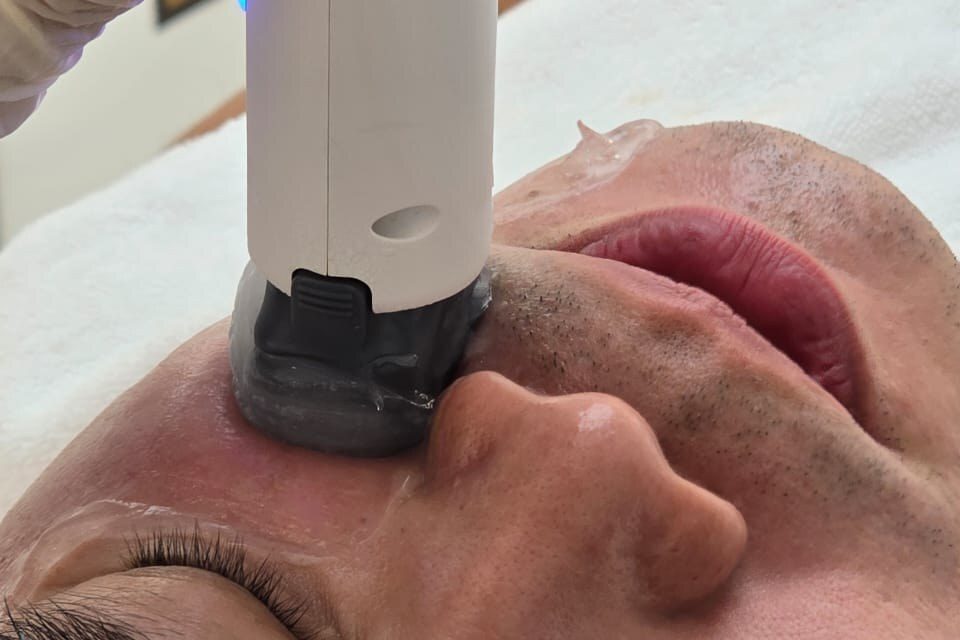
XERF delivers dual-frequency monopolar radiofrequency, two frequencies in sequence: within a single pulse, 6.78 MHz is followed by 2 MHz. The significance of that combination is depth. Different frequencies penetrate tissue differently, so delivering both in a single pass means the energy works across more than one layer, reaching toward the deeper structural tissue where laxity actually begins.
What makes this more precise than older monopolar RF devices is the real-time impedance feedback. The device reads the electrical resistance of the skin continuously and adjusts energy delivery with every pulse. This is not AI, it is accurate, real-time biophysical feedback that prevents over-delivery to one area and under-delivery to another.
The other feature worth understanding is the Integrated Cryogen Delivery, or ICD. This is a burst of cooling applied to the skin surface as the RF energy heats deeper tissue. The surface is protected while the target depth does the work. That is why most patients do not need topical numbing, which is a meaningful practical difference from some older RF modalities. A grid-style applicator distributes the field evenly across the treatment area, which can be the face, the brow, the jawline or the neck. The standard protocol is two sessions a few weeks apart. XERF is MDA-registered in Malaysia.
What it actually felt like
Everyone online calls it painless. I want to push back on that, gently.
With the ICD cooling running, I would rate my own experience at around 3 out of 10. That is genuinely comfortable. But it is not nothing, and describing it as painless sets up a patient for a small surprise when they feel the heat pulse through the cooling. I am also, I will admit without much shame, a bit of a coward about pain. My patients were considerably braver than me.
Several of them sat through the highest intensity setting on the device, which is a 10 out of 10 on the machine's own scale, and did so without needing a break. So the comfort story is real. It just depends on the individual, their threshold, and how the treatment is performed. If a clinic is running it at low intensity to keep every patient perfectly comfortable, it may also be running it below where the results live.
What comes after the session is the part people ask about most and the part that gets written about least. The common finding is redness: the skin can look flushed and feel warm for a while once the session ends, sometimes into the evening, with mild tenderness or slight swelling for some. Less commonly the redness outlasts the day, or a tender patch appears, or rarely a small blister where energy has concentrated. Those are uncommon, and they are covered before anything is switched on. Then, for most of a week, little happens, which is what the mechanism predicts and what a patient waiting for a visible event finds hardest to sit with.
What comes after the session is the part people ask about most and the part that gets written about least. The common finding is redness: the skin can look flushed and feel warm for a while once the session ends, sometimes into the evening, with mild tenderness or slight swelling for some. Less commonly the redness outlasts the day, or a tender patch appears, or rarely a small blister where energy has concentrated. Those are uncommon, and they are covered before anything is switched on. Then, for most of a week, little happens, which is what the mechanism predicts and what a patient waiting for a visible event finds hardest to sit with.
What I noticed, honestly
Within about a week I could see a change in skin texture. A little tightening. Nothing that would make someone stop you in the street, but enough that I noticed it in good light.
Over the following months it kept improving, gradually, as the collagen rebuilt. That is how RF-based remodelling works: the heat stimulus happens in the session, but the tissue response is slow and cumulative. The first week is the start, not the finish.
I am offering this as my own observation, not as a clinical claim or a promise about what you will see. Early human data from a 2026 study exists, but it is small and limited, and I will not lean on it as proof of anything durable. What I can say is that what I observed in myself was consistent with what the mechanism would predict: modest, real, and gradual.
A small 2026 study on XERF does exist. It is encouraging early data, but the sample size and follow-up period are limited. We need more. My experience is one data point, not a verdict.
Who it is actually for, and who it is not
The sweet spot is mild to moderate laxity. Roughly the late thirties to late forties, though skin age and chronological age are not the same thing, and I assess both.
For patients in their sixties or seventies who have maintained their skin well, XERF can be a sensible maintenance treatment. The foundation is already reasonably sound; the goal is to slow the drift rather than reverse significant loss.
Where XERF will disappoint is when laxity is advanced, when the deeper structural support has already considerably given way, or when the real underlying problem is volume loss. Energy devices do not replace lost volume. Heavy sagging is a different clinical problem from early laxity, and treating one with the tool designed for the other is how patients end up with expensive underwhelm. I would tell you this before we proceeded, not after.
XERF and Ultherapy: not an either/or
Both are energy-based skin-tightening treatments. They are not the same, and they are not simply interchangeable. Ultherapy uses focused ultrasound to reach very specific depths, including the SMAS layer, the deeper structural layer that surgeons address in a facelift. XERF delivers its energy across multiple depths via RF. They are doing related but distinct things.
For some faces the honest answer is both, layered, as part of a considered plan. For some it is one. For others it is neither, and something else entirely is the better starting point. That is what a proper assessment works out. It is a diagnosis, not a menu.
So is it worth it?
Yes, for the right face or neck, with realistic expectations, and ideally as part of a treatment plan rather than a standalone magic bullet.
The result is real. The result is gradual. The result depends significantly on where you are starting from. If you have mild to moderate laxity and you want to slow and partially reverse it without surgery, XERF belongs in the conversation.
If you are expecting to see a different face in the mirror two weeks later, you will be disappointed, and that disappointment is not the machine's fault, it is the expectation that was set.
I put my honest short-take version on Instagram in a reel if you want the two-minute version: watch it here. But the full picture, including whether XERF is the right call for your face specifically, is a conversation best had in person.
An assessment is where we work out whether XERF, Ultherapy, a combination, or something different is right for you. Book one.